
Common drone fly
Eristalis tenax · Hover flies
A widespread hoverfly that mimics honeybees; adults are important pollinators and larvae are aquatic "rat-tailed" maggots.
!Is the common drone fly dangerous?
No. Adults cannot sting or bite and carry no venom; like all hoverflies they only feed on nectar and pollen. They may land on people while visiting flowers but are completely harmless.
Pets
Harmless to pets. Larvae are not a threat to animals, though heavy larval infestations in livestock watering areas indicate poor water hygiene.
📖Overview
Eristalis tenax is a common, cosmopolitan hoverfly (family Syrphidae) that closely resembles honeybee drones in size and coloration. Adults feed on nectar and pollen and are frequent visitors to gardens, meadows and flowering crops. The larvae are aquatic or semi-aquatic "rat-tailed" maggots that live in stagnant, often organically rich water such as drains, ditches, manure pits and sewage-contaminated water.
The species is not dangerous to humans: adults cannot sting or bite. Because adults mimic bees in appearance and flight, they may be mistaken for honeybees. Their presence is usually beneficial because of pollination, though larval breeding in very dirty water can be a nuisance in livestock or waste-management settings.
🔍How to identify a common drone fly
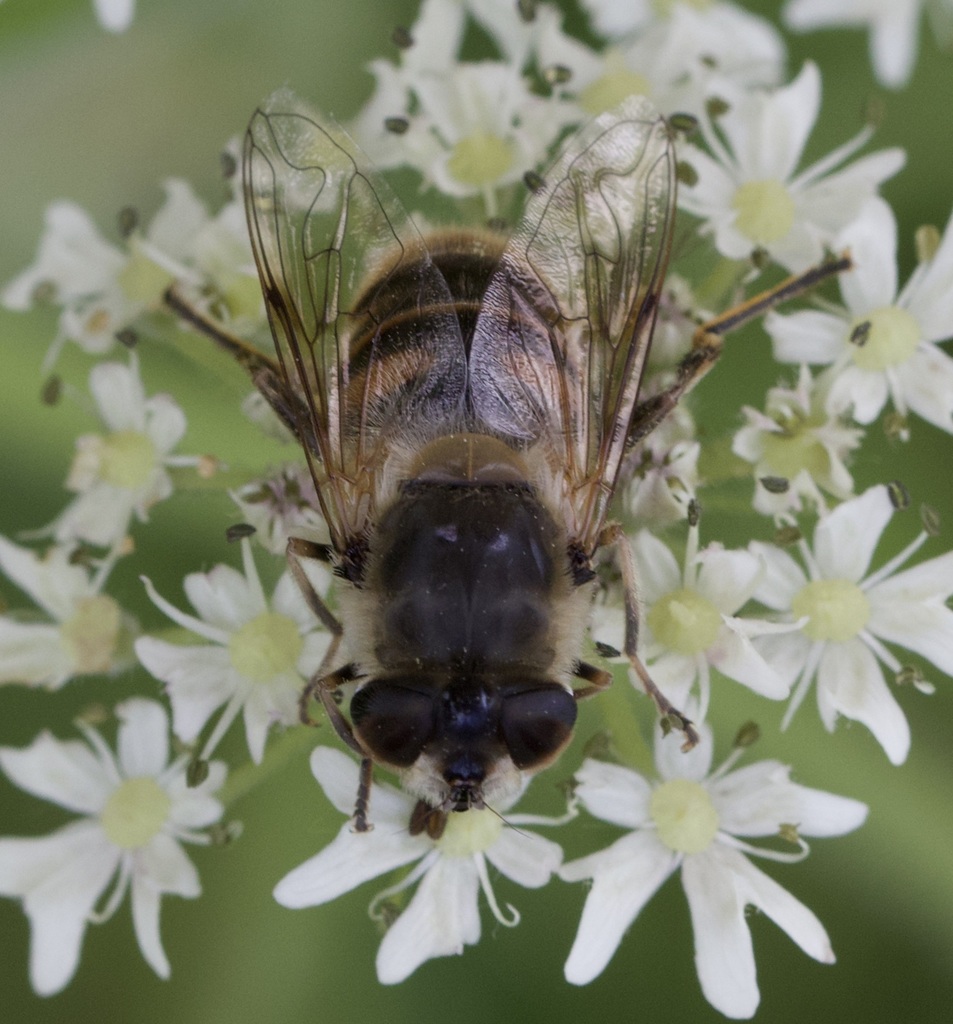
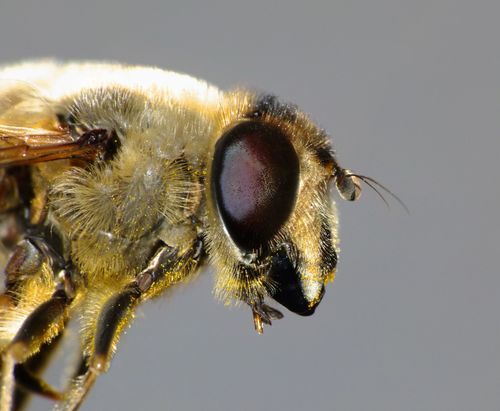
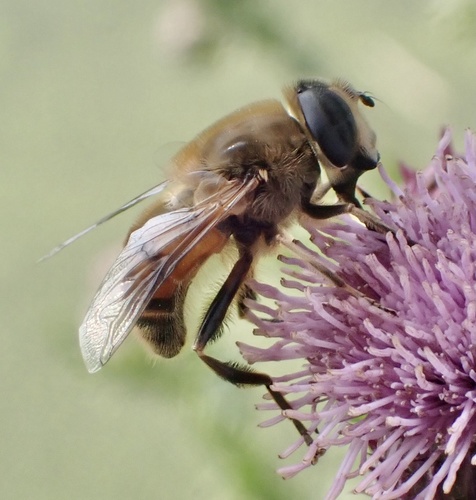
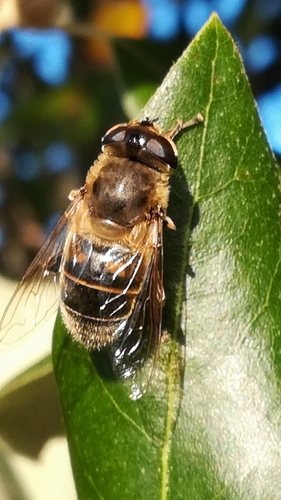
Adults are robust flies about the size and general shape of a honeybee drone, with a broad, compact body, short antennae and large compound eyes. The thorax is generally dark brown to black and the abdomen shows banded patterns of brown, black and pale yellow or orange that give a bee-like look. Wings are clear to slightly smoky and held flat at rest. Under close inspection, the body is less hairy than a real bee and hoverflies have only one pair of wings (true flies) compared with two pairs in bees.
- Bee-like banded abdomen but body less hairy on close inspection.
- Single pair of wings (flies) versus two pairs in bees — look for wing venation typical of hoverflies.
- Characteristic hovering flight and darting movement; often visits flowers like a bee.
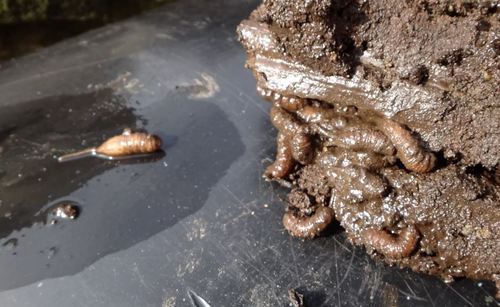
- If you can see the larva, the long posterior breathing tube ("rat-tail") identifies Eristalis-type larvae.
Lookalikes
Western honeybee (drone) Apis mellifera
Honeybees have denser body hair, two pairs of wings, long elbowed antennae and, in workers, pollen baskets on the hind legs; workers can sting, drones cannot. Drone flies have one pair of wings, very short antennae and large eyes that take up most of the head.
Eristalis pertinax Eristalis pertinax
A very similar Eristalis hoverfly; E. tenax has dark front feet and two vertical stripes of dark hairs on its eyes, while E. pertinax has pale yellow front and middle feet and a more tapering abdomen in males.
Syrphus hoverflies Syrphus spp.
Smaller and more slender, with different abdominal markings and behavior; Syrphus species lack the large bee-like build of Eristalis tenax.
↻Life cycle
Egg
Small, white eggs are laid near or on semi-liquid, decaying organic material or stagnant water with high organic content.
Larva (rat-tailed maggot)
The larva is an elongate, legless maggot with a characteristic long posterior breathing tube (the "rat-tail") used to access air while submerged in polluted water. Larval development occurs in nutrient-rich, often low-oxygen water or sludge.
Pupa
Larvae pupate in drier margins of the breeding site or in nearby soil/organic matter before emerging as adults.
Adult (hoverfly)
Adults feed on nectar and pollen and are often seen hovering or resting on flowers; they mate and females lay eggs near suitable larval habitats.
🍃Diet and predators
Young eat
Decaying organic matter and microorganisms in stagnant, polluted water (filter-feeding); larvae take up dissolved nutrients and bacteria.
Adults eat
Nectar and pollen from a wide variety of flowering plants.
Predators of the young
Aquatic predators such as beetle larvae and some predatory insects; microbial pathogens can also affect them.
Predators of adults
Birds, dragonflies, spiders and predatory wasps.
🌱Effect on plants and gardens
Adults visit a wide range of flowering plants for nectar and pollen, making them useful pollinators in gardens and farmland.
📍Where and when to find it
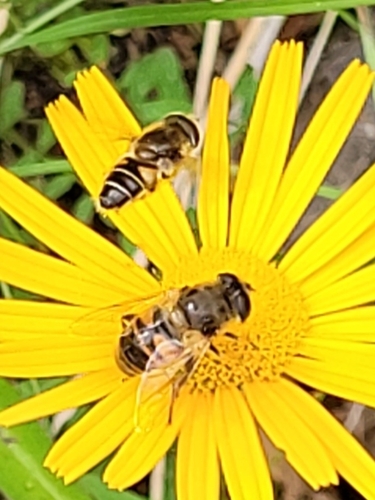
Adults: on flowers in gardens, meadows, orchards and field margins. Larvae: in stagnant, organic-rich water, drains, manure pits and sewage-affected pools.
Best time
Spring to autumn in temperate regions; midday on warm sunny days when flowers are open and nectar is available.
Observation tips
Photograph adults visiting flowers from the side to show body shape and wing venation. Larvae are found only in wet, dirty water—use caution and protective gloves if inspecting such sites.
✨Fun facts
- Eristalis tenax mimics honeybee drones so closely that casual observers often mistake them for bees.
- The larval "rat-tail" breathing tube can be several times the length of the larva's body and allows it to breathe while submerged in low-oxygen, polluted water.
- Because of its close resemblance to honeybees, Eristalis tenax is sometimes called the "drone fly" — 'drone' referring to male honeybees it resembles.
?Frequently asked questions
Are drone flies dangerous?
No. Adult drone flies do not sting or transmit diseases to humans and are harmless.
Do drone flies bite?
No. They do not bite people as part of their normal behavior; they feed on nectar and pollen.
Why is a drone fly in my house?
Adults are attracted to flowers but may enter houses through open windows or be drawn to light. They may also wander indoors looking for resting spots.
How do I get rid of drone flies?
Catch and release outdoors or gently shoo them away. Remove or clean stagnant, organic-rich water sources such as blocked drains, manure heaps or slurry pits to prevent larval breeding.
Where do drone fly larvae live?
Larvae live in stagnant, nutrient-rich or polluted water and wet organic matter, such as drains, ditches, manure heaps and sewage-contaminated pools.
📷Photos of the common drone fly
More flies & mosquitoes
This guide was written with AI assistance and fact-checked, last updated 2026-10-10. Identification from photos is never certain: don't handle insects you can't identify, and get medical advice for bites, stings or allergic reactions. More about the common drone fly: iNaturalist, Wikipedia.