
Greater bee fly
Bombylius major · Bee flies
A hairy, bee-mimicking fly that hovers at flowers in spring and whose larvae parasitize solitary bee and wasp nests.
!Is the greater bee fly dangerous?
No. Adults do not sting or bite and have no venom. They are harmless to people; their bee-like appearance is Batesian mimicry.
Pets
Not dangerous to pets. A bee fly has no sting or toxins, so a pet that catches or eats one is not at risk beyond, at most, mild stomach upset.
📖Overview
Bombylius major is a small, stout fly that mimics bees in appearance and behaviour. Adults are commonly seen in spring, hovering at flowers to sip nectar with a long proboscis. Females lay eggs near the nests of solitary bees and some wasps; the larvae enter the nests and feed on host larvae and their food stores. Adults are important early-season pollinators but the species can reduce local numbers of solitary bees where it is abundant.
🔍How to identify a greater bee fly
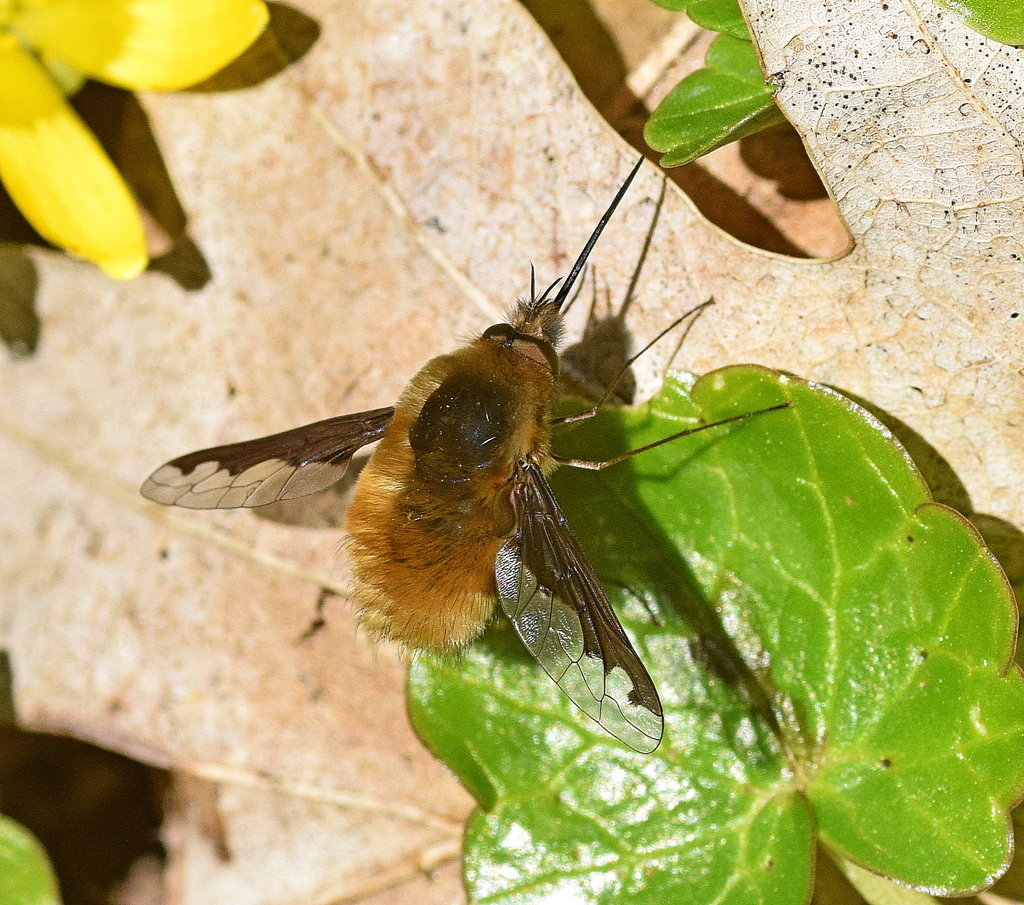
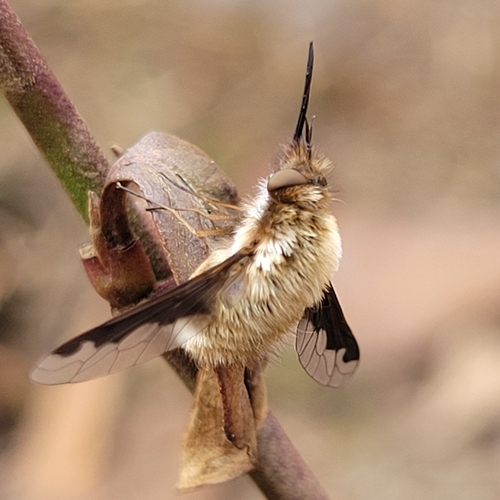
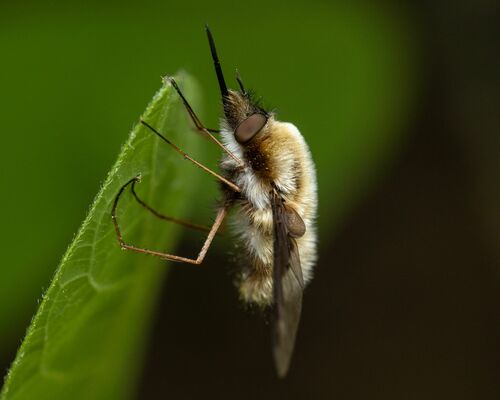
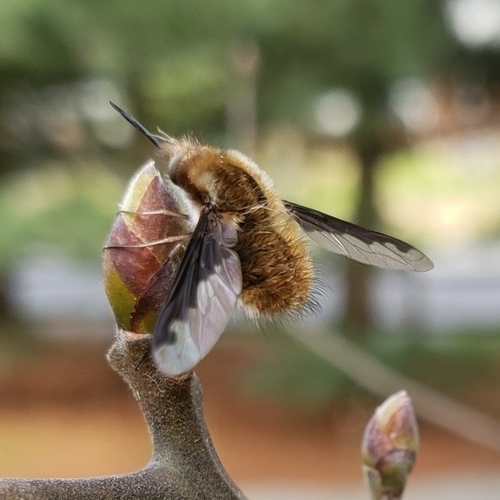
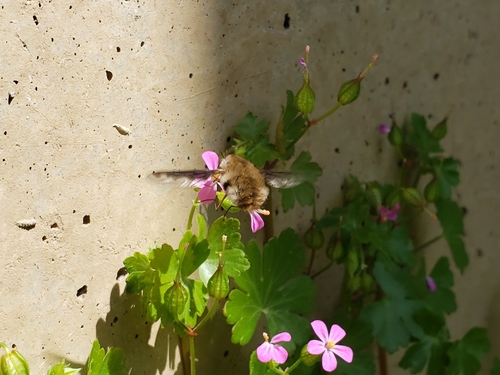
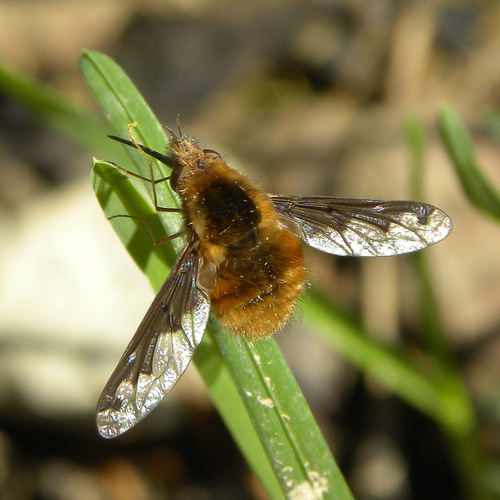
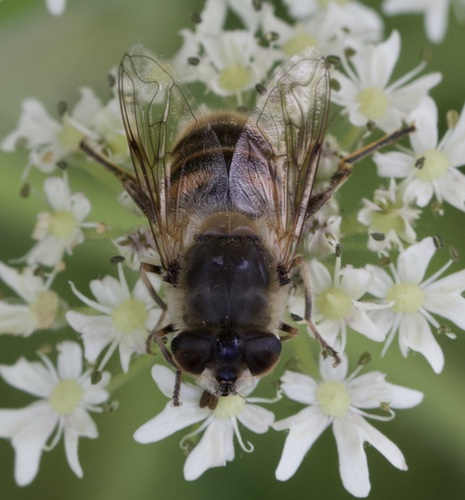
The adult is densely hairy, golden-brown, giving a round, bee-like profile. The body is short and stout with a noticeably long, straight proboscis held out in front. Each wing has a dark brown front half with a sharp, wavy boundary against the clear rear half. Legs are long and slender and are used to hold onto flowers while feeding. In flight the insect hovers like a tiny hummingbird and darts quickly between flowers.
- Dense, bee-like hair giving a round, fuzzy body shape (bee mimic).
- Long straight proboscis visible when feeding; adults hover while probing flowers.
- Clear wings with dark patching, often a distinct dark mark near the wing tip.
- Small size (about 9-14 mm body length) and rapid, hovering flight in spring.
Lookalikes
Heath bee-fly Bombylius minor
Smaller with paler, more uniform wings lacking the sharp dark front half; flies later in summer, mainly on heathland.
Dotted bee-fly Bombylius discolor
Similar hairy appearance but the wings are clear with scattered dark spots rather than a solid dark front half.
↻Life cycle
Egg
Females deposit batches of eggs near entrances to solitary bee or wasp nests; they may flick eggs toward nest entrances. Eggs hatch in a few days.
Larva
Larvae locate and enter host nests, feeding on the host larvae and stored provisions; this is the parasitic stage and lasts until pupation.
Pupa
Larvae overwinter inside the host bee cell and pupate there in late winter or spring; the pupa works its way to the surface just before the adult emerges.
Adult
Adults emerge in spring, feed on nectar and pollen, mate, and begin the next generation.
🍃Diet and predators
Young eat
Larvae feed on the larvae and stored food of solitary bees and some solitary wasps (parasitoid/kleptoparasite).
Adults eat
Nectar and pollen from a wide range of spring-flowering plants.
Predators of the young
Predatory insects and mites in soil and inside host nests; parasitoids of larvae are not well documented.
Predators of adults
Birds, predatory insects such as robber flies and spiders catch adults; they may also fall prey to insectivorous birds.
🌱Effect on plants and gardens
Adults feed on nectar and pollen and are effective early-season pollinators of a variety of spring flowers.
📍Where and when to find it
Adults: hovering and feeding at early-spring flowers (primroses, buttercups, hawthorn, etc.). Eggs/larvae: near entrances of solitary bee and wasp nests in bare or sandy ground.
Best time
March to May; warm, sunny days during the day.
Observation tips
Approach slowly to photograph hovering adults. Look for them over flower patches and near areas of bare soil where solitary bees nest. Since they fly quickly, a fast shutter speed helps freeze hovering shots.
✨Fun facts
- Females sometimes flick eggs toward bee nest entrances rather than entering nests themselves.
- They hover while feeding like tiny hummingbirds, using a long proboscis to reach nectar without landing fully.
- Although they look and act like bees, they cannot sting — their resemblance is mimicry to deter predators.
?Frequently asked questions
Do greater bee flies sting?
No. Bombylius major is a fly and lacks a stinging apparatus; it only resembles stinging bees.
Are they dangerous to people or pets?
No. Adults are harmless to people and pets. They do not bite, sting or inject venom.
Why are they in my garden?
Adults visit gardens to feed on nectar and pollen from early spring flowers. They are attracted to sunny spots and flower patches.
Do greater bee flies harm bees?
Their larvae parasitize solitary bees and some solitary wasps, so they can reduce local numbers of those solitary species, but they are not known to threaten social honeybee colonies on a large scale.
How can I get rid of them?
Control is not necessary. Bee flies are a natural part of healthy ecosystems with solitary bees and rarely reduce bee numbers severely; encouraging plenty of flowers and nesting habitat helps keep populations balanced.
When is the best time to see greater bee flies?
Look in spring (March to May in temperate zones) on warm, sunny days when they hover at open flowers.
📷Photos of the greater bee fly
More flies & mosquitoes
This guide was written with AI assistance and fact-checked, last updated 2026-10-10. Identification from photos is never certain: don't handle insects you can't identify, and get medical advice for bites, stings or allergic reactions. More about the greater bee fly: iNaturalist, Wikipedia.