
Two-spotted bumble bee
Bombus bimaculatus · Bumble bees
A common eastern North American bumble bee, a friendly, efficient pollinator that normally only stings if handled or threatened.
!Is the two-spotted bumble bee dangerous?
Only mildly. Bumble bees can sting and will do so if trapped against the skin or if the nest is disturbed. Stings are painful, with localized swelling and redness; most people have only minor reactions. Bumble bees do not leave a stinger behind and can sting more than once. First aid: wash with soap and water and apply a cold pack. Anyone with a known bee allergy should carry prescribed epinephrine; signs of anaphylaxis (difficulty breathing, swelling of the face or throat, dizziness) need epinephrine and emergency services immediately.
Pets
Can sting pets that bother or try to eat them; multiple stings may be more serious for small animals. Keep pets away from nests; seek veterinary care if a pet shows severe swelling, breathing difficulty or collapse after stings.
📖Overview
Bombus bimaculatus is a medium-to-large bumble bee found across eastern North America. It forages on a wide variety of flowers and nests in grass tussocks, cavities or abandoned rodent nests. Colonies are annual: a single queen starts a nest in spring, workers appear through summer, and new queens and males are produced in late summer to autumn. It is an important native pollinator in gardens, farms and wildland sites.
🔍How to identify a two-spotted bumble bee
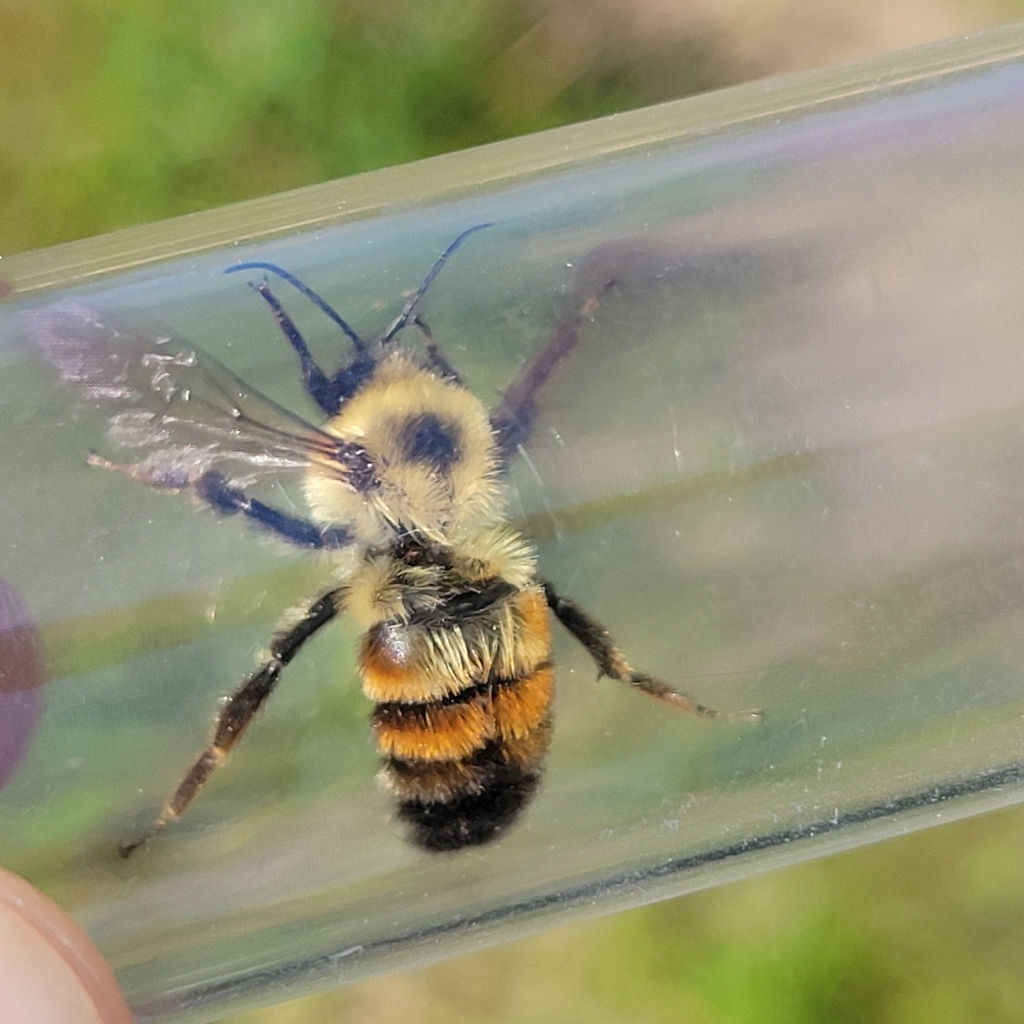
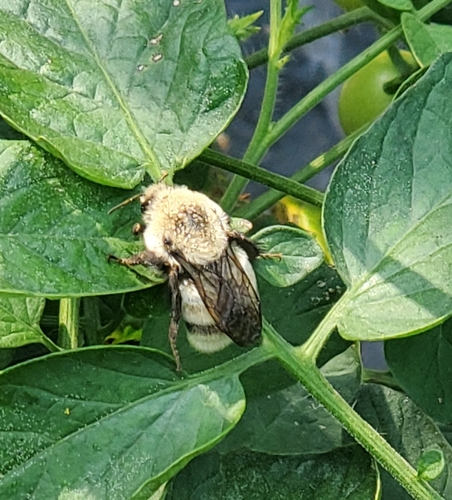
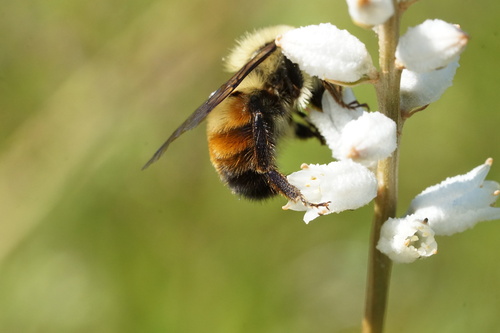
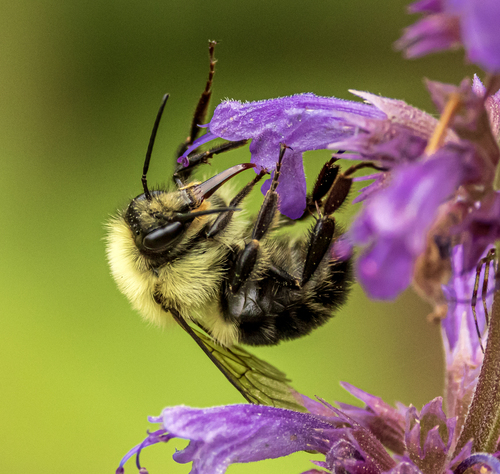
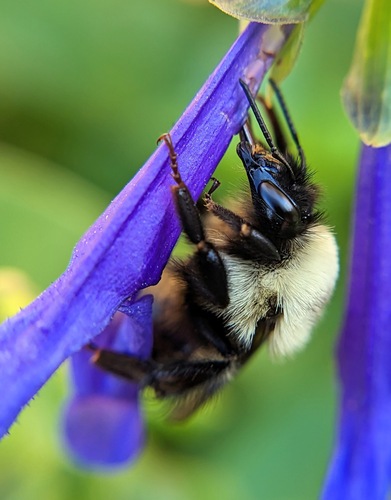
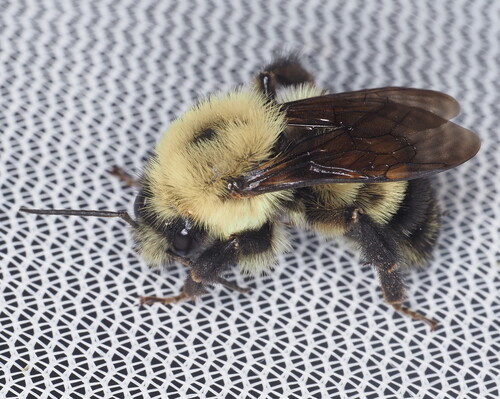
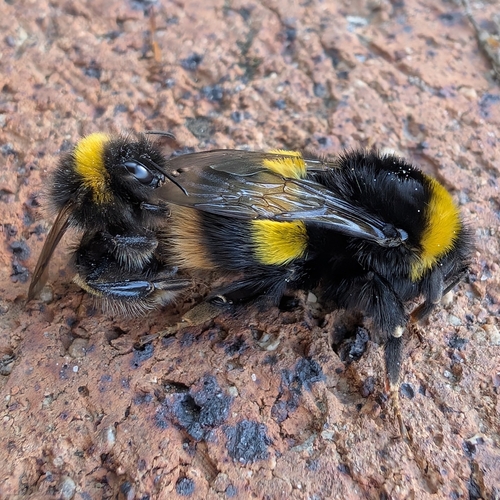
Workers and males have a yellow thorax (often with a small black central spot) and a mostly black abdomen. The field mark that gives the species its name is the yellow on the first two abdominal segments: the first is yellow and the second has a yellow patch that is often two-lobed or M-shaped, sometimes looking like two spots; the rest of the abdomen is black. Queens are larger with the same basic pattern. Hair (pile) is dense and fuzzy, giving the bee a rounded, robust appearance.
- Medium to large, robust bee with dense hair (fuzzy appearance).
- Yellow thorax and black abdomen with yellow on the first two segments; the yellow on the second segment is often two-lobed or M-shaped.
- Queens noticeably larger than workers, with the same colour pattern.
- Compared to similar species, the yellow pattern on the abdomen is patchier rather than a single broad band; check multiple features and regional guides for confident ID.
Lookalikes
Common eastern bumble bee Bombus impatiens
B. impatiens has yellow only on the first abdominal segment, whereas B. bimaculatus has yellow on the first two segments, the second often with a two-lobed patch.
Half-black bumble bee Bombus vagans
B. vagans has a noticeably longer face and the yellow on the second abdominal segment usually forms a fuller band; close examination is often needed to separate them.
↻Life cycle
Egg
Laid by the queen inside the nest in spring; eggs hatch in a few days.
Larva (grub)
Larvae are legless, fed by the queen or workers on nectar and pollen; they grow rapidly over several days to weeks.
Pupa
Larvae pupate inside sealed brood cells and transform into adult workers, males or queens over 1-3 weeks depending on temperature.
Adult
Adult workers forage, maintain the nest and care for brood; new queens and males leave the nest to mate in late summer and queens overwinter alone.
🍃Diet and predators
Young eat
Fed regurgitated nectar and pollen by the queen or workers
Adults eat
Nectar for energy and pollen for protein; forage on many flower species
Predators of the young
Small mammals, ants, wasps and parasites that raid nests
Predators of adults
Birds, crabronid wasps, robber flies and spiders; also parasitized by cuckoo bumble bees in some cases
🌱Effect on plants and gardens
Forages on a wide range of flowering plants, including fruit trees, berry bushes, clover, goldenrod and many garden flowers; valuable for crop and wild plant pollination.
📍Where and when to find it
Look on flowers in gardens, meadows and orchards. Nests are often in grass clumps, under compost piles or in abandoned rodent burrows.
Best time
Spring through early autumn (April to October in many areas); mid-morning to mid-afternoon on warm days is best for foraging activity.
Observation tips
Use a long lens and keep distance—approach slowly and avoid sudden movements. Flower-rich areas and native plantings attract them; watch for slow, deliberate flight and 'buzzing' on flowers.
✨Fun facts
- Despite the name, not every individual shows obvious 'two spots'—pattern variation occurs by caste and region.
- Bumble bees are 'buzz pollinators': they can vibrate flowers to release pollen from plants like tomatoes and blueberries.
- A single queen founds a colony in spring and rears the first generation of workers alone.
?Frequently asked questions
Are two-spotted bumble bees dangerous?
Only mildly. They are not aggressive by nature and will sting only if squeezed, handled roughly or if their nest is threatened. Most people experience a painful sting and minor swelling, but people with bee allergies can have serious reactions.
Do two-spotted bumble bees sting people?
Yes, they can sting, but workers seldom sting unless provoked. Queens can sting but rarely do; males cannot sting.
Why is a bumble bee in my house?
A forager may have followed light or flowers, or a queen may be investigating a sheltered cavity for nesting. Occasionally bees enter houses through open windows or doors.
How do I get rid of a bumble bee nest?
Because bumble bees are valuable pollinators, avoid destroying nests when possible. If a nest is in a dangerous location, contact a local beekeeper or pest control professional who can relocate it. As a last resort, professionals can remove or treat the nest; do not attempt nest removal without protective equipment.
Where does the two-spotted bumble bee live?
It lives across eastern North America in meadows, gardens, orchards and open woodlands, nesting in underground cavities, tussocks or abandoned rodent nests.
📷Photos of the two-spotted bumble bee
More bees, wasps & ants
Bites and formic acid
Painful sting
Stinging insect
Can sting
Can sting
Can sting
This guide was written with AI assistance and fact-checked, last updated 2026-10-10. Identification from photos is never certain: don't handle insects you can't identify, and get medical advice for bites, stings or allergic reactions. More about the two-spotted bumble bee: iNaturalist, Wikipedia.