
Red-banded leafhopper
Graphocephala coccinea · Leafhoppers
A small, brightly colored sap-feeding leafhopper common on shrubs and trees in eastern North America; not harmful to people but can cause minor plant damage.
!Is the red-banded leafhopper dangerous?
No. Does not bite or sting people. It is not venomous or dangerous. Handle gently if necessary; some people might experience minor skin irritation from crushing many insects, but this species is not known to cause allergic reactions.
Pets
Not toxic to pets. Pets could eat individual leafhoppers without harm, though feeding on large numbers of any insect is not recommended.
📖Overview
Graphocephala coccinea is a strikingly colored leafhopper found across eastern and central North America. Adults feed by piercing plant tissue and sucking sap from a wide range of woody and herbaceous plants. They are active in warm months and are often seen on leaves and stems where they hop or fly short distances when disturbed. They are not dangerous to people or pets, though large numbers can cause localized leaf yellowing or stippling on host plants.
🔍How to identify a red-banded leafhopper
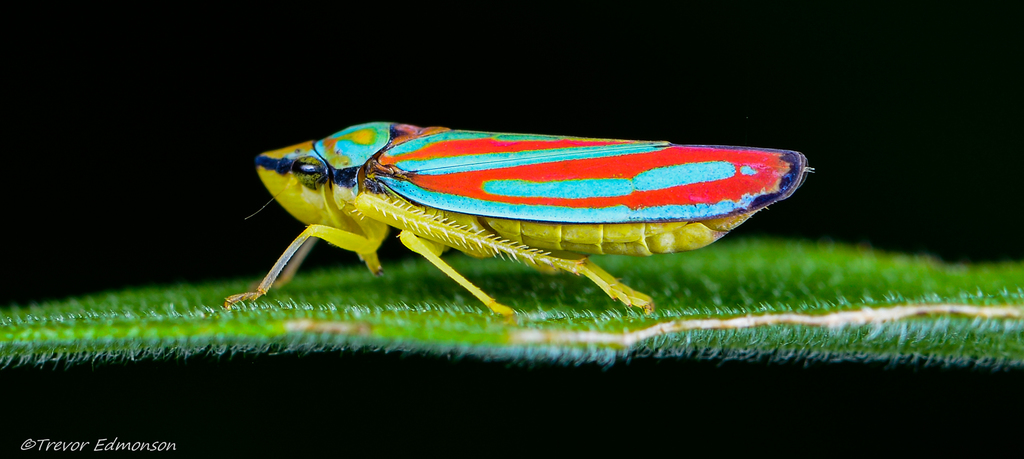
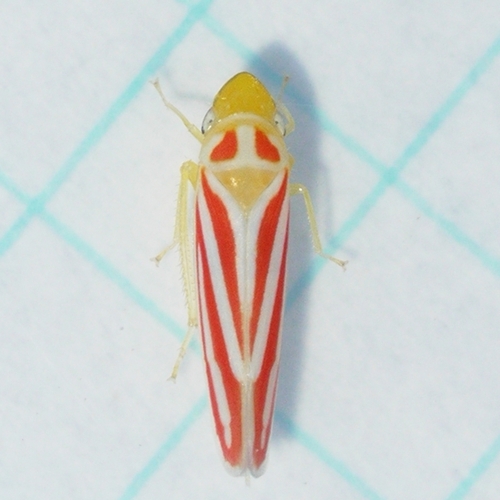
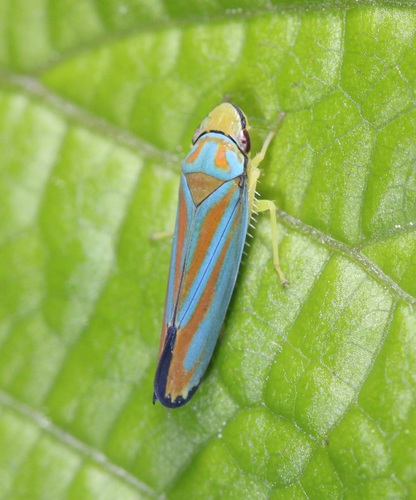
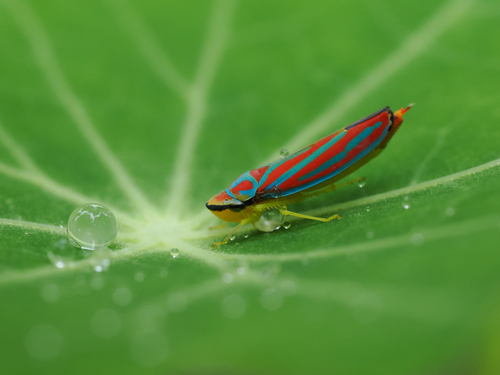
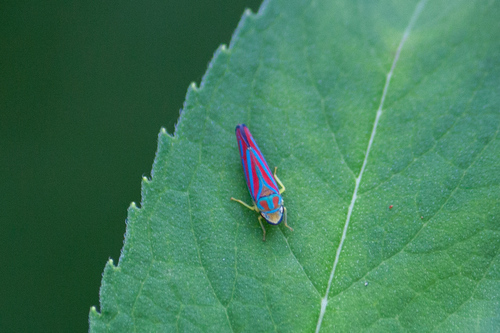
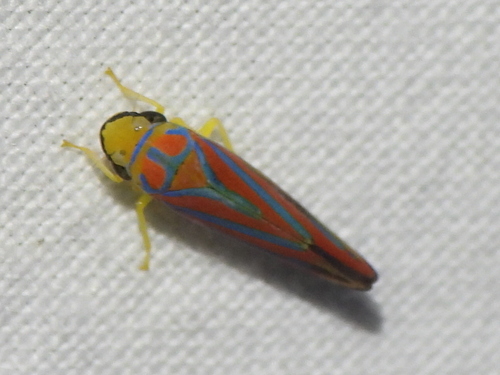
Adults are small, wedge-shaped insects about 6-8 mm long with bold alternating red and blue-green stripes running along the forewings and onto the pronotum. The head, legs and underside are yellow, and the head has fine black lines. Nymphs are wingless and more uniformly greenish or yellowish, becoming progressively more colorful as they develop.
- Notice the bold red and blue-green stripes along the wings, with a yellow head and legs.
- Small wedge-shaped body about 6-8 mm long with distinctive color pattern visible from above.
- When disturbed they hop or fly a short distance rather than crawl.
Lookalikes
Rhododendron leafhopper Graphocephala fennahi
Very similar red-and-green striped pattern; mostly found on rhododendrons and introduced to Europe. Separation from G. coccinea relies on fine details of colour pattern and male genitalia.
Graphocephala versuta Graphocephala versuta
Closely related and similarly colored; identification often requires comparison of exact color pattern and sometimes examination of genitalia for definitive separation.
↻Life cycle
Egg
Females lay eggs inserted into plant tissue such as stems or leaf veins; eggs overwinter in colder areas or develop through the season depending on climate.
Nymph (immature)
Nymphs hatch wingless and resemble small, pale leafhoppers. They go through several molts, feeding on plant sap and growing larger each instar.
Adult
Adults develop wings and the characteristic red and green coloration; they are mobile and can fly or hop to escape disturbance.
🍃Diet and predators
Young eat
Plant sap (mainly xylem) from the same host plants used by adults.
Adults eat
Sap from leaves and stems of a wide variety of shrubs, trees and herbaceous plants.
Predators of the young
Predatory insects (lacewings, spiders, assassin bugs), small birds.
Predators of adults
Birds, spiders, predatory insects, and parasitic wasps.
🌱Effect on plants and gardens
Feeds on xylem sap of a wide range of woody and herbaceous plants. Individual insects usually cause only superficial stippling or discoloration; heavy infestations can stress young or weak plants. This species is not generally a major agricultural pest, although its egg-laying in rhododendron buds is associated with spreading the fungus that causes rhododendron bud blast.
📍Where and when to find it
Look on the upper and lower surfaces of leaves, stems and branches of shrubs, trees and garden plants. Nymphs are found more on tender new growth; adults on leaves in sunlit areas.
Best time
Late spring through early autumn during warm daylight hours.
Observation tips
Use a hand lens or close-focus camera to capture the red banding; approach slowly as adults hop quickly when disturbed. Sweeping a net through foliage is an effective way to sample leafhoppers.
✨Fun facts
- The bright red and green colors make G. coccinea one of the most visually striking leafhoppers in North America.
- Leafhoppers communicate in part through substrate-borne vibrations; many species use these signals during courtship.
- Despite their showy appearance, these insects are small and easily overlooked until you look closely at foliage.
?Frequently asked questions
Do red-banded leafhoppers bite?
No. They feed on plant sap and do not bite or sting people.
Are red-banded leafhoppers harmful to my plants?
Individual leafhoppers cause only minor stippling or discoloration. Heavy infestations can stress young or weakened plants, but G. coccinea is not usually a major pest.
Why are these leafhoppers on my houseplants?
They are attracted to foliage where they can feed on sap. Outdoor plants and houseplants placed outdoors or near windows can sometimes host leafhoppers.
How can I get rid of leafhoppers?
For small numbers, hand-removal or a strong spray of water can dislodge them. In gardens, encourage predators, remove nearby weedy hosts, and use insecticidal soap or pyrethroid-based products only if necessary and according to label instructions.
Where does the red-banded leafhopper live?
It lives on shrubs, trees and herbaceous plants across eastern and central North America, preferring sunlit foliage during warm months.
📷Photos of the red-banded leafhopper
More true bugs, cicadas & aphids
Bites cause itching
Non-venomous nuisance
Non-toxic
Smelly secretion
Potential disease vector
Painful bite
This guide was written with AI assistance and fact-checked, last updated 2026-10-10. Identification from photos is never certain: don't handle insects you can't identify, and get medical advice for bites, stings or allergic reactions. More about the red-banded leafhopper: iNaturalist, Wikipedia.