
Poplar hawk-moth
Laothoe populi · Hawk moths
A large, grey-brown sphingid moth whose swept-back hindwings and stout body make it unmistakable on poplars and willows across Europe and much of Asia.
!Is the poplar hawk-moth dangerous?
No. Not dangerous to people. Adults do not bite or sting. Handle gently if needed; moth scales can rub off but are harmless. No medical first aid is normally required.
Pets
Harmless if encountered. As with most moths, ingestion by pets may cause mild stomach upset but the species is not toxic.
📖Overview
Laothoe populi is a widespread hawk-moth found across Europe and temperate Asia. Adults are large and bulky with a characteristic posture: when settled they hold the hindwings projected forward beneath the forewings, producing a distinctive triangular outline. Caterpillars feed mainly on poplar and willow leaves; pupation takes place in the soil. Depending on latitude there is usually one main generation per year, with a partial second generation in warmer areas.
🔍How to identify a poplar hawk-moth
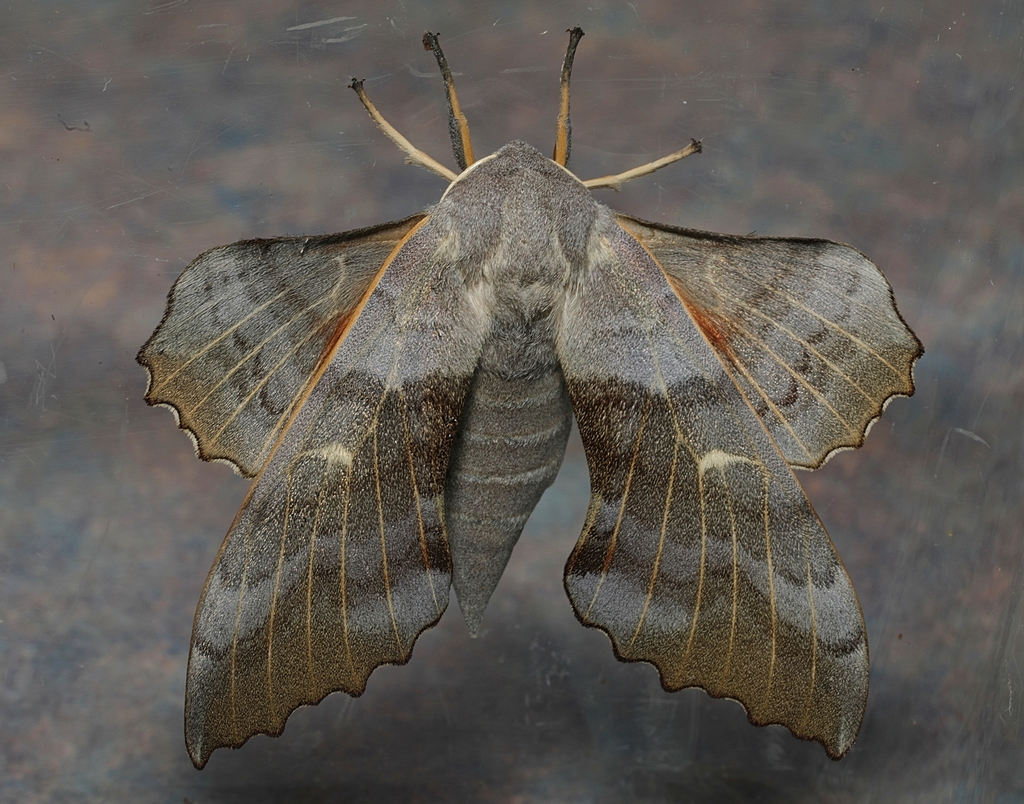
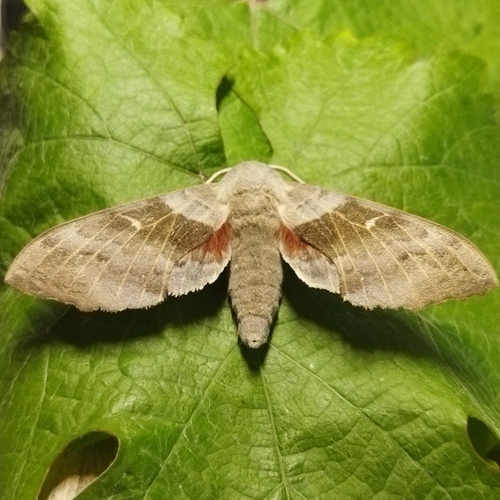
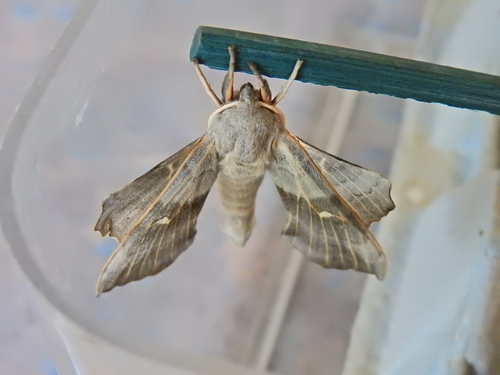
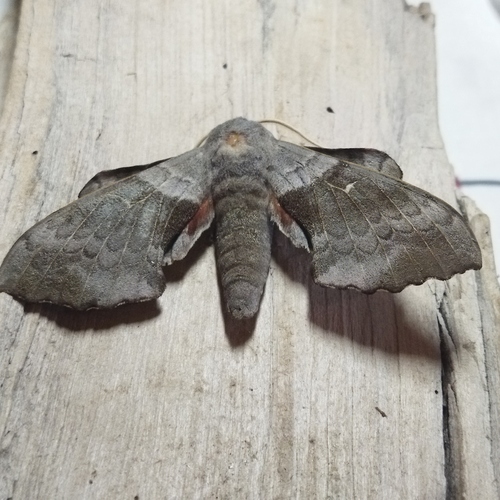
Adults have a heavy body and broad, scalloped forewings. Colouration is variable but typically grey or brown with fine mottling and darker transverse lines; some individuals are more pinkish-buff. The hindwings have a rusty-red patch near the base that is flashed when the moth is disturbed. When at rest the hindwings are held forward of the forewings so the moth looks angular, like a cluster of dead leaves. Wingspan commonly 70-100 mm. Caterpillars are green (sometimes with red spots) with a rough, granular skin, oblique yellow side stripes and a yellow tail horn. Pupae are dark brown and formed in the soil without a cocoon.
- Large sphingid moth with wingspan 70-100 mm and stout body
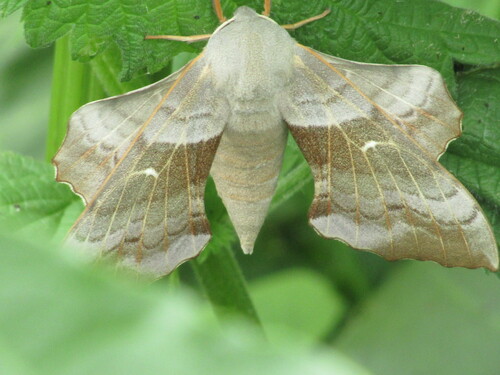
- Hindwings swept forward under forewings when resting, producing an angular triangular outline
- Grey or brown mottled forewings with transverse lines; rusty-red patch at the base of the hindwing
- Caterpillars green with rough skin, yellow diagonal side stripes and a yellow tail horn
Lookalikes
Eyed hawk-moth Smerinthus ocellata
Smerinthus has large eye-spots on the hindwings visible when spread and a different resting posture; Laothoe lacks conspicuous eye-spots and tucks hindwings forward.
Lime hawk-moth Mimas tiliae
Similar angular resting shape, but forewings are pinkish-green with dark green central blotches; caterpillars feed mainly on lime trees.
↻Life cycle
Egg
Small eggs laid singly on the underside of host leaves; hatch in about 1-2 weeks depending on temperature.
Larva (caterpillar)
Green or brown caterpillars that feed on host tree foliage through several instars over weeks. Later instars are larger and show diagonal side markings.
Pupa
Pupates in a shallow chamber in the soil, forming a dark brown pupa; overwinters as a pupa.
Adult (moth)
Nocturnal adult that flies at night to mate and lay eggs; adults do not feed and typically live 1-2 weeks.
🍃Diet and predators
Young eat
Leaves of poplar, willow, aspen, sometimes birch and related trees
Adults eat
Adults do not feed; their mouthparts are non-functional and they live on reserves built up as caterpillars.
Predators of the young
Birds, predatory insects and parasitic wasps and flies
Predators of adults
Bats, nocturnal birds and predatory insects
🌱Effect on plants and gardens
Larvae feed on leaves of poplars (Populus spp.), willows (Salix spp.), aspen and occasionally birch and sallow. Heavy local infestations can cause noticeable defoliation but serious long-term damage is uncommon.
📍Where and when to find it
Look on poplar and willow leaves for caterpillars. Adults are attracted to light at night and rest on tree trunks or branches by day.
Best time
Spring to late summer (exact months depend on region); night for adults, daytime for locating resting moths or searching trees for caterpillars.
Observation tips
Check the undersides of leaves for eggs and young caterpillars. Photograph resting adults from above to show the distinctive triangular outline; use a flashlight for night photos but avoid shining continuously at moths.
✨Fun facts
- When at rest Laothoe populi tucks its hindwings forward under the forewings, making it look like a dead leaf or a triangular lump.
- Its common name refers to one of its main host trees, the poplars, though it feeds on several related tree species.
- Pupae overwinter in the soil, so mature caterpillars often leave the host tree and drop to the ground to pupate.
?Frequently asked questions
Is the poplar hawk-moth dangerous?
No. It does not bite or sting and is not toxic. It is harmless to people.
Do poplar hawk-moth caterpillars eat garden trees?
Caterpillars feed on poplars, willows and related trees, but they occur in small numbers and rarely cause noticeable damage.
Why is this moth in my garden?
If you have poplars, willows or similar trees nearby the moth is there to lay eggs; larvae feed on those host trees. Adults are nocturnal and may be attracted to lights at night.
How do I get rid of poplar hawk-moth caterpillars?
For small numbers pick caterpillars off by hand. Encourage birds and parasitic insects. In severe cases on valuable trees, use targeted biological control such as Bacillus thuringiensis kurstaki (Btk) when larvae are young, following product instructions.
When can I see poplar hawk-moths?
Adults fly at night from spring through summer depending on latitude. Caterpillars are most visible in the weeks after hatching through late summer.
📷Photos of the poplar hawk-moth
More butterflies & moths
This guide was written with AI assistance and fact-checked, last updated 2026-10-10. Identification from photos is never certain: don't handle insects you can't identify, and get medical advice for bites, stings or allergic reactions. More about the poplar hawk-moth: iNaturalist, Wikipedia.