
Hummingbird hawk-moth
Macroglossum stellatarum · Hawk moths
A day-flying sphinx moth that hovers at flowers like a tiny hummingbird, common across Europe, North Africa and much of Asia.
!Is the hummingbird hawk-moth dangerous?
No. Not dangerous. Adults do not sting or bite in normal circumstances. They may briefly land or probe at skin while nectaring but do not pose a medical risk. No special first aid needed.
Pets
Harmless to cats and dogs. Caterpillars are not known to be toxic to pets, though ingestion of any large insect may cause stomach upset.
📖Overview
Macroglossum stellatarum is a medium-sized hawk moth known for its rapid wingbeat and hovering flight while feeding at flowers. Unlike most moths, it is mainly active in daylight and at dusk, often seen visiting garden flowers and nectar-rich blossoms. It is migratory in parts of its range and can appear in large numbers in good years. Adults are important pollinators; the caterpillars feed on bedstraws and a few related plants.
🔍How to identify a hummingbird hawk-moth
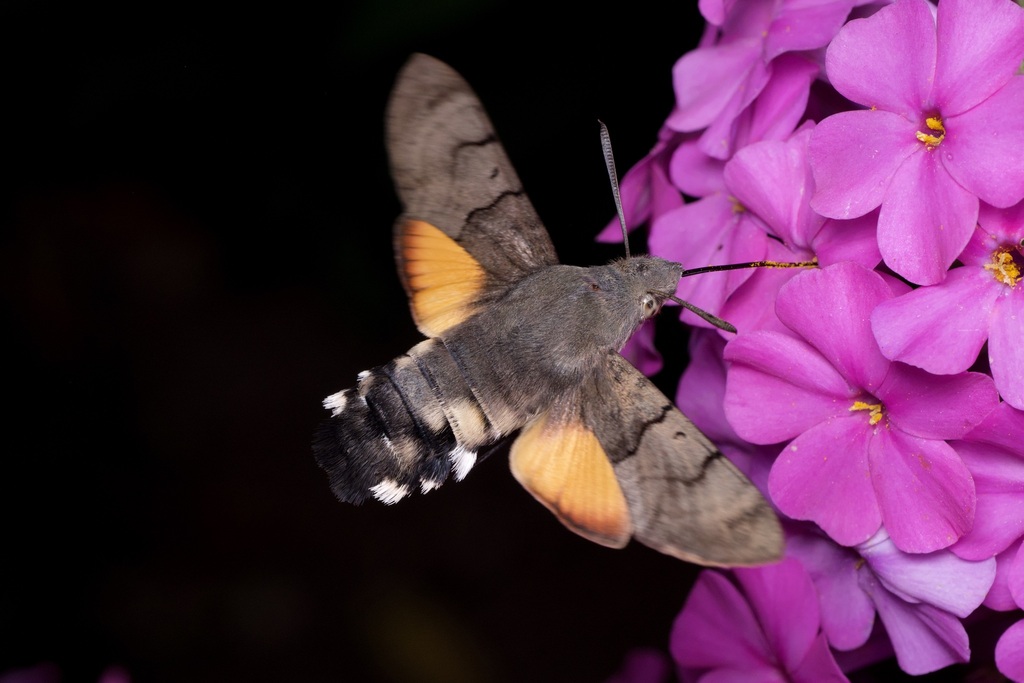
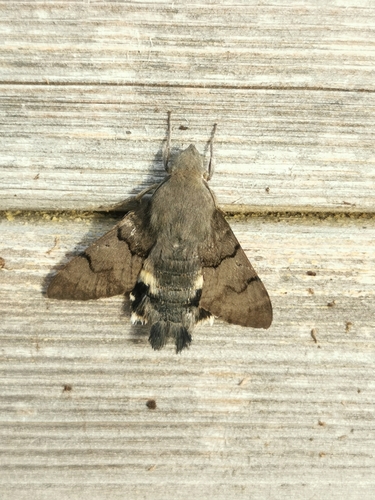
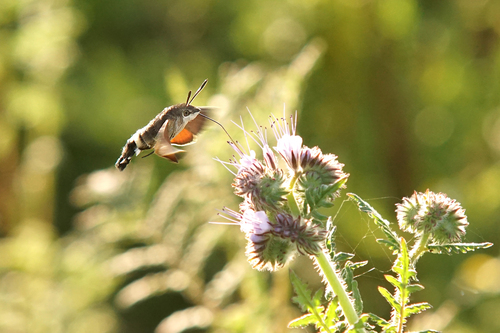
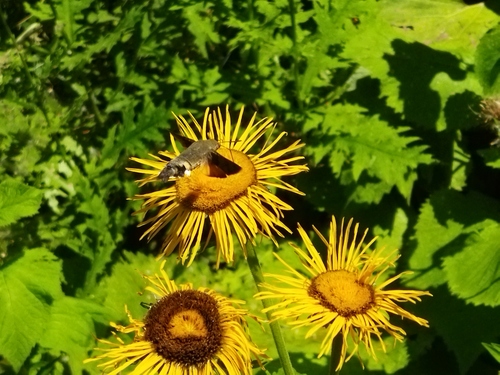
The adult has a robust, streamlined body with a long proboscis used for sipping nectar while hovering. Forewings are grey-brown with fine black wavy lines; hindwings are orange with a dark border. The abdomen is grey-brown with black-and-white chequered sides and a broad, fan-like tail tuft. In flight the moth flashes orange hindwings and beats its wings so rapidly that it resembles a small hummingbird. Wingspan typically about 40-50 mm.
- Day-flying hawk moth that hovers at flowers like a hummingbird and beats wings very rapidly.
- Orange hindwings with a dark border visible in flight; brown-grey forewings with darker markings.
- Long proboscis and streamlined body; often seen feeding while hovering rather than perching.
Lookalikes
Convolvulus hawk-moth Agrius convolvuli
Much larger species with broader wings and different pinkish hindwing tones; A. convolvuli is nocturnal and generally does not hover in daylight like Macroglossum stellatarum.
Broad-bordered bee hawk-moth Hemaris fuciformis
Also a day-flying hawk-moth that hovers at flowers, but has largely clear, glassy wings with a reddish-brown border and a bumblebee-like banded body instead of orange hindwings.
Other Macroglossum species Macroglossum spp.
Related species may look similar but differ in regional range, subtle wing pattern details and size; close comparison of markings and geography helps separate them.
↻Life cycle
Egg
Females lay single eggs on the underside of host plant leaves (often bedstraws).
Larva (caterpillar)
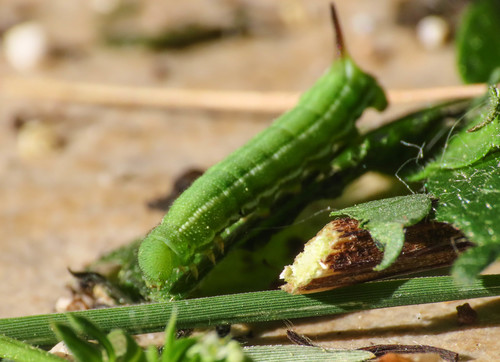
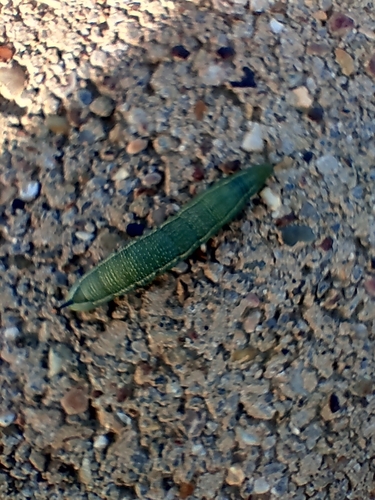
Green or brown caterpillars with pale side stripes and a horn on the rear (bluish with an orange tip) feed on leaves of Galium and related plants; they grow through several instars.
Pupa
Pupation occurs in the soil or leaf litter in a loose cocoon; pupal stage duration depends on temperature and season.
Adult (moth)
Adults are strong fliers, active by day and dusk, visiting flowers while hovering and using a long proboscis to extract nectar.
🍃Diet and predators
Young eat
Leaves of bedstraws (Galium species) and some related plants.
Adults eat
Nectar from a wide range of flowers, especially those with deep corollas (e.g. buddleia, valerian, petunia, red valerian and other garden flowers).
Predators of the young
Parasitoid wasps, predatory insects, birds and small mammals.
Predators of adults
Birds, bats (at dusk/night), spiders and predatory insects.
🌱Effect on plants and gardens
Adults feed on nectar from many flowers, pollinating garden and wild plants. Larvae feed primarily on bedstraws (Galium species) and some related plants; they rarely cause significant damage.
📍Where and when to find it
Adults at flower clusters (buddleia, valerian, petunia) in gardens, meadows and edges; caterpillars on leaves of Galium and related plants.
Best time
Spring through autumn in warm weather; active during daylight and at dusk.
Observation tips
Use a fast shutter speed to freeze the rapid wingbeats when photographing. Look for hovering moths around nectar-rich flowers on sunny days or at dusk.
✨Fun facts
- Its rapid wingbeat and hovering feeding behaviour earned it the 'hummingbird' name, though it is a moth not a bird.
- It is often seen during daylight, unusual for most moth species which are nocturnal.
- Macroglossum stellatarum is migratory in parts of Europe and Asia and can appear far outside its usual range in warm years.
?Frequently asked questions
Are hummingbird hawk-moths dangerous?
No. They do not sting or bite and are harmless to people and pets.
Do hummingbird hawk-moths bite?
No. They feed with a long proboscis and do not bite humans.
Why is a hummingbird hawk-moth in my garden?
They visit gardens to feed on nectar from flowers, especially those with tubular blooms like buddleia and valerian.
How can I attract hummingbird hawk-moths?
Plant nectar-rich, tubular flowers (buddleia, valerian, petunia, red valerian) and avoid heavy pesticide use. Warm sunny spots help attract them.
How do I get rid of hummingbird hawk-moths?
They are harmless and beneficial pollinators; removal is usually unnecessary. If caterpillars are unwanted on specific plants, hand-pick them or relocate them to nearby vegetation.
Where does the caterpillar feed?
Most commonly on bedstraws (Galium species) and some related plants; check these plants if you find foliage damage.
📷Photos of the hummingbird hawk-moth
More butterflies & moths
This guide was written with AI assistance and fact-checked, last updated 2026-10-10. Identification from photos is never certain: don't handle insects you can't identify, and get medical advice for bites, stings or allergic reactions. More about the hummingbird hawk-moth: iNaturalist, Wikipedia.