
Giant crane fly
Tipula abdominalis · Crane flies
One of the largest crane flies in North America; adults are fragile and non-biting, and the larvae live in streams and wet soil feeding on decaying leaves.

!Is the giant crane fly dangerous?
No. Adults do not bite or sting and are harmless. They may startle people because of their size and long legs but do not pose a health risk. If an adult is handled roughly it can deliver a mild pinch with mouthparts but this is extremely rare and not medically significant.
Pets
Harmless to pets. Neither adults nor larvae are toxic, and a pet that catches and eats one is very unlikely to have any problem.
📖Overview
Tipula abdominalis is one of the largest crane flies in eastern North America. Adults are long-legged, mosquito-like insects most often seen from late spring through summer near streams, wooded wetlands and moist shady areas. They are weak fliers and are commonly attracted to lights or found resting on vegetation and buildings. The larvae are aquatic or semi-aquatic, living in streams, seeps and saturated soil, where they shred and eat fallen leaves and other decaying plant material.
This species is not dangerous to people. Adults do not bite or sting. Its larvae are important leaf-shredders in woodland streams and are not lawn pests, unlike some smaller introduced crane flies.
🔍How to identify a giant crane fly
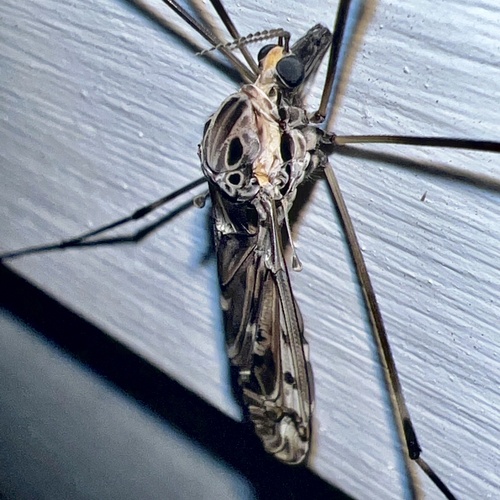
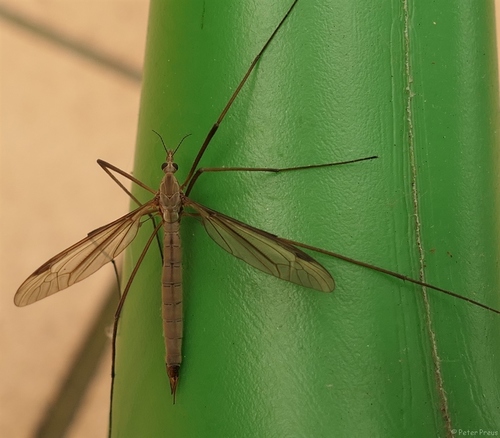
Adults are large and slender-bodied with very long legs and a V-shaped suture on the thorax typical of crane flies. Wings are long with brownish mottling and are held outstretched when resting. The abdomen is long and orange-yellow to brownish with darker stripes. Antennae are relatively long and multi-segmented. Larvae are large, cylindrical, legless grubs with tough, leathery greyish to brown skin and a ring of fleshy lobes around the breathing pores at the rear.
- Very long legs and slender body with a V-shaped thoracic suture typical of crane flies
- Long wings with brownish mottling, held outstretched at rest
- Long orange-yellow to brownish abdomen with darker stripes
- Much larger than most crane flies; usually found near streams and wet woods
Lookalikes
Common crane fly Tipula oleracea (and other Tipula spp.)
Much smaller, with mostly clear wings and a greyish-brown body; it is an introduced lawn and pasture pest whose larvae live in turf, whereas T. abdominalis is larger with mottled wings and aquatic larvae.
Daddy longlegs spider (harvestman) Opiliones (various)
Harvestmen are arachnids with a single rounded body segment and eight legs; crane flies are true flies with two wings and three body segments (head, thorax, abdomen).
↻Life cycle
Egg
Laid in or near water, in wet soil, mud or stream margins; eggs hatch in days to weeks depending on temperature.
Larva (leatherjacket)
Large aquatic or semi-aquatic grubs that shred and eat decaying leaves in streams and saturated soil; this stage lasts the longest (months to about a year).
Pupa
Pupation occurs in moist soil or mud near the water; the pupal stage lasts days to weeks before the adult emerges.
Adult (crane fly)
Short-lived, primarily for mating and egg-laying; adults do not feed extensively and are often seen near lights or vegetation.
🍃Diet and predators
Young eat
Decaying leaves, wood and other plant debris and the microbes growing on them
Adults eat
Minimal feeding; some species sip nectar or water, but adults are largely focused on reproduction
Predators of the young
Fish, salamanders, predatory aquatic insects, birds and small mammals
Predators of adults
Birds, bats, spiders and predatory insects
🌱Effect on plants and gardens
Larvae feed on fallen leaves and other decaying plant material in streams and wet soil, helping recycle nutrients; they do not damage lawns or garden plants.
📍Where and when to find it
Adults: on vegetation near streams, on walls and near lights. Larvae: in leaf packs and soft sediment of small streams and in saturated soil.
Best time
Late spring through summer; adults near water by day and at lights at night.
Observation tips
Photograph spread wings and the dorsal abdomen for identification; larvae can be found by gently sifting through leaf packs in shallow streams.
✨Fun facts
- Crane flies are sometimes called 'daddy long-legs' in parts of North America, a name shared with harvestmen and cellar spiders which can cause confusion.
- Despite their mosquito-like appearance, crane flies do not bite humans and many adults do not feed at all.
- Its larvae are important leaf-shredders in woodland streams, breaking down fallen leaves that feed many other stream animals.
?Frequently asked questions
Are giant crane flies dangerous?
No. Adults are harmless to people and do not bite or sting.
Do crane flies bite or sting?
No. Adult crane flies lack mouthparts adapted to biting humans; they are harmless.
Why are crane flies in my house?
Adults are attracted to lights and may wander indoors on warm evenings or when windows and doors are open.
Can the larvae damage my lawn?
No. Tipula abdominalis larvae live in streams and saturated soil and eat decaying leaves; lawn damage is caused by other crane fly species such as the European and common crane flies.
How do I get rid of crane flies?
For occasional indoor adults, gently capture and release them outdoors. No control is needed: adults are harmless and short-lived, and the larvae live in streams and wet ground.
Where does Tipula abdominalis live?
It lives near streams, seeps and wooded wetlands across eastern North America; larvae live in stream beds and saturated soil.
📷Photos of the giant crane fly



More flies & mosquitoes
This guide was written with AI assistance and fact-checked, last updated 2026-10-10. Identification from photos is never certain: don't handle insects you can't identify, and get medical advice for bites, stings or allergic reactions. More about the giant crane fly: iNaturalist, Wikipedia.