
Eastern cicada killer
Sphecius speciosus · Digger wasps
A large solitary wasp that digs burrows and provisions each nest with paralyzed cicadas to feed its larvae.
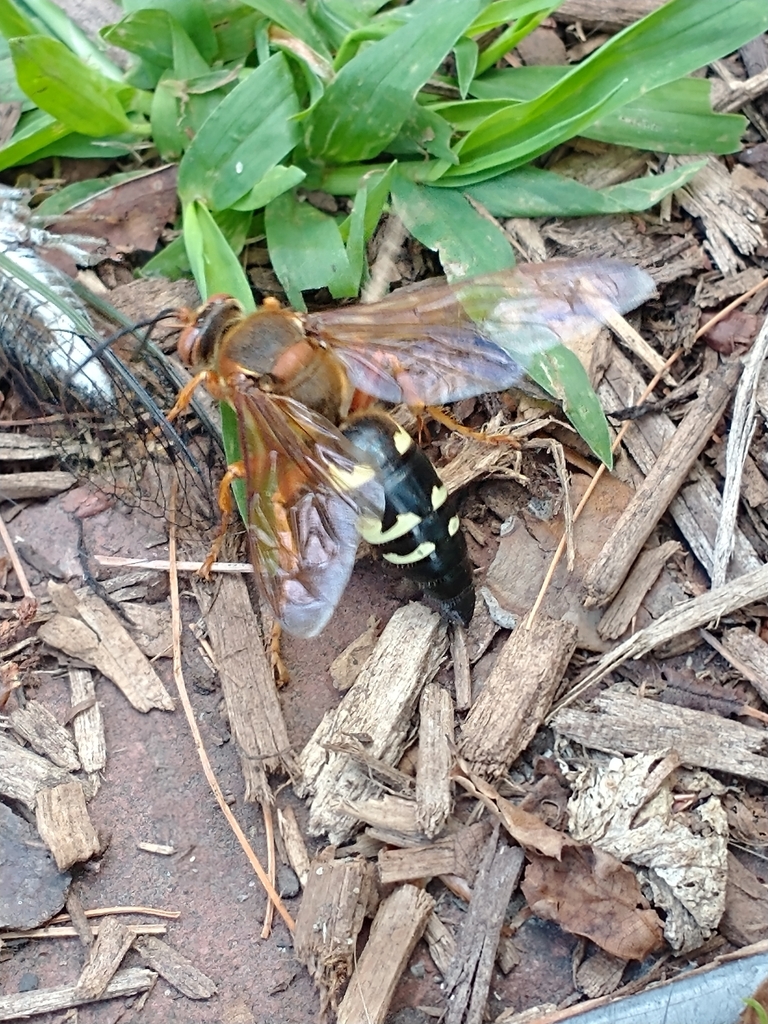
!Is the eastern cicada killer dangerous?
Only mildly. Females can sting and the sting is painful but not generally dangerous to most people. Allergic individuals could have serious reactions and should seek immediate medical attention for signs of anaphylaxis. Males have no functional sting but can behave aggressively by diving or chasing intruders. First aid for a sting: remove any stinger (wasps do not leave a stinger, but check the area), wash with soap and water, apply cold compress to reduce swelling, and use over-the-counter pain relievers or antihistamines as needed. Seek medical help for breathing difficulties, widespread hives, or swelling of face/throat.
Pets
Stings can be painful to pets (dogs, cats) and may cause local swelling. Very small animals could be more affected. If a pet shows signs of severe allergic reaction or distress, seek veterinary care.
📖Overview
Sphecius speciosus is a large solitary wasp native to eastern North America. Females dig burrows in bare or sparsely vegetated soil, capture one or more cicadas, sting and paralyze them, then drag them into an underground cell where a single egg is laid. The developing larva consumes the paralyzed cicada. Adults are most often seen in summer and feed on nectar and plant sap.
They are not social like yellow jackets or hornets and generally avoid attacking people. Females can sting if handled or provoked near their nest; males cannot sting but may fly aggressively to defend territory. Populations can be noticeable in lawns, sandbanks and open, sunny sites where females can dig nest burrows.
🔍How to identify a eastern cicada killer
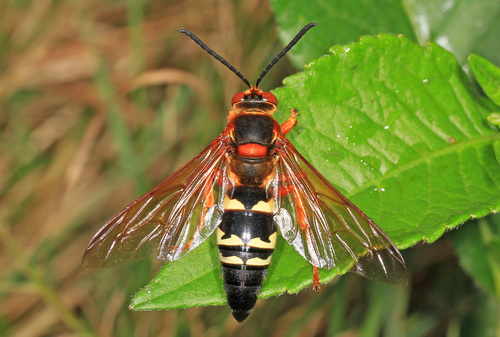
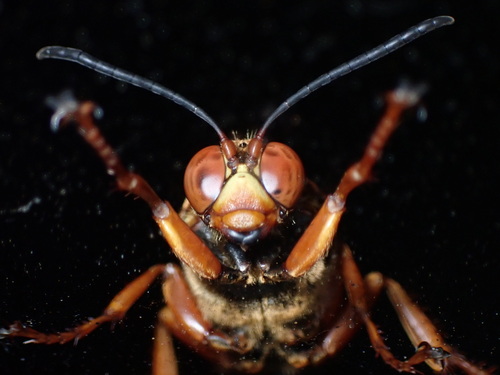
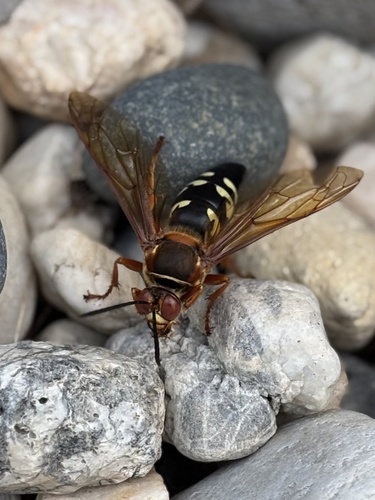
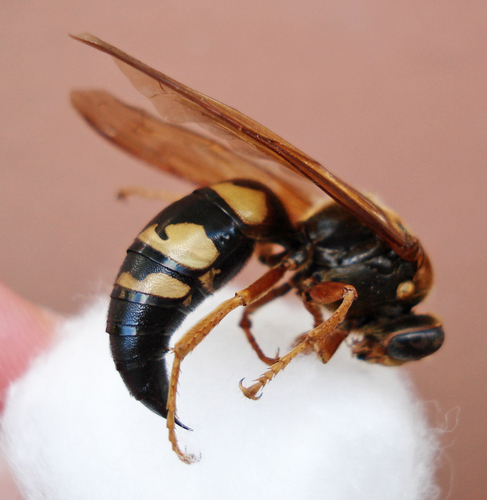
Adults are robust, wasp-shaped and about 25-50 mm long, with females larger and heavier than males. The abdomen is black to dark reddish-brown with pale yellow bands or markings on the first few segments; the head and thorax are rusty red to dark brown. Legs are reddish to yellowish-brown and the wings are amber-tinted.
- Large, stout wasp about 25-50 mm long with a black to dark reddish-brown abdomen marked with pale yellow bands.
- Rusty red to brown head and thorax, amber-tinted wings and reddish-yellow legs.
- Observe nesting behavior: females dig burrows in bare/sandy soil and carry cicadas.
- Males smaller and more slender than females and frequently hover or chase near nest areas.
Lookalikes
Pacific cicada killer Sphecius convallis
Very similar in shape and behavior; Pacific cicada killer is found in western North America and has slightly different banding patterns and regional range.
Mud dauber wasp Various species (e.g., Sceliphron caementarium)
Mud daubers are more slender with narrow 'waists' and build mud nests on walls; they do not dig burrows or carry large cicadas.
Paper wasps Polistes spp.
Paper wasps are slimmer with longer legs that hang in flight and build exposed paper nests; they are smaller and not specialized cicada hunters.
↻Life cycle
Egg
A single egg is laid on a paralyzed cicada placed in an underground cell.
Larva (grub)
The larva hatches and consumes the stored cicada(s); this is the feeding stage and lasts until pupation.
Pupa
The mature larva pupates in the burrow and develops inside a cocoon before emerging as an adult.
Adult (wasp)
Adults emerge in summer; males patrol territories and mate while females dig burrows and provision nest cells with cicadas.
🍃Diet and predators
Young eat
Feed exclusively on paralyzed cicadas supplied by the female.
Adults eat
Nectar, plant sap and sometimes honeydew; adults do not feed on cicadas.
Predators of the young
Parasitic flies and wasps, fungal pathogens, and some predators that can enter burrows.
Predators of adults
Birds, robber flies, praying mantises and other larger predators; mammals may dig up nests to eat larvae.
🌱Effect on plants and gardens
Adults visit flowers for nectar and can contribute to pollination; larvae feed on cicadas so the species has no direct harmful effect on plants and may reduce cicada damage locally.
📍Where and when to find it
Look for adults on flowers and around sunny, bare patches of soil. Check lawn edges, sandbanks and slopes for small burrow entrances and soil mounds where females dig nest tunnels. Larvae are found inside underground brood cells with paralyzed cicadas.
Best time
June to August on warm sunny days, during daylight hours when adults are active.
Observation tips
Keep a safe distance from burrows to avoid provoking females. Use a zoom lens for photos. Morning and late afternoon light gives good contrast on their banded bodies.
✨Fun facts
- Females are much stronger than they look: they can fly with a paralyzed cicada that may outweigh them, and drag it to the burrow.
- Males cannot sting because they lack a functional stinger; they defend territory by flying aggressively.
- A single female may provision several brood cells in one season, each with one or more cicadas.
?Frequently asked questions
Do cicada killers sting people?
Yes, females can sting if handled or squeezed; the sting is painful but not usually medically dangerous. Males cannot sting.
Why are cicada killers in my yard?
They prefer sunny spots with exposed, well-drained soil for digging nests and areas where cicadas are available to provision their young. Lawns, sandy patches and bare soil attract them.
Are cicada killers harmful to my garden?
No, they do not damage plants. Adults help pollinate flowers and larvae feed on cicadas, so they are generally beneficial.
How can I get rid of cicada killers?
Nonlethal options: discourage nesting by replanting or mulching bare soil, watering grassy areas to make digging harder, or covering small patches with mulch or gravel. For active nests that pose a risk, contact pest control; insecticidal dusts applied at night by a professional can be effective. Avoid killing adults indiscriminately—female removal without addressing nests may not solve the problem.
Are cicada killers endangered or protected?
No. Eastern cicada killers are common across their range and not considered endangered.
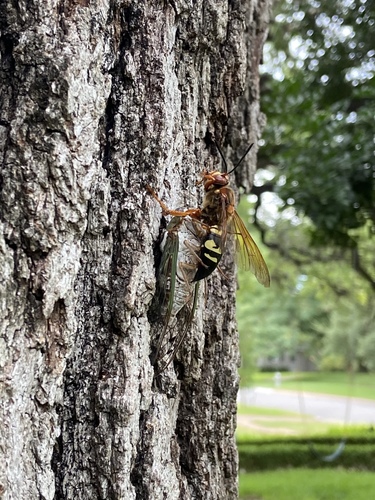
📷Photos of the eastern cicada killer
More bees, wasps & ants
Bites and formic acid
Painful sting
Stinging insect
Can sting
Can sting
Can sting
This guide was written with AI assistance and fact-checked, last updated 2026-10-09. Identification from photos is never certain: don't handle insects you can't identify, and get medical advice for bites, stings or allergic reactions.