
Common fruit fly
Drosophila melanogaster · Fruit flies
A tiny, cosmopolitan fly that breeds in fermenting fruit and organic matter; a harmless but persistent household nuisance and a key model organism in genetics.
!Is the common fruit fly dangerous?
No. Does not bite or sting. Not known to spread serious human disease, but adults can land on and contaminate exposed food. Good hygiene (discard overripe fruit, clean drains and bins) prevents problems. No special first aid is needed for contact.
Pets
Harmless to cats and dogs. Large numbers can be a nuisance but do not harm pets.
📖Overview
Drosophila melanogaster is a small dipteran found worldwide where humans and fermenting plant material occur. It is best known as the common fruit fly or vinegar fly and breeds in fermenting fruit, vegetables, drains and other moist, decaying organic matter. Outdoors it frequents orchards, compost and fallen fruit; indoors it is common in kitchens and near trash or recycling bins.
This species is not dangerous to humans: adults do not bite or sting and they are not known to transmit serious disease, though they can contaminate food and be an annoyance. It is one of the most intensively studied animals in science; its short lifecycle, easy culture and well-mapped genetics have made it a central model in genetics and developmental biology for over a century.
🔍How to identify a common fruit fly
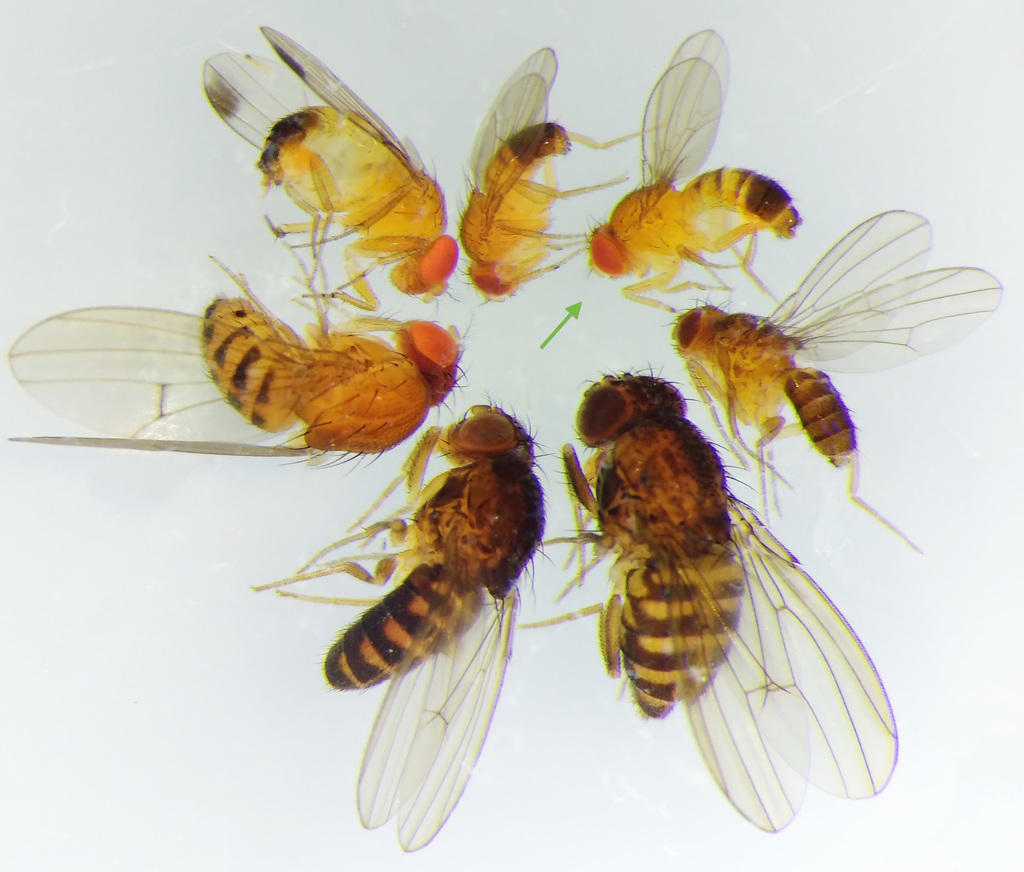
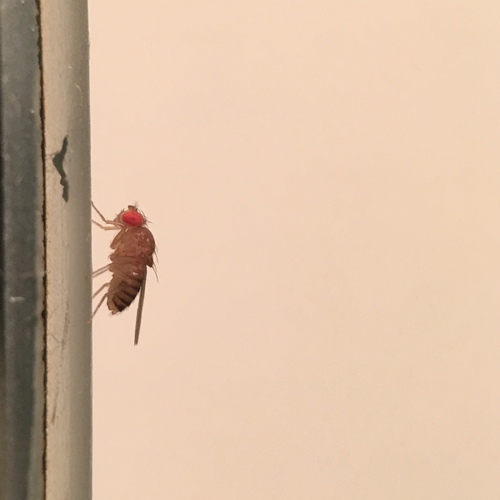
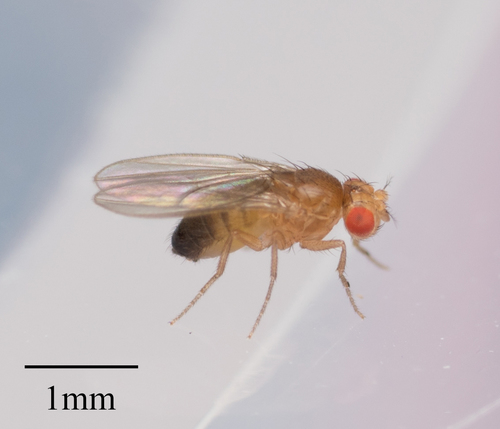
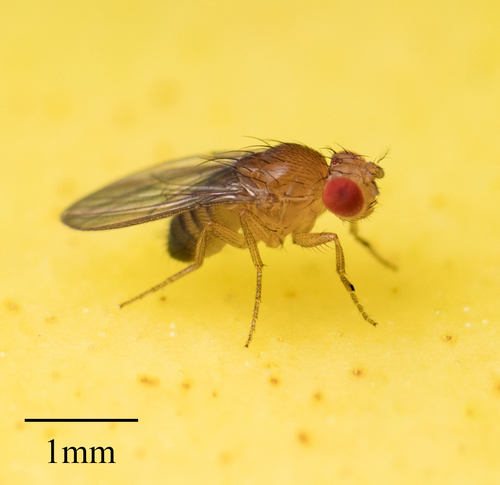
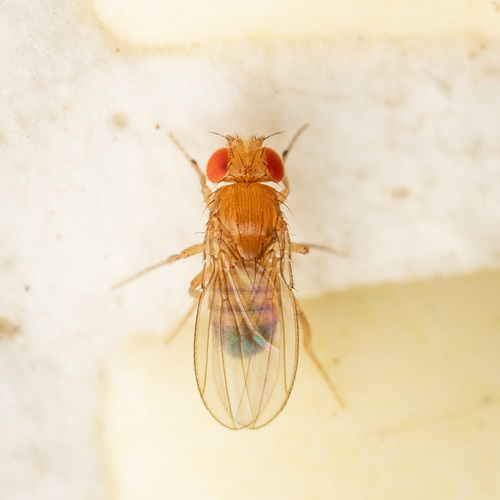
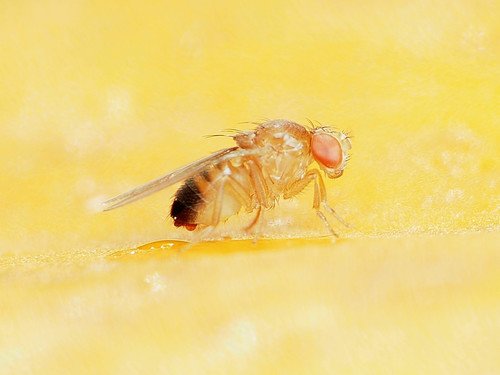
Adults are very small (about 2-3 mm long), with a tan to yellow-brown thorax, darker abdomen with faint black striping, and conspicuous red eyes (in wild-type). Wings are clear with simple venation. Males are slightly smaller than females and have a darker, rounded abdomen and a fringe of bristles called sex combs on the forelegs; females have a longer pointed abdomen for egg-laying. Larvae are cream-coloured, legless maggots with tapered ends; pupae are brownish and attached to dry surfaces by a sticky pad.
- Very small size (2-3 mm) — noticeably smaller than house flies.
- Red eyes (wild-type) and tan to yellow-brown thorax with a darker striped abdomen.
- Short, clear wings without distinctive dark spots (contrast with Drosophila suzukii whose males have a dark spot near each wingtip), and males have sex combs on the forelegs visible under magnification.
- Found hovering near or walking on fermenting fruit, drains, compost or garbage where they breed.
Lookalikes
Spotted-wing drosophila Drosophila suzukii
D. suzukii adults have a dark spot near the tip of each wing (males) and females have a sawlike ovipositor; D. melanogaster lacks wing spots and attacks mostly fermenting or damaged fruit rather than healthy fruit.
Drosophila simulans Drosophila simulans
Very similar in appearance; D. simulans often has slightly different genitalia and behavioral differences—identification usually requires microscopic examination or genetic testing.
Phorid fly (humpbacked fly) Family Phoridae
Phorid flies are similar in size but have a characteristic hump-backed profile and run rapidly across surfaces; behavior and body shape help separate them.
↻Life cycle
Egg
Females lay tiny white eggs on fermenting fruit or other moist organic matter; eggs hatch in about 24-36 hours at warm temperatures.
Larva (maggot)
Three larval instars feed on yeast and microbes in the substrate for about 3-7 days depending on temperature.
Pupa
Larvae crawl to a drier surface and pupate; pupal stage lasts about 3-6 days before adults emerge.
Adult
Adults are sexually mature within about 8-12 hours to a day and continue the cycle; generation time can be as short as 8-10 days in warm conditions.
🍃Diet and predators
Young eat
Yeast, bacteria and microorganisms within fermenting fruit or decaying plant matter.
Adults eat
Feeds on the liquid and microbes of fermenting fruit, nectar and other sugary liquids; adults also feed on microbes rather than solid fruit tissue.
Predators of the young
Predatory mites, ants, beetles and parasitic wasps (in natural settings).
Predators of adults
Spiders, predatory insects, some small birds and other insectivores.
🌱Effect on plants and gardens
Larvae feed on yeast and microbes in fermenting or damaged fruit and may accelerate breakdown of overripe fruit; they do not normally attack intact healthy fruit. Outdoors some related species are agricultural pests, but D. melanogaster itself is generally a minor pest.
How to get rid of common fruit flys
Eliminate breeding sites: discard or refrigerate ripe fruit, clean drains and trash containers, clean spills, and remove compost or fermenting substrates. Use simple bait traps (apple-cider vinegar with a drop of dish soap in a jar) to capture adults. Seal windows/doors and use fine-mesh screens to reduce entry. Chemical sprays are rarely necessary indoors and are a temporary measure only.
📍Where and when to find it
Look on or near overripe and fermenting fruit, compost, rubbish bins, kitchen sinks and drains; larvae are found inside fermenting substrates, pupae on nearby dry surfaces.
Best time
Indoors year-round; outdoors most commonly spring through fall. Daytime and dusk are good for observing adults.
Observation tips
Use a small jar with a piece of fermenting fruit or apple-cider vinegar as bait to attract and observe adults. A magnifying glass helps see red eyes and male sex combs.
✨Fun facts
- Drosophila melanogaster has been used in genetics research for over 100 years and was key to many foundational discoveries.
- Its genome was one of the first animal genomes to be fully sequenced, making it a cornerstone of molecular biology.
- A single female can lay hundreds of eggs in her lifetime and a full generation can take as little as 8-10 days in warm conditions.
- Male fruit flies have distinctive black sex combs on their front legs used during mating.
?Frequently asked questions
Are fruit flies dangerous?
No — common fruit flies do not bite or sting and are not known to transmit serious diseases, but they can contaminate food and are an unpleasant nuisance.
Do fruit flies bite people?
No. Fruit flies feed on liquids and microbes; they do not bite people.
Why do I have fruit flies in my house?
They are attracted to fermenting or overripe fruit, vegetables, drains, compost and any moist decaying organic matter. Even small amounts of spilled juice or residue in drains can support breeding.
How do I get rid of fruit flies?
Remove breeding materials (refrigerate or discard ripe fruit), clean drains and bins, use vinegar bait traps, and seal entry points. Repeated cleaning and removing attractants is the most effective control.
How fast do fruit flies reproduce?
At warm temperatures a complete generation can take about 8-10 days; many generations can occur in a single season.
Is this the same fly used in genetics labs?
Yes. The same species, Drosophila melanogaster, is the classic model organism used in genetic and developmental research.
📷Photos of the common fruit fly
More flies & mosquitoes
This guide was written with AI assistance and fact-checked, last updated 2026-10-09. Identification from photos is never certain: don't handle insects you can't identify, and get medical advice for bites, stings or allergic reactions.