
Common buckeye
Junonia coenia · Brush-footed butterflies
A distinctive brown butterfly with large eye spots and orange bands, common in open sunny habitats across much of North America.
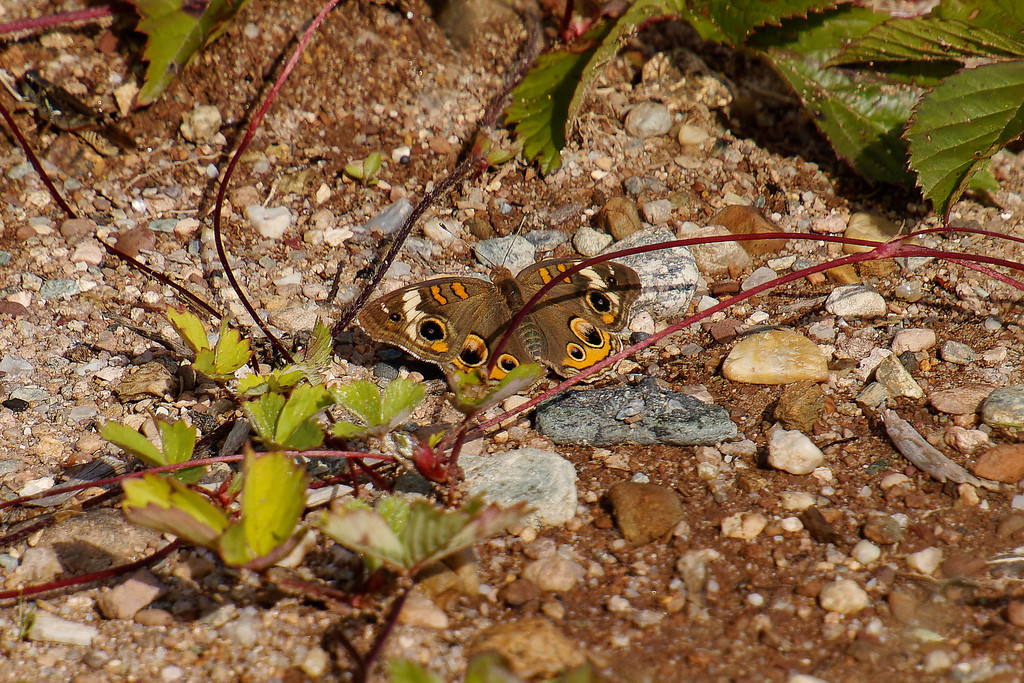
!Is the common buckeye dangerous?
No. Harmless to people. Adults do not bite or sting. Handle gently if necessary; avoid touching wings because scales rub off easily.
Pets
Not dangerous to pets. Individual butterflies are not toxic or harmful if touched or eaten, though ingestion of any insect could upset an animal's stomach.
📖Overview
The Common buckeye is a medium-sized brush-footed butterfly known for its conspicuous eyespots and bold patterning. It is widespread across the United States, southern Canada and into Mexico; populations expand and contract seasonally and with weather. Adults are strong fliers that prefer open, sunny areas such as fields, roadsides and gardens and are frequent visitors to nectar-producing flowers. Larvae feed on low-growing host plants and go through the typical butterfly life stages: egg, caterpillar, chrysalis, adult.
🔍How to identify a common buckeye
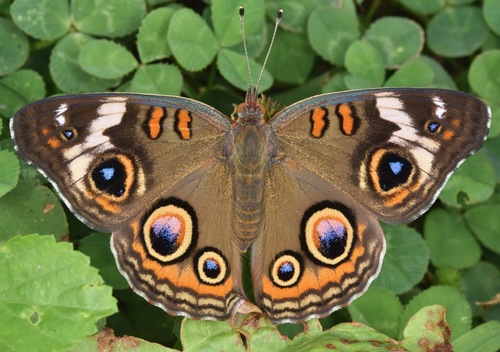
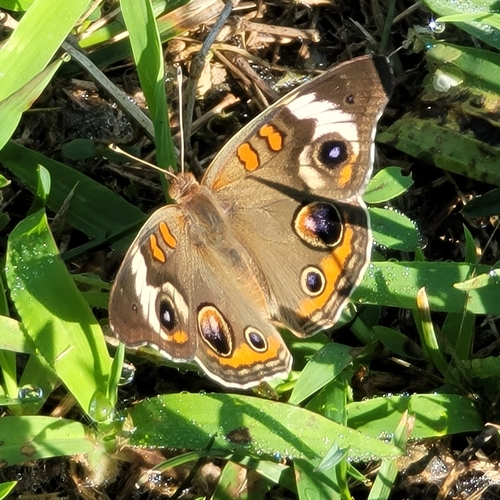
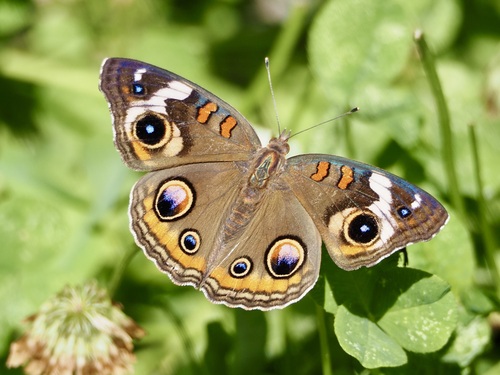
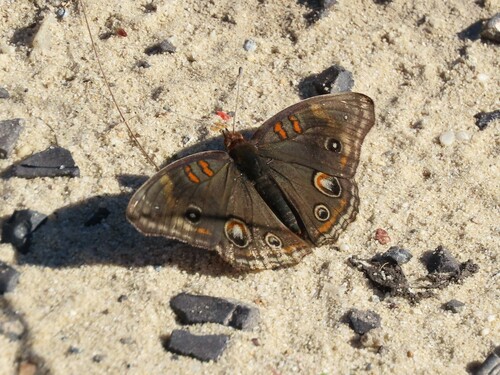
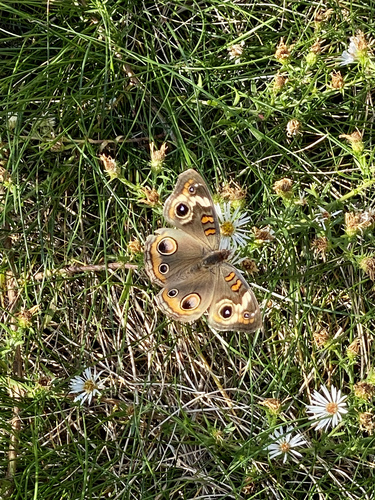
Wings are broad and rounded with a wingspan about 45-65 mm. Upperwings are mainly brown. Each forewing has one large eyespot set in a whitish band and two orange bars near the leading edge; each hindwing has two eyespots (the upper one larger) and an orange band along the edge. The undersides are mottled brown and gray, providing good camouflage when wings are closed. Males and females are similar; females are slightly larger with broader wings.
- Large eyespots on the upperwings: one big eyespot on each forewing and two on each hindwing
- Whitish band around the forewing eyespot and two orange bars near the forewing's leading edge
- Brown ground color with mottled, cryptic underside when wings are closed
- Wingspan about 45-65 mm; overall chunky, rounded wing shape typical of Junonia species
Lookalikes
Tropical buckeye Junonia zonalis
Tropical buckeye is darker brown with smaller eyespots, a pinkish or tan (not white) band around the forewing eyespot, and is limited mainly to southern Florida, south Texas and the tropics.
Mangrove buckeye Junonia neildi
Mangrove buckeye has a large forewing eyespot and an orange (not white) band near it, and lives mainly in coastal mangroves of Florida and south Texas.
Eyed brown Lethe eurydice
Eyed brown is a pale tan satyr of wet meadows with rows of small eyespots and no orange bars or white forewing band; buckeyes have large, bold eyespots and orange markings.
↻Life cycle
Egg
Small, pale eggs laid singly on the leaves of host plants. Incubation lasts about 4-10 days depending on temperature.
Larva (caterpillar)
Dark caterpillars with branched spines and pale lines and spots that feed on host plant leaves. Several instars over 2-4 weeks before pupating.
Pupa (chrysalis)
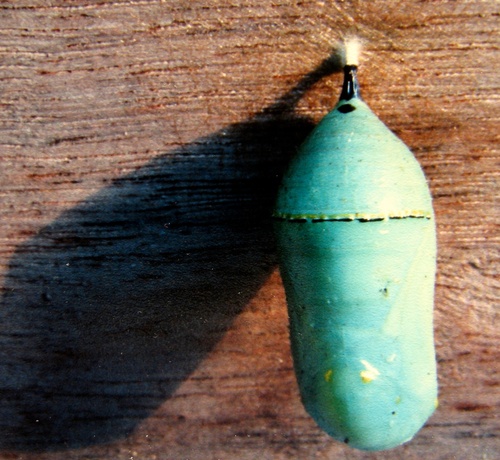
A chrysalis attached to stems or leaves; pupal stage typically lasts about 1-2 weeks in warm weather.
Adult (butterfly)
Winged adult that feeds on nectar, mates and disperses; may produce multiple generations per year in warm regions.
🍃Diet and predators
Young eat
Leaves of host plants such as plantains (Plantago spp.) and other low-growing species used by the genus Junonia
Adults eat
Nectar from a wide variety of flowers (asters, clover, milkweeds and many garden plants)
Predators of the young
Parasitoid wasps and flies, predatory insects and spiders, small birds
Predators of adults
Birds, dragonflies, spiders and other insect-eating predators
🌱Effect on plants and gardens
Adults feed on nectar from many flowers (e.g., asters, milkweed, clover). Caterpillars feed on low-growing host plants such as plantains (Plantago species) and various plants in families historically treated as Scrophulariaceae/Plantaginaceae and related groups. They generally do not cause significant damage.
📍Where and when to find it
Adults: nectaring on flowers in sunny spots, perched on bare ground or low vegetation. Larvae: on the leaves of host plants such as plantain and other low herbs.
Best time
Spring through fall; midday on warm sunny days is best for adult activity.
Observation tips
Look for the orange band and eye spots when photographing. Approach slowly and use a telephoto or zoom; a quick shot from a few metres is often best because butterflies are easily disturbed.
✨Fun facts
- The large eyespots are thought to deter predators by directing strikes away from the body or startling attackers.
- In autumn, large numbers of common buckeyes migrate south, especially along the Atlantic coast.
- Males perch on bare ground or low plants in sunny spots and fly out at passing insects while searching for females.
?Frequently asked questions
Do Common buckeye butterflies sting or bite?
No. They are harmless to people and have neither sting nor biting structures that affect humans.
Why is a buckeye in my garden?
They visit gardens for nectar and may lay eggs if host plants such as plantains are present. Sunny, open gardens with nectar flowers attract adults.
How do I get rid of buckeye caterpillars?
They are not typically pests. If you need to remove them, pick host plants with caterpillars and relocate the caterpillars to non-sensitive areas. Avoid broad insecticide use to protect beneficial insects.
Where do Common buckeye butterflies live?
Open, sunny habitats—fields, roadsides, meadows, gardens—across much of the United States, southern Canada and into Mexico.
What do buckeye caterpillars eat?
Caterpillars feed on low-growing host plants, especially plantains (Plantago) and related species used by Junonia.
📷Photos of the common buckeye
More butterflies & moths
This guide was written with AI assistance and fact-checked, last updated 2026-10-10. Identification from photos is never certain: don't handle insects you can't identify, and get medical advice for bites, stings or allergic reactions. More about the common buckeye: iNaturalist, Wikipedia.