
Blue-eyed ensign wasp
Evania appendigaster · Ensign wasps
A small, harmless parasitoid wasp that attacks cockroach egg cases and is often found near human dwellings worldwide.
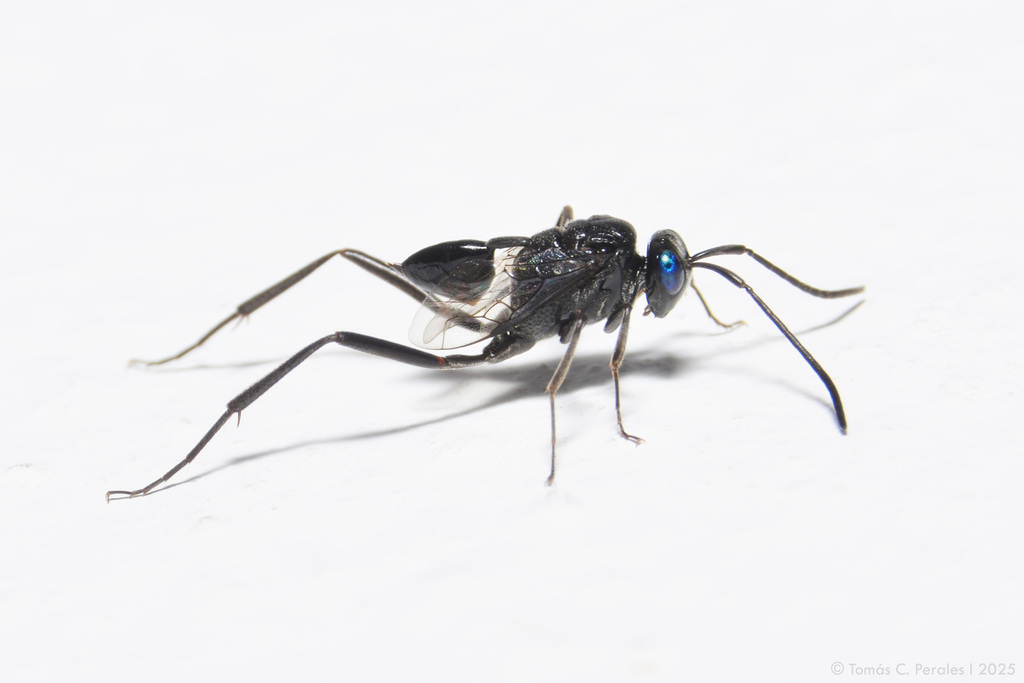
!Is the blue-eyed ensign wasp dangerous?
No. Not dangerous. They do not seek to bite or sting people; reports of stings are effectively nonexistent for this species. No known medically significant venom. If handled roughly the wasp could pinch with mandibles but this rarely breaks skin. No special first aid is needed beyond normal wound care if a minor pinch occurs.
Pets
Harmless to pets. Too small to cause injury; not known to transmit disease to pets.
📖Overview
Evania appendigaster is a small, cosmopolitan ensign wasp that parasitizes cockroach oothecae (egg cases). Females seek out cockroach egg cases, lay a single egg inside each ootheca, and the developing larva consumes the cockroach eggs. Adults are most often encountered near buildings, kitchens, basements and other places where cockroaches lay eggs. They are considered beneficial because they reduce cockroach reproduction but do not control established large infestations on their own.
These wasps are non-aggressive toward people and are not considered pests. They do not bite and stinging reports are extremely rare; their ovipositor is not adapted for stinging humans. Because they rely on cockroach eggs, their presence usually indicates nearby cockroach activity (even if the cockroaches themselves are not seen).
🔍How to identify a blue-eyed ensign wasp
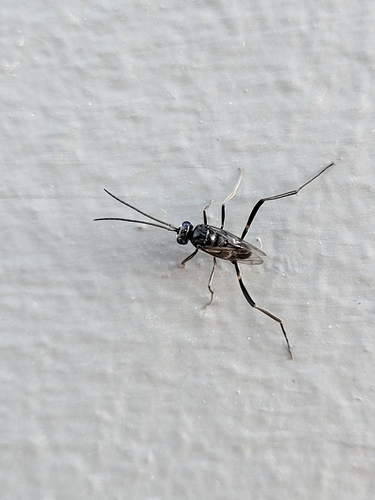
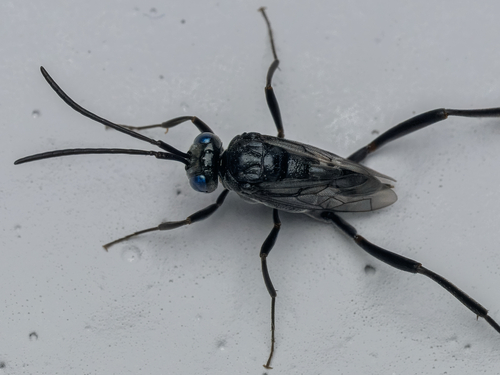
Adults are small (a few millimetres long), shiny black to very dark brown with a distinctive compressed, flag-like metasoma (abdomen) mounted on a slender petiole so it is carried upright, giving the common name "ensign". The common name refers to the bluish or greenish sheen of the eyes seen in many living individuals. Antennae are relatively long and threadlike. Wings are clear or lightly tinted and fold flat over the thorax when at rest. Overall the body is delicate and wasp-like but lacks the pronounced stinger seen in social wasps.
- Small (about 4-8 mm), shiny black wasp with a laterally compressed, flag-like abdomen held upright on a narrow stalk.
- Often shows metallic bluish eyes (giving the 'blue-eyed' name) and long threadlike antennae.
- Wings clear or lightly tinted, folded flat over thorax when resting; body delicate compared with larger social wasps.
- Found near cockroach egg cases or in areas with cockroach activity.
Lookalikes
Other ensign wasps Various Evaniidae
Many Evaniidae share the upright, flag-like metasoma; Evania appendigaster is distinguished by small size and the common bluish eye tint, but microscopic characters are used for definitive ID.
Chalcid wasps Various Chalcidoidea
Chalcids are often tiny and metallic but lack the distinctive upright, sail-like abdomen that characterises ensign wasps.
↻Life cycle
Egg
Female lays a single egg inside a cockroach ootheca (egg case).
Larva
Larva develops inside the ootheca, consuming cockroach eggs; this is the destructive stage for the host.
Pupa
After feeding, the larva pupates within the ootheca; pupation leads to the adult wasp.
Adult
Adults emerge from the ootheca, search for new cockroach egg cases and may feed on nectar or honeydew while locating hosts.
🍃Diet and predators
Young eat
Consume the eggs inside cockroach oothecae.
Adults eat
Feed on nectar, honeydew or other sugary liquids; adults do not feed on cockroaches themselves.
Predators of the young
Likely vulnerable to parasitoids, predators or decomposition while within exposed oothecae; specific predators are not well documented.
Predators of adults
Small insectivores such as spiders, ants, and predatory flies or other wasps may prey on adults.
🌱Effect on plants and gardens
Does not feed on or damage plants. Adults may feed on nectar or honeydew but have no notable impact on vegetation.
📍Where and when to find it
Look for adults on walls, ceilings, near cupboards, in basements, around stored boxes, and on or near visible cockroach oothecae. Larvae and pupae occur inside cockroach egg cases.
Best time
Year-round indoors; outdoors most often in warm months. Daytime is good for finding adults when they are active searching for hosts.
Observation tips
Check areas with a history of cockroaches. Photograph the tiny upright abdomen and eyes for a clear identification; use a macro lens or smartphone close-up mode.
✨Fun facts
- Ensign wasps have a unique posture: the narrow petiole and upright abdomen make them look like tiny flags or "ensigns" waving above their body.
- They are natural enemies of cockroaches: a single female can parasitize multiple cockroach oothecae, helping reduce future cockroach generations.
- Despite looking wasp-like, they are harmless to people and are considered beneficial in and around homes.
?Frequently asked questions
Do blue-eyed ensign wasps sting people?
No. They are not aggressive and are not known to sting humans. Their ovipositor is adapted for laying eggs in cockroach egg cases, not for defense.
Are they dangerous or poisonous?
No. They pose no toxic threat to people or pets and are considered harmless.
Why is one in my house?
Because they search for cockroach egg cases. Finding one usually indicates there are or were cockroaches nearby, since their larvae need cockroach eggs to develop.
How can I get rid of them?
They are beneficial predators of cockroach eggs, so removal is usually unnecessary. To reduce their presence, eliminate cockroach sources by improving sanitation, sealing cracks, removing food residues and using cockroach control methods if needed.
Will they control a cockroach infestation?
They can help reduce cockroach reproduction by parasitizing egg cases, but they rarely eliminate established infestations alone. Integrated cockroach control (sanitation, exclusion, baits, insecticidal treatments) is typically needed for heavy infestations.
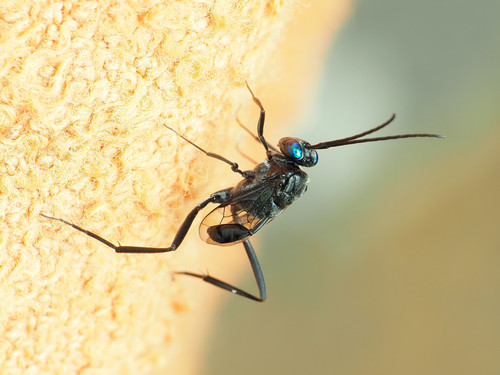
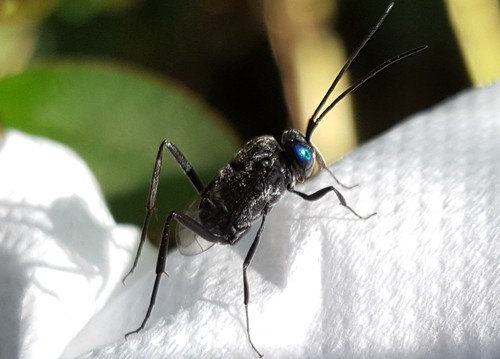
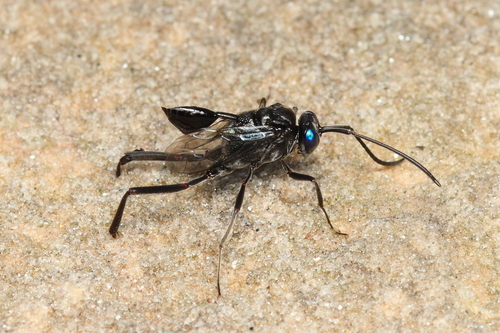
📷Photos of the blue-eyed ensign wasp
More bees, wasps & ants
Bites and formic acid
Painful sting
Stinging insect
Can sting
Can sting
Can sting
This guide was written with AI assistance and fact-checked, last updated 2026-10-10. Identification from photos is never certain: don't handle insects you can't identify, and get medical advice for bites, stings or allergic reactions. More about the blue-eyed ensign wasp: iNaturalist, Wikipedia.