
Bicolored striped sweat bee
Agapostemon virescens · Sweat bees
A common, metallic green-and-black striped sweat bee that is an important native pollinator and usually non-aggressive toward people.

!Is the bicolored striped sweat bee dangerous?
Only mildly. Not aggressive; females can sting but generally do so only if trapped against skin or handled roughly. Stings cause localized pain, swelling and redness similar to other small bees; sweat bees do not leave their stinger behind. Wash the area and apply a cold compress. If signs of a severe allergic reaction (anaphylaxis) appear, such as trouble breathing, swelling of the face or throat, widespread hives, dizziness or fainting, use a prescribed epinephrine auto-injector if available and call emergency services immediately.
Pets
Generally not dangerous to pets. Pets that repeatedly harass or eat bees may receive painful stings in the mouth or throat; allergic reactions in pets are rare but monitor for swelling or breathing difficulty.
📖Overview
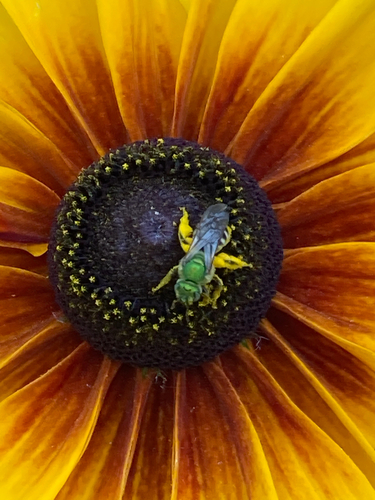
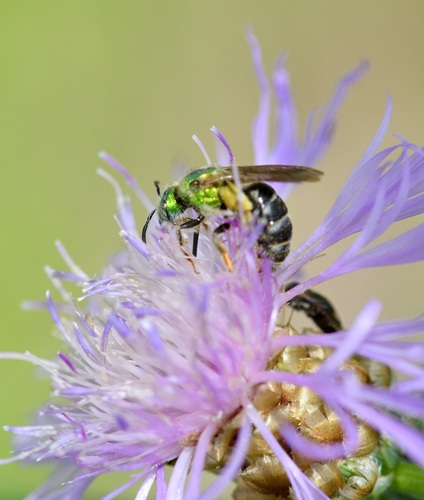
Agapostemon virescens is a widespread North American sweat bee known for its metallic green head and thorax and black abdomen with pale hair bands in females (males have a black-and-yellow striped abdomen). It is a solitary to communal ground-nesting species often found in gardens, meadows and urban green spaces where it visits many kinds of flowers. These bees are important pollinators of wild and cultivated plants and are generally non-aggressive; females can sting but rarely do so unless handled or crushed. Nests are built underground in bare or sparsely vegetated soil and may be shared by several females in a communal arrangement.
🔍How to identify a bicolored striped sweat bee
Adult females have a bright metallic green head and thorax and a black, non-metallic abdomen crossed by narrow bands of pale whitish hair; this green-and-black combination gives the species its "bicolored" name. Males are similarly metallic green on the head and thorax but have a slimmer abdomen with bold black and yellow stripes, and largely yellow legs. Length typically about 10-13 mm. Bodies are relatively smooth and shiny compared with hairy bees like bumbles. Wings are clear to slightly smoky.
- Metallic green head and thorax in both sexes; females have a black abdomen with narrow pale hair bands, males a black-and-yellow striped abdomen.
- Medium-small size (about 10-13 mm) and shiny, smooth body lacking the dense hairs of bumble bees.
- Ground-nesting habits and frequent visits to a wide variety of open flowers; often seen singly or in small numbers rather than large colonies.
Lookalikes
Texas striped sweat bee Agapostemon texanus
Females usually have a metallic green abdomen (not black as in A. virescens females); males are very similar and need close examination. A. texanus is more widespread in the west.
Golden-green sweat bee Augochlorella aurata
Smaller (about 5-7 mm) and metallic green or golden-green all over, including the abdomen, with no stripes.
↻Life cycle
Egg
Laid in brood cells underground; one egg per cell. Females provision each cell with a pollen-nectar mass for the larva.
Larva (grub)
Larvae feed on the pollen-nectar provision, grow through instars inside the cell, then pupate; development time varies with season and temperature.
Pupa
Non-feeding stage in the sealed brood cell when larva metamorphoses into adult form.
Adult (bee)
Emerges from the nest to forage, mate and provision new brood cells; adults are the seasonally visible pollinators.
🍃Diet and predators
Young eat
Pollen and nectar provided in the brood cell by the mother.
Adults eat
Nectar for energy and pollen for protein; adults forage on a wide range of flowering plants.
Predators of the young
Ground-nesting brood can be vulnerable to parasitic flies, wasps, ants and fungal pathogens.
Predators of adults
Predators include birds, spiders, robber flies and mantids; parasitoids and kleptoparasitic bees or wasps may also target nests.
🌱Effect on plants and gardens
Visiting a wide variety of flowers, including native wildflowers, garden flowers, fruit blossoms and some crops. They are effective pollinators for many plant species but do not typically damage plants.
📍Where and when to find it
Look on open, sunlit flowers (Asteraceae, Fabaceae, Brassicaceae and many garden flowers). Check bare or compacted soil patches for small ground nests; adults are commonly seen on low flowers.
Best time
Spring through early fall on warm, sunny days; mid-morning to mid-afternoon when flowers are open.
Observation tips
Use a camera with a macro lens and approach slowly; photograph from the side to show metallic thorax and abdominal stripes. Avoid handling to prevent stress to the bee and possible stings.
✨Fun facts
- Some Agapostemon species form loose communal nests where multiple females share an entrance but each provisions her own brood cells.
- They are attracted to human sweat for the salts, which is why they are called 'sweat bees', though this behavior is uncommon compared with nectar foraging.
- Their bright metallic color is due to structural coloration (microscopic cuticle structure) rather than pigment.
?Frequently asked questions
Are bicolored striped sweat bees dangerous?
Only mildly. They are not aggressive and pose little danger; females can sting but usually only if handled or squeezed, and the sting is similar to other small bees.
Do bicolored striped sweat bees sting humans?
Occasionally. Stings are uncommon because these bees do not defend large hives and will usually fly away if not trapped.
Why is a bicolored striped sweat bee in my house?
They may accidentally fly indoors while foraging or chasing light. If a nest is nearby (ground burrow), you might also see more individuals near entrances outside.
How do I get rid of sweat bees in my yard?
Control is rarely necessary because they are beneficial pollinators. If nests near high-traffic areas are a concern, remove bare-sand nesting sites by increasing vegetation or mulch, or temporarily block nest entrances late evening. Use insecticides only as a last resort and with professional advice.
Where do bicolored striped sweat bees live?
They nest in the ground in bare or sparsely vegetated patches in sunny locations and forage on many types of flowers across eastern and central North America.
📷Photos of the bicolored striped sweat bee



More bees, wasps & ants
Bites and formic acid
Painful sting
Stinging insect
Can sting
Can sting
Can sting
This guide was written with AI assistance and fact-checked, last updated 2026-10-10. Identification from photos is never certain: don't handle insects you can't identify, and get medical advice for bites, stings or allergic reactions. More about the bicolored striped sweat bee: iNaturalist, Wikipedia.