
Asian weaver ant
Oecophylla smaragdina · Weaver ants
A strongly territorial, arboreal ant that weaves living leaf nests and is an important predator and biological control agent in tropical trees and plantations.

!Is the Asian weaver ant dangerous?
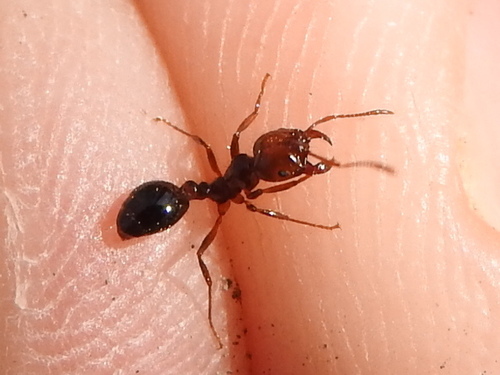
Only mildly. Workers do not sting but bite strongly with their mandibles and frequently apply formic acid to the bite, causing sharp pain, redness and local irritation. Reactions are usually local; allergic reactions are uncommon but possible. First aid: remove ants, wash area with soap and water, apply cool compress and topical antiseptic; seek medical care for severe allergic reactions or persistent symptoms.
Pets
Can bite and irritate small pets if handled or if pets disturb nests in trees; generally not life-threatening to healthy pets but may cause local pain and avoidance behaviour. Keep pets away from active nests.
📖Overview
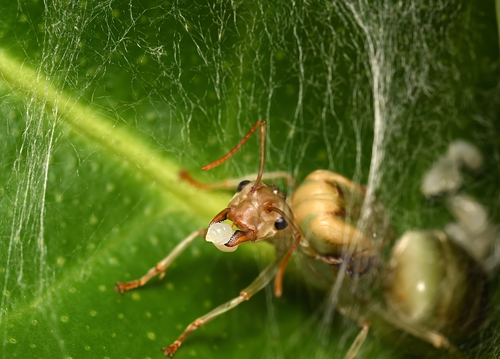
Oecophylla smaragdina is a large, highly social, arboreal ant found in tropical Asia and northern Australia. Colonies are made of multiple nests constructed by workers stitching live leaves together using silk from their larvae. These ants are predatory and territorial, hunting insects on tree foliage and tending hemipteran honeydew; they are also valued in some agricultural systems as natural pest control. Colonies can be aggressive toward intruders and deliver painful bites and topical formic acid, but they do not inject venom like stinging ants.
🔍How to identify an Asian weaver ant
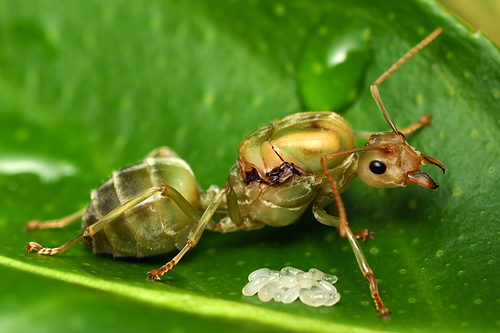
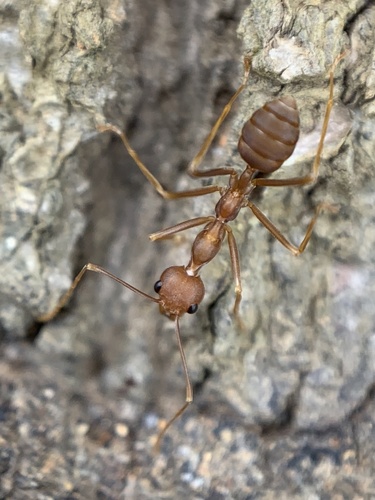
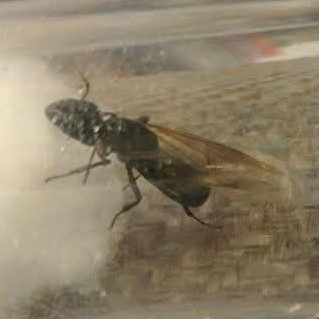
Workers are slender and long-legged with marked size polymorphism: smaller minor workers stay in the nest while larger major workers forage and defend. Workers are usually orange to reddish-brown; in Australian and some New Guinea populations the gaster (abdomen) is bright green, which gives the name green tree ant. Queens are much larger and green to brownish. The head carries strong mandibles used for biting and holding leaves during nest construction. Eyes are well developed for an arboreal lifestyle.
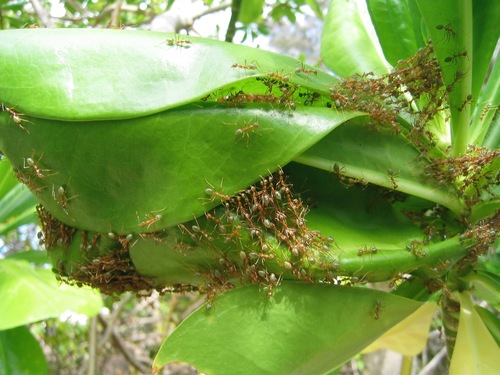
- Look for arboreal leaf nests: leaves stitched together into pouch-like nests on tree branches.
- Workers are relatively large (about 5-10 mm), slender and long-legged, usually orange to reddish-brown (green-abdomened in Australia).
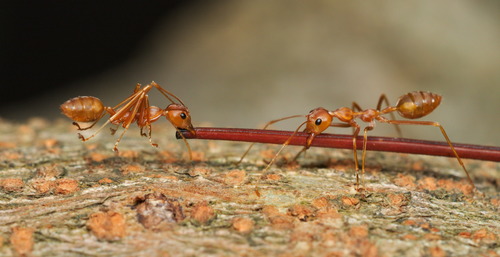
- Observe coordinated group behaviour: workers link bodies to form bridges and rapidly swarm small intruders on foliage.
- Nests built from live leaves using larval silk are diagnostic of Oecophylla species in the region.
Lookalikes
African weaver ant Oecophylla longinoda
Very similar orange-brown workers and identical leaf-weaving behaviour; Oecophylla longinoda lives in tropical Africa, so geographic range is the main way to separate them.
Spiny ants Polyrhachis spp.
Some Polyrhachis also use larval silk in their nests, but workers are usually black or golden-haired with conspicuous spines on the thorax and petiole, unlike the smooth orange weaver ant.
↻Life cycle
Egg
Queens lay small, oval eggs in the nest. Eggs are tended by workers until hatching.
Larva (grub)
Larvae are fed by workers. Notably, workers use larval silk to stitch leaves together during nest construction by bringing larvae to the leaf edge and stimulating them to produce silk.
Pupa
Pupae develop within a cocoon inside the leaf nest until metamorphosis is complete.
Adult
Adults emerge as workers, males or new queens. Workers build and maintain nests, forage and defend territory.
🍃Diet and predators
Young eat
Fed insect prey, trophic secretions from workers and regurgitated liquids; protein-rich diet from captured arthropods.
Adults eat
Predatory on live insects and other arthropods; also consume nectar, honeydew from hemipterans and other sweet secretions.
Predators of the young
Birds, predatory insects and spiders that can access nests, some ants and arboreal reptiles.
Predators of adults
Birds, arboreal lizards, larger predatory ants and some spiders; colony defence with many workers deters many predators.
🌱Effect on plants and gardens
Predatory behaviour reduces populations of herbivorous insects in trees; used as a natural pest control in crops like citrus, mango and cashew. They may protect sap-sucking insects such as scale or aphids that provide honeydew, which can indirectly harm plants.
📍Where and when to find it
Search tree canopies, branches and leaf clusters in tropical gardens, orchards and forests. Look for stitched leaf nests and active worker trails between trees; inspect flowers and fruiting branches for foraging workers.
Best time
Year-round in the tropics; best photographed during daylight when workers forage actively (morning to late afternoon).
Observation tips
Use binoculars for canopy nests; approach slowly and avoid disturbing nests to reduce aggressive swarming. For close photos, wear gloves and protective clothing and keep hands clear of branches with visible workers.
✨Fun facts
- Workers use silk produced by their own larvae as a 'sewing thread' to stitch live leaves into nests.
- Large colonies can protect entire trees from herbivores and are used as natural pest control in some traditional and modern orchards.
- Weaver ant workers cooperatively form living chains and bridges to transport nest material and tackle prey.
?Frequently asked questions
Are Asian weaver ants dangerous to humans?
Only mildly. They do not sting, but workers bite and spray formic acid into the bite, causing sharp pain and local irritation; serious reactions are rare.
Do Asian weaver ants sting?
No. Oecophylla smaragdina workers lack a functional sting; they defend themselves by biting and spraying formic acid.
Why are they in my tree or garden?
They nest in trees where they find abundant prey and honeydew-producing insects; well-structured trees and orchards provide ideal sites for nesting and foraging.
How can I get rid of weaver ants from my property?
For single nuisance nests, pruning, physically removing the nest or relocating small trees can help. In orchards where they are beneficial, avoid broad insecticide use. For persistent problems near buildings consult local pest control for humane, site-appropriate methods.
Do they help crops?
Yes. In many crops they reduce pest insect populations and have been used as an effective biological control in citrus, mango and other tree crops.
How do they build nests?
Workers pull leaf edges together and hold them while other workers bring larvae; the larvae produce silk that is applied to fasten the leaves, creating pouch-like nests.
📷Photos of the Asian weaver ant
More bees, wasps & ants
Bites and formic acid
Painful sting
Stinging insect
Can sting
Can sting
Can sting
This guide was written with AI assistance and fact-checked, last updated 2026-10-10. Identification from photos is never certain: don't handle insects you can't identify, and get medical advice for bites, stings or allergic reactions. More about the Asian weaver ant: iNaturalist, Wikipedia.