
Seven-spot ladybird vs Eyed ladybird
These two are easy to mix up. Here's how to tell a seven-spot ladybird from an eyed ladybird, and whether either one bites or stings.
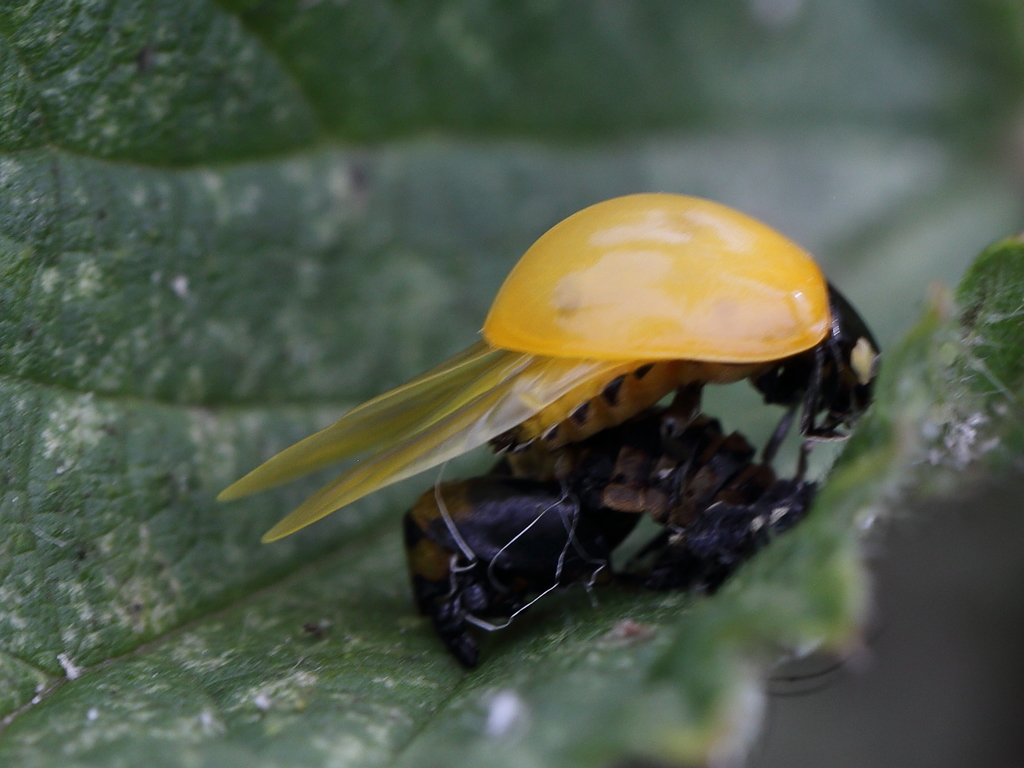
Seven-spot ladybird
Coccinella septempunctata

Eyed ladybird
Anatis ocellata
≠The key differences
Smaller on average and its black spots lack pale halo rings; different spot pattern (seven spots)
⚖︎Side by side
| Seven-spot ladybird | Eyed ladybird | |
|---|---|---|
| To humans | Non-toxic | Non-toxic |
| Size | 5-8 mm body length | 7-9 mm long |
| Colours | Red, Black, White, Dark brown | Orange-red, Black, Cream |
| Family | Coccinellidae | Coccinellidae |
| Habitat | Gardens, meadows, hedgerows, orchards, farmland and other vegetated areas with aphid presence; occasionally enters buildings to overwinter. | Coniferous and mixed forests, plantations, wooded hedgerows and occasionally gardens near trees |
| Range | Native to Europe and parts of Asia; introduced and established in North America and other regions as a biological control agent. | Northern and central Europe across Russia into Siberia and east to Japan; generally Palearctic in distribution |
| Active | Spring to autumn for feeding and breeding; adults active by day. Overwintering in autumn and winter in sheltered sites. | Spring to autumn; adults most active by day (diurnal); overwinter as adults |
| Pest? | No | No |
🔍How to spot a seven-spot ladybird
- Bright red to orange elytra with seven clear black spots (three on each elytron and one shared spot at the front of the wing covers).
- Black head and pronotum with distinct white or pale markings on the pronotum.
- Broad, dome-shaped beetle 5-8 mm long with shiny appearance.
- Larvae are dark, elongated and alligator-like with orange markings (if present on plants with aphids).
🔍How to spot an eyed ladybird
- Large, rounded ladybird 7-9 mm long (larger than many common garden ladybirds)
- Elytra orange-red with several large black spots each surrounded by a pale ring (gives the 'eyed' look)
- Pronotum with distinctive black and pale markings; overall domed shape and short antennae
- Found on conifers or nearby trees rather than low garden plants
?Frequently asked questions
What is the difference between a seven-spot ladybird and an eyed ladybird?
Smaller on average and its black spots lack pale halo rings; different spot pattern (seven spots)
Is a seven-spot ladybird or an eyed ladybird more dangerous?
Seven-spot ladybird: Non-toxic. Eyed ladybird: Non-toxic. Not dangerous. Not dangerous.
Identification from photos is never certain: don't handle insects you can't identify, and get medical advice for bites, stings or allergic reactions.