
Lovebug vs Fungus gnat
These two are easy to mix up. Here's how to tell a lovebug from a fungus gnat, and whether either one bites or stings.
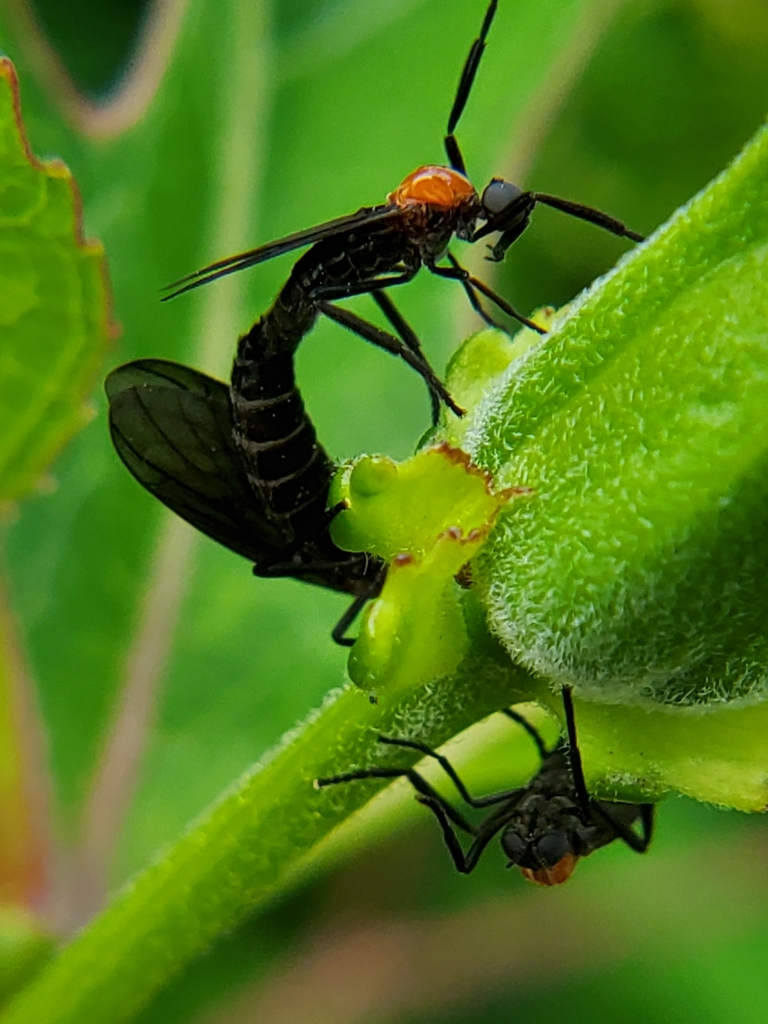
Lovebug
Plecia nearctica
Fungus gnat
Bradysia coprophila
≠The key differences
Fungus gnats are more delicate, longer-legged and not typically seen in persistent mating pairs or large daytime swarms.
⚖︎Side by side
| Lovebug | Fungus gnat | |
|---|---|---|
| To humans | Non-toxic | Non-toxic |
| Size | 6-8 mm body length (typical) | 2-4 mm long |
| Colours | Black, Red-orange, Smoky wing | Black, Dark gray, Brown |
| Family | Bibionidae | Sciaridae |
| Habitat | Moist grassy areas, roadside verges, gardens with compost or heavy leaf litter, and nearby soils where larvae develop. | Moist, organic-rich soils, potted plants, greenhouses, compost, decaying plant material |
| Range | Native to Central America; established and common in the southeastern United States and Gulf Coast states, with range expansions northward and inland in recent decades. | Cosmopolitan in temperate regions; common wherever potted plants, greenhouses or decaying organic matter provide habitat |
| Active | Two annual peaks: spring (often April-May) and late summer (often August-September) in the southeastern United States; adults fly during daylight hours. | Year-round in heated greenhouses and indoors; spring to fall outdoors in temperate regions, most active in warm, damp conditions and at dusk |
| Pest? | No | Yes |
🔍How to spot a lovebug
- Small humpbacked black fly with a distinct red-orange thorax in many individuals.
- Adults commonly seen in mating pairs glued together end-to-end while flying.
- Active in large swarms during two seasonal peaks (spring and late summer) in affected regions.
🔍How to spot a fungus gnat
- Adults are 2-4 mm long, slender, dark-bodied flies with long legs and long multi-segmented antennae.
- Larvae are white or translucent maggots with a dark head capsule, found in the top 1-3 cm of moist potting soil.
- Adults are weak fliers and often seen walking on soil or flying low in swarms near plants or lights.
- Species-level separation from other sciarids requires microscopic examination of adult genitalia; look for general sciarid morphology for field ID.
?Frequently asked questions
What is the difference between a lovebug and a fungus gnat?
Fungus gnats are more delicate, longer-legged and not typically seen in persistent mating pairs or large daytime swarms.
Is a lovebug or a fungus gnat more dangerous?
Lovebug: Non-toxic. Fungus gnat: Non-toxic. Lovebugs do not bite or sting and are not venomous. Adults do not bite or sting.
Identification from photos is never certain: don't handle insects you can't identify, and get medical advice for bites, stings or allergic reactions.