
Brown recluse vs Southern house spider
These two are easy to mix up. Here's how to tell a brown recluse from a southern house spider, and whether either one bites or stings.
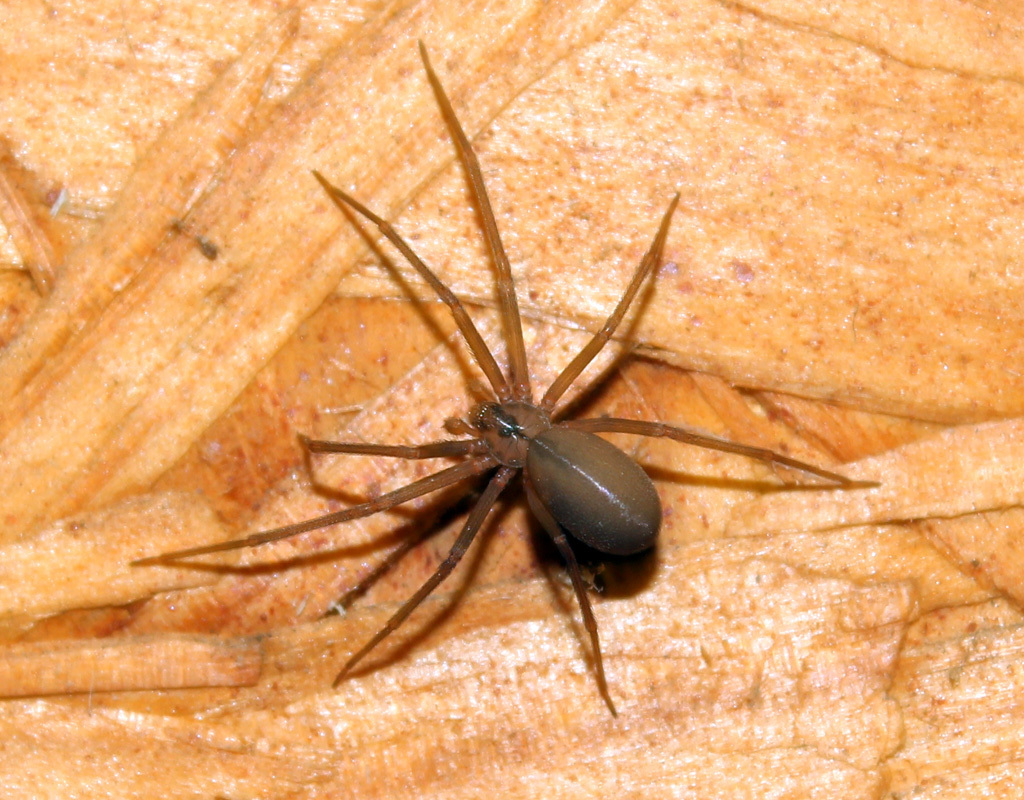
Brown recluse
Loxosceles reclusa
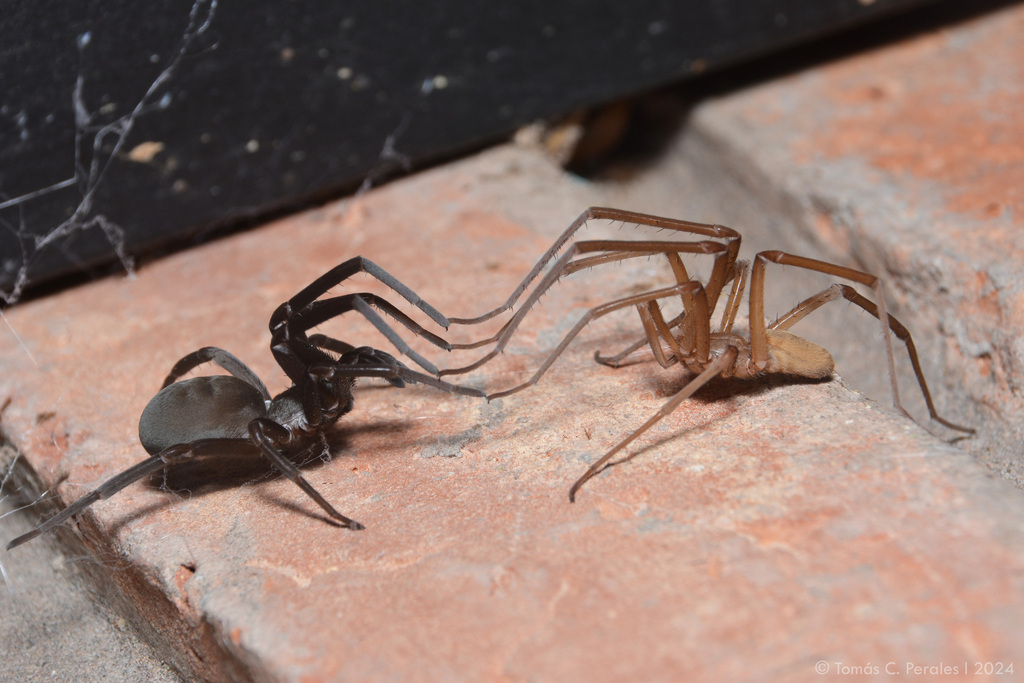
Southern house spider
Kukulcania hibernalis
≠The key differences
Tan male southern house spiders are often mistaken for brown recluses. Recluses have six eyes in three pairs and a dark violin-shaped mark on the carapace; K. hibernalis males have eight eyes clustered on a small mound, no violin mark, and long, slender pedipalps.
⚖︎Side by side
| Brown recluse | Southern house spider | |
|---|---|---|
| To humans | Venomous bite | Mild bite |
| Size | 6-12 mm body length (about 1/4 to 1/2 inch); leg span up to about 25 mm | Females 13-19 mm body length; males about 9-10 mm body length |
| Colours | Light brown, Tawny, Cream | Black, Dark brown, Light brown (male) |
| Family | Sicariidae | Filistatidae |
| Habitat | Dry, sheltered, undisturbed places around and inside buildings: closets, attics, basements, cardboard boxes, woodpiles, behind baseboards and inside shoes. | Human structures (eaves, window frames, crawl spaces), rock crevices and under bark in warm temperate to subtropical regions |
| Range | Native to the south-central and lower midwestern United States (e.g. Missouri, Kansas, Oklahoma, Arkansas, Tennessee, Kentucky) and parts of the Southeast. Not established across the entire U.S.; many reports from outside its range are misidentifications. | Southeastern and southern United States, parts of the central U.S., Mexico, Central America and Caribbean islands; associated with human buildings and warm microhabitats |
| Active | Primarily nocturnal; most active at night and during warm months (spring through fall) but can be encountered year-round indoors. | Year-round in warm climates; adult males most commonly seen roaming in late winter to spring when searching for mates, mostly at night and on warm days |
| Pest? | Yes | No |
🔍How to spot a brown recluse
- Look for a dark violin-shaped mark on the cephalothorax with the neck of the violin pointing toward the abdomen.
- Check eye arrangement: recluse spiders have six eyes arranged in three dyads (pairs) in a semicircle — most spiders have eight eyes.
- Uniformly colored legs without obvious banding and a uniformly colored abdomen help distinguish it from many harmless lookalikes.
- Size is small: body length about 6-12 mm; note that other small brown spiders may appear similar, so combine characteristics rather than relying on a single mark.
🔍How to spot a southern house spider
- Strong sexual dimorphism: chunky, dark, sedentary female with a woolly web radiating from a crevice; slender, long-legged, tan male that wanders.
- Females 13-19 mm body length and velvet-black to dark brown; males about 9-10 mm, tan to light brown with very long legs.
- Webs are irregular, woolly sheets radiating from a hole or crack, often in corners, window frames or under eaves.
- Found in cracks, window frames, behind shutters and other narrow crevices on buildings.
?Frequently asked questions
What is the difference between a brown recluse and a southern house spider?
Tan male southern house spiders are often mistaken for brown recluses. Recluses have six eyes in three pairs and a dark violin-shaped mark on the carapace; K. hibernalis males have eight eyes clustered on a small mound, no violin mark, and long, slender pedipalps.
Is a brown recluse or a southern house spider more dangerous?
Brown recluse: Venomous bite. Southern house spider: Mild bite. Bites are uncommon and usually occur when the spider is pressed against skin. Bites are rare and usually cause only minor local pain, redness or swelling.
Identification from photos is never certain: don't handle insects you can't identify, and get medical advice for bites, stings or allergic reactions.