
Common house spider vs Southern house spider
These two are easy to mix up. Here's how to tell a common house spider from a southern house spider, and whether either one bites or stings.
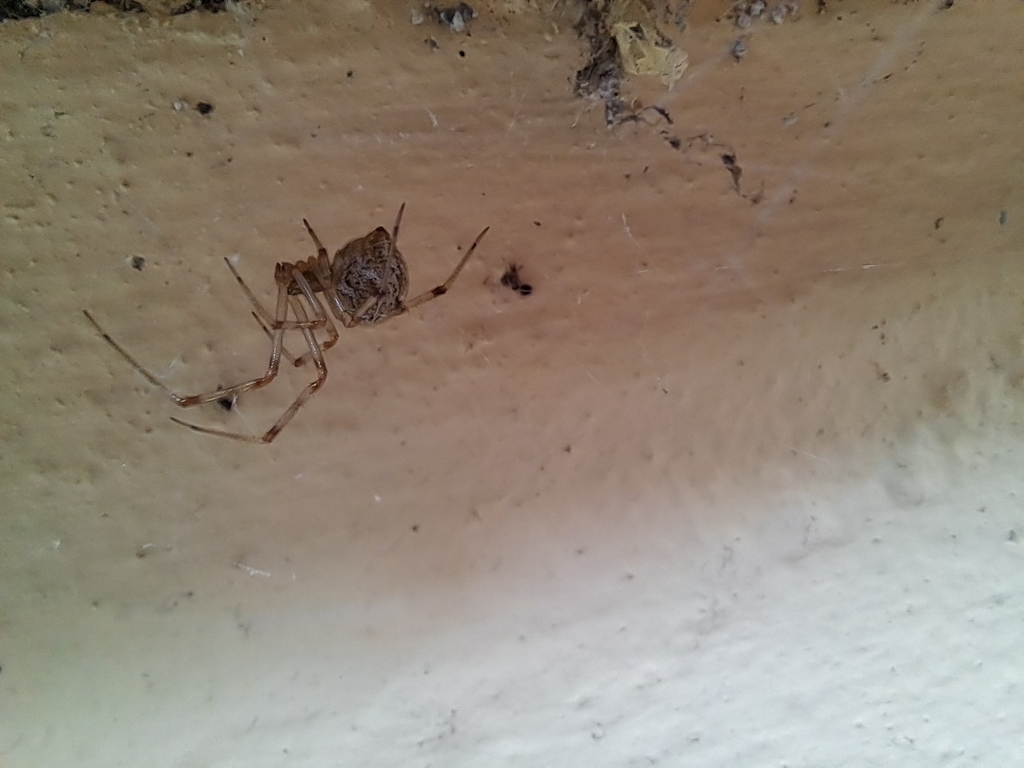
Common house spider
Parasteatoda tepidariorum
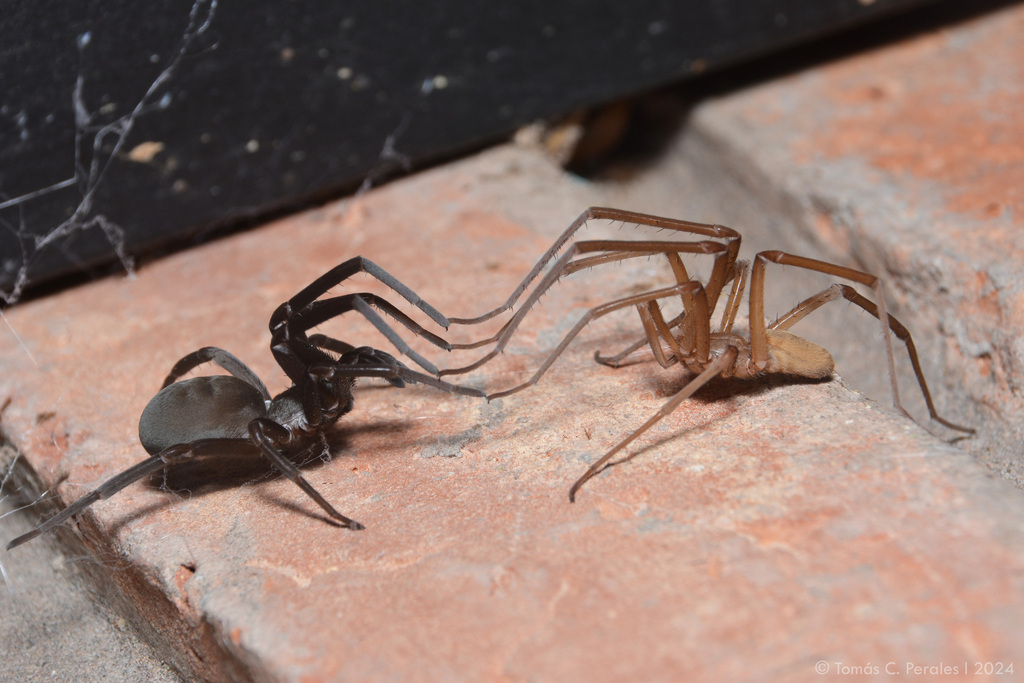
Southern house spider
Kukulcania hibernalis
≠The key differences
Parasteatoda builds rounder tangled orb-like webs and both sexes are similar in appearance; K. hibernalis females are darker and build funnel/retreat webs in crevices.
⚖︎Side by side
| Common house spider | Southern house spider | |
|---|---|---|
| To humans | Mild bite | Mild bite |
| Size | Females 5-8 mm body length; males 3-6 mm body length | Females 13-19 mm body length; males about 9-10 mm body length |
| Colours | Brown, Tan, Cream, Dark brown | Black, Dark brown, Light brown (male) |
| Family | Theridiidae | Filistatidae |
| Habitat | Sheltered indoor and peridomestic sites: corners, ceilings, basements, attics, garages, window frames, behind furniture and under eaves. | Human structures (eaves, window frames, crawl spaces), rock crevices and under bark in warm temperate to subtropical regions |
| Range | Probably native to South America but now cosmopolitan; found across North America, Europe, Asia, and other temperate regions often associated with human structures. | Southeastern and southern United States, parts of the central U.S., Mexico, Central America and Caribbean islands; associated with human buildings and warm microhabitats |
| Active | Year-round indoors; most active at night when hunting and maintaining webs. | Year-round in warm climates; adult males most commonly seen roaming in late winter to spring when searching for mates, mostly at night and on warm days |
| Pest? | No | No |
🔍How to spot a common house spider
- Irregular, three-dimensional tangled web in sheltered indoor corners with a silken retreat.
- Rounded, somewhat bulbous abdomen with variable brown/tan markings.
- Females noticeably larger and more robust than males; males slimmer with visible pedipalps.
- Shorter legs relative to long-legged house spiders; abdomen often patterned rather than uniformly black.
🔍How to spot a southern house spider
- Strong sexual dimorphism: chunky, dark, sedentary female with a woolly web radiating from a crevice; slender, long-legged, tan male that wanders.
- Females 13-19 mm body length and velvet-black to dark brown; males about 9-10 mm, tan to light brown with very long legs.
- Webs are irregular, woolly sheets radiating from a hole or crack, often in corners, window frames or under eaves.
- Found in cracks, window frames, behind shutters and other narrow crevices on buildings.
?Frequently asked questions
What is the difference between a common house spider and a southern house spider?
Parasteatoda builds rounder tangled orb-like webs and both sexes are similar in appearance; K. hibernalis females are darker and build funnel/retreat webs in crevices.
Is a common house spider or a southern house spider more dangerous?
Common house spider: Mild bite. Southern house spider: Mild bite. Bites are rare and usually occur only if the spider is trapped against skin. Bites are rare and usually cause only minor local pain, redness or swelling.
Identification from photos is never certain: don't handle insects you can't identify, and get medical advice for bites, stings or allergic reactions.