
Fall armyworm
Spodoptera frugiperda · Owlet moths
A highly destructive agricultural moth whose caterpillars (armyworms) feed on many crops and can migrate long distances.
!Is the fall armyworm dangerous?
No. Fall armyworm is not dangerous or venomous to people. Caterpillars do not bite or sting; handling may cause mild skin irritation in rare cases if there are allergens or residues of plant sap or pesticides. Wash hands after handling.
Pets
Not toxic to pets by contact. Secondary risk exists if pets consume caterpillars treated with insecticide or plant material heavily sprayed with pesticides.
📖Overview
Spodoptera frugiperda is a moth in the family Noctuidae whose larvae (called fall armyworms) are major agricultural pests. Native to the Americas, it has spread since 2016 to Africa, Asia and Australia and causes severe damage to maize, sorghum, rice, sugarcane and many other crops. Adults are nocturnal moths; the caterpillars feed gregariously when young and can strip leaves quickly when populations are high. Management relies on monitoring, biological control and integrated pest management because populations can develop resistance to insecticides.
🔍How to identify a fall armyworm
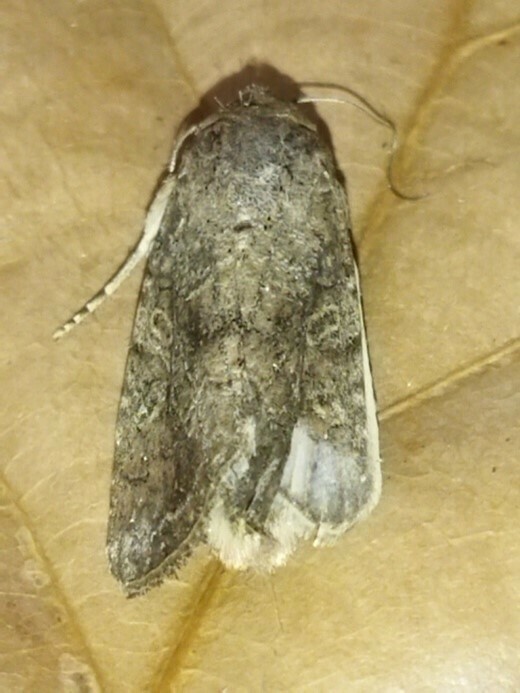
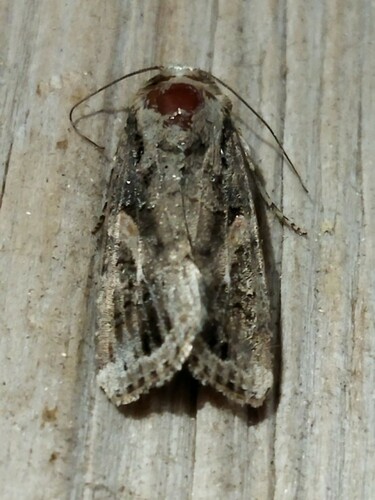
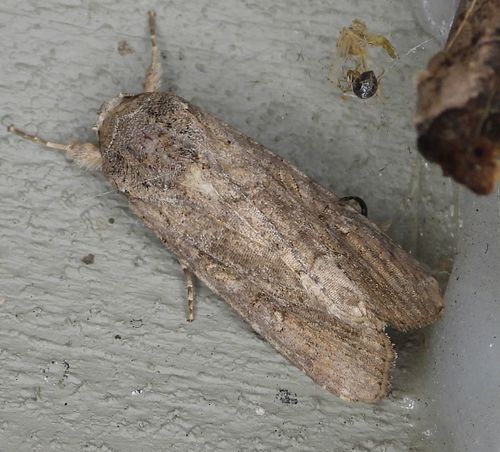
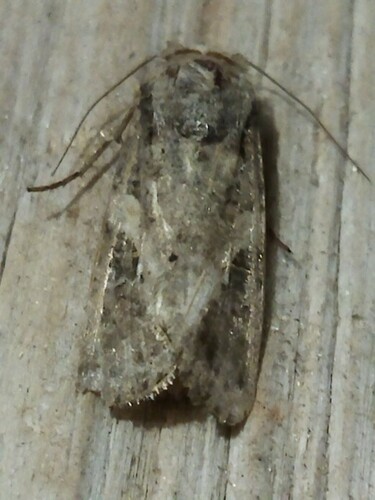
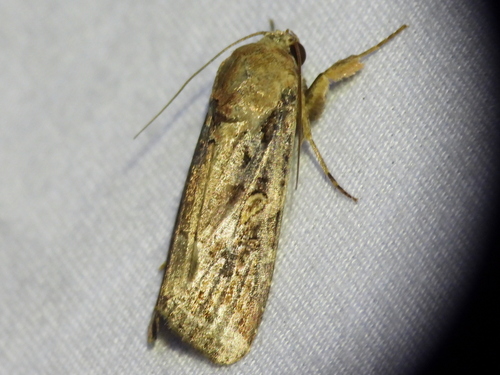
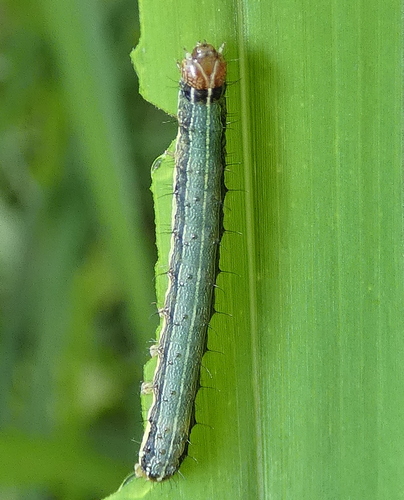
Adult moths have a wingspan of about 32-40 mm and forewings that are mottled gray-brown with a distinctive white spot near the center on the forewing of males; a kidney- or comma-shaped reniform spot may be present. Hindwings are pale with a thin dark margin. Larvae (caterpillars) go through several instars: early instars are often gregarious and darker, later instars grow up to 30-40 mm, usually green, brown or nearly black, with longitudinal stripes and a characteristic inverted 'Y' pale mark on the head capsule and four dark spots arranged in a square on the upper side of the eighth abdominal segment (near the rear end).
- Look for the inverted pale 'Y' mark on the caterpillar head — a reliable larval ID feature.
- Mature larvae have four black spots in a square on the upper side of the eighth abdominal segment, near the rear end.
- Adult moths have mottled gray-brown forewings with a pale central spot (especially in males) and pale hindwings with a thin dark margin.
- Severe, characteristic ragged feeding in maize whorls and chewed leaf edges in large numbers indicates armyworm attack.
Lookalikes
True armyworm Mythimna unipuncta
True armyworm larvae are more uniformly colored without the inverted 'Y' head mark; adults differ in wing pattern. Host range and seasonal movements also differ.
African cotton leafworm Spodoptera littoralis
Closely related Spodoptera species can look similar as adults; larval pattern differences and genitalia/larval markings are used by experts for definite ID.
↻Life cycle
Egg
Females lay clusters of 100-200 eggs, often on leaf undersides, covered with scales; eggs hatch in 2-10 days depending on temperature.
Larva (caterpillar)
Larvae pass through 6 instars over about 2-3 weeks in warm conditions; early instars feed gregariously while later instars disperse and feed more voraciously.
Pupa
Mature larvae pupate in soil or leaf litter in a loose earthen cell; pupal stage lasts about 7-14 days depending on temperature.
Adult (moth)
Nocturnal moths that fly, mate and disperse; females can produce many eggs and adults can migrate, spreading infestations.
🍃Diet and predators
Young eat
Leaves, whorls and reproductive parts of grasses and many broadleaf plants; primary hosts include maize, sorghum, rice, sugarcane and many pasture grasses.
Adults eat
Adults feed on nectar and do not cause direct crop damage.
Predators of the young
Natural enemies include parasitoid wasps and flies (Braconidae, Tachinidae), predatory beetles and bugs, spiders, birds and entomopathogenic fungi and viruses.
Predators of adults
Bats, insectivorous birds and predatory insects may take adults; adults are also prey for night-active predators.
🌱Effect on plants and gardens
Larvae feed on a very wide range of host plants but cause greatest economic damage to maize, sorghum, rice, sugarcane, millet and various grasses and vegetables. They feed on leaves, whorls and reproductive structures, and heavy infestations can cause complete defoliation.
How to get rid of fall armyworms
Use integrated pest management: monitor with pheromone traps to detect adult flights, scout fields for egg masses and early instar larvae, conserve natural enemies (parasitoid wasps, predatory insects, birds), consider biological controls (Bacillus thuringiensis products effective on young larvae), use selective insecticides only when economic thresholds are exceeded, rotate modes of action to delay resistance, and use resistant crop varieties where available. In small plantings, handpick egg masses and larvae if practical. Follow local extension service recommendations for thresholds and registered treatments.
📍Where and when to find it
Look for egg masses on undersides of leaves, young larvae in crop whorls (maize) and larger larvae on leaves. Adults can be attracted to light at night and males to pheromone traps.
Best time
Warm months and nights; in temperate areas late summer to autumn. Larvae are easiest to spot during daylight when feeding.
Observation tips
Scout fields early in the season for small larvae before they cause widespread damage, use a beating sheet or visually inspect whorls in maize, and deploy pheromone traps to detect adult flights.
✨Fun facts
- Despite the name, fall armyworm is a year-round problem in tropical regions and can migrate long distances.
- Populations have rapidly spread from the Americas to Africa, Asia and Australia since 2016, illustrating how quickly agricultural pests can become global.
- Some populations have developed resistance to multiple insecticide classes and to certain Bt toxins, making management challenging.
?Frequently asked questions
Are fall armyworms dangerous to people?
No. They do not bite or sting and are not venomous. The main concern is crop damage and economic loss.
Do fall armyworms bite?
No. Caterpillars do not bite people; they feed on plant tissue. Handle them only if necessary and wash hands afterward.
Why is fall armyworm in my field or garden?
Adults can migrate and lay eggs on suitable host plants. Populations build where there is abundant host crop or grass; warm temperatures speed development.
How can I get rid of fall armyworm on my crops?
Monitor with pheromone traps and field scouting, use biological controls (Bt products, natural enemies), apply insecticides only when thresholds are exceeded and follow integrated strategies to reduce resistance.
Can fall armyworm be controlled naturally?
Yes — parasitoids, predators, pathogens and targeted microbial insecticides (like Bt) can reduce populations. Conservation of natural enemies helps long-term control.
Has fall armyworm spread to my region?
Since 2016 it has invaded many regions outside the Americas. Check your national agricultural extension or FAO updates for current local reports.
📷Photos of the fall armyworm
More butterflies & moths
This guide was written with AI assistance and fact-checked, last updated 2026-10-10. Identification from photos is never certain: don't handle insects you can't identify, and get medical advice for bites, stings or allergic reactions. More about the fall armyworm: iNaturalist, Wikipedia.