
Pavement ant vs Odorous house ant
These two are easy to mix up. Here's how to tell a pavement ant from an odorous house ant, and whether either one bites or stings.
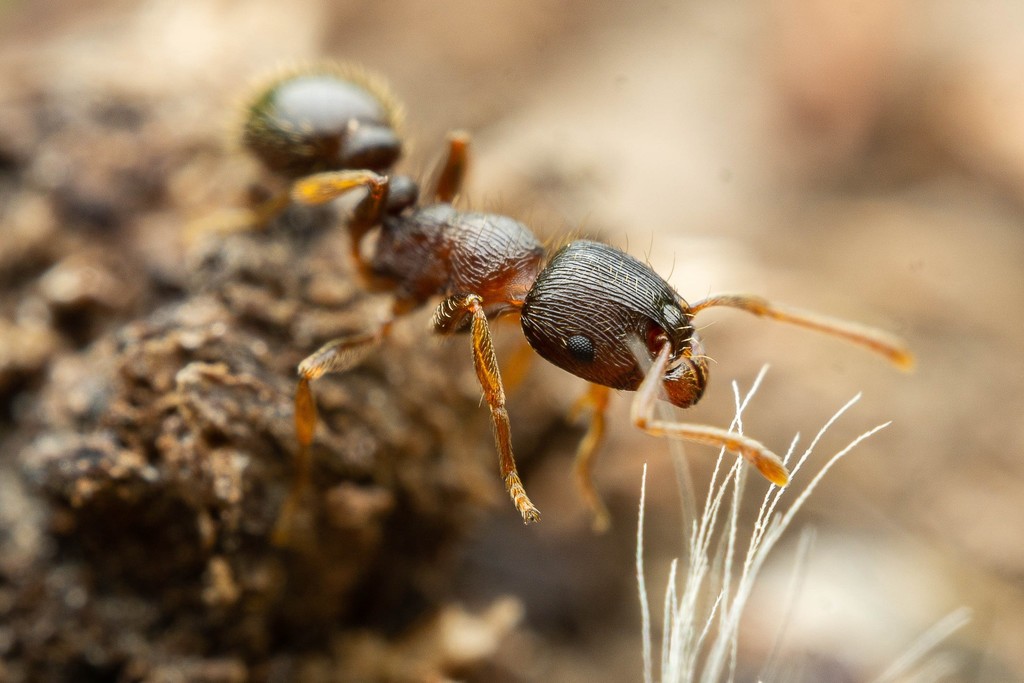
Pavement ant
Tetramorium immigrans
Odorous house ant
Tapinoma sessile
≠The key differences
Pavement ants have a visibly sculptured head and thorax and a two-segmented petiole that is apparent in profile; they do not emit the coconut odour.
⚖︎Side by side
| Pavement ant | Odorous house ant | |
|---|---|---|
| To humans | Non-toxic | Non-toxic |
| Size | Workers 2.5-4 mm; queens 6-8 mm | Workers 2.4-3.3 mm long; queens larger (about 4-5 mm) |
| Colours | Brown, Dark brown, Black | Light brown, Dark brown, Black |
| Family | Formicidae | Formicidae |
| Habitat | Urban and suburban areas: cracks in pavement and sidewalks, under stones, curbs, building foundations, lawns and occasionally inside buildings. | Urban and suburban areas, inside buildings (kitchens, wall voids), under stones, wood, mulch and in soil; tolerant of varied habitats |
| Range | Native to Europe and parts of Asia; introduced and common across North America and other temperate regions worldwide. | Native to North America and widespread across the United States and southern Canada; found in diverse habitats from forests to cities |
| Active | Spring through fall (most active during warm months); workers forage day and night depending on temperature. | Active year-round in heated buildings; outdoors mostly spring to fall and during warm parts of the day |
| Pest? | Yes | Yes |
🔍How to spot a pavement ant
- Small workers 2.5-4 mm, uniformly brown to dark brown with a slightly darker gaster.
- Two petiole nodes (two-segmented waist) and two short spines on the rear of the mesosoma.
- Head and thorax show fine parallel sculpturing; antennae with 12 segments and a 3-segmented club.
- Nests in cracks in pavement, along foundations and under stones; look for worker trails at nest entrances.
🔍How to spot an odorous house ant
- Very small workers (2.4-3.3 mm) with a smooth profile because the petiole is hidden by the gaster
- Colour variable from light brown to dark brown or black
- When crushed, workers give off a distinctive odour often described as rotten coconut, pine, or moldy cheese
- Do not have a distinct antenna club and have 12-segmented antennae
?Frequently asked questions
What is the difference between a pavement ant and an odorous house ant?
Pavement ants have a visibly sculptured head and thorax and a two-segmented petiole that is apparent in profile; they do not emit the coconut odour.
Is a pavement ant or an odorous house ant more dangerous?
Pavement ant: Non-toxic. Odorous house ant: Non-toxic. Pavement ants do not have dangerous venom. Odorous house ants do not have a sting.
Identification from photos is never certain: don't handle insects you can't identify, and get medical advice for bites, stings or allergic reactions.