
Northern giant hornet vs Asian hornet
These two are easy to mix up. Here's how to tell a northern giant hornet from an Asian hornet, and whether either one bites or stings.
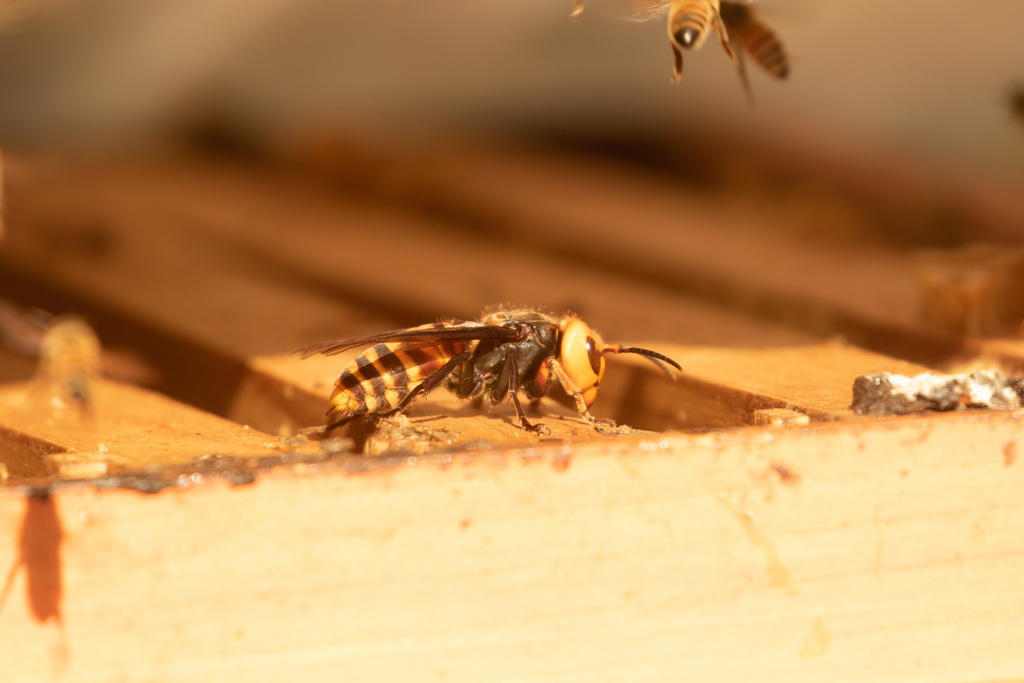
Northern giant hornet
Vespa mandarinia
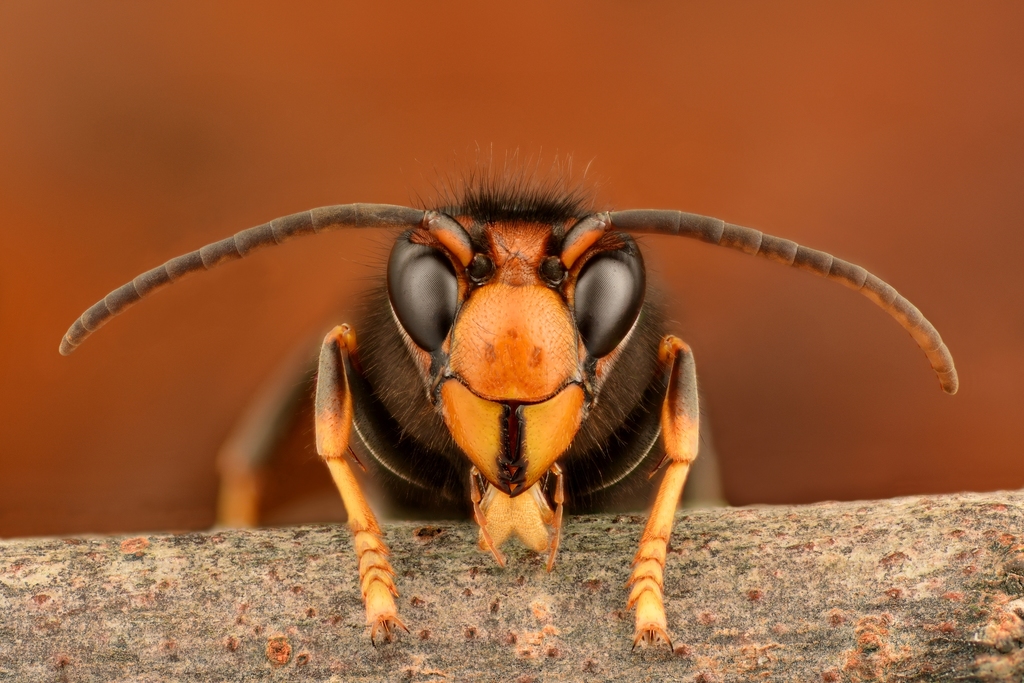
Asian hornet
Vespa velutina
≠The key differences
Smaller than Vespa mandarinia with a darker, mostly brown body and a characteristic narrow yellow band on the fourth abdominal segment.
Much larger (up to 50 mm), with a large orange head and broad yellow-orange bands on the abdomen; far bigger than V. velutina.
⚖︎Side by side
| Northern giant hornet | Asian hornet | |
|---|---|---|
| To humans | Dangerous sting | Venomous sting |
| Size | Workers 25-40 mm long; queens 40-50 mm long | Workers 20-25 mm, queens up to 30 mm |
| Colours | Orange (head), Dark brown / black (thorax and bands), Yellow / pale orange (abdominal bands), Chestnut brown (body) | Dark brown / black, Orange / reddish, Yellow, Brown wings |
| Family | Vespidae | Vespidae |
| Habitat | Forests and forest edges, rural areas; nests in underground cavities, root cavities, tree cavities, or sheltered ground holes | Woodland edges, gardens, parks; nests in trees, shrubs, roof spaces and cavities near human habitation |
| Range | Native to East Asia and parts of South and Southeast Asia (including Japan, Korea, China, Taiwan and the Russian Far East). It was detected in Washington State and British Columbia in 2019-2021; after an eradication program it was declared eradicated from the United States in December 2024. | Native to Asia (India, China, Southeast Asia). Invasive in parts of Europe (France, Spain, Portugal, Italy, UK and others), South Korea, Japan (introduced populations vary by region) and reported elsewhere via accidental transport. |
| Active | Active spring through autumn (colony peak in summer); diurnal (day-active) | Spring to autumn; workers most numerous in summer and early autumn; active during daylight hours |
| Pest? | Yes | Yes |
🔍How to spot a northern giant hornet
- Very large size: workers 25-40 mm, queens up to about 50 mm.
- Broad orange to reddish-orange head with large mandibles.
- Abdomen with alternating pale yellow/orange and dark brown/black bands.
- Habit of flying with a powerful, buzzing flight and often seen hunting around hive entrances or tearing prey.
🔍How to spot an Asian hornet
- Workers 20-25 mm long, dark velvety thorax and mostly dark abdomen with a thin yellow band at the front and one broad yellow-orange band near the rear.
- Legs noticeably yellowish (visible in flight) — 'yellow-legged hornet'.
- Smaller and darker than the European hornet (Vespa crabro); face and lower abdomen have orange hues.
?Frequently asked questions
What is the difference between a northern giant hornet and an Asian hornet?
Smaller than Vespa mandarinia with a darker, mostly brown body and a characteristic narrow yellow band on the fourth abdominal segment. Much larger (up to 50 mm), with a large orange head and broad yellow-orange bands on the abdomen; far bigger than V. velutina.
Is a northern giant hornet or an Asian hornet more dangerous?
Northern giant hornet: Dangerous sting. Asian hornet: Venomous sting. Stings are very painful and can inject a significant volume of venom. Stings are painful and can cause local swelling.
Identification from photos is never certain: don't handle insects you can't identify, and get medical advice for bites, stings or allergic reactions.