
American giant millipede vs Giant African millipede
These two are easy to mix up. Here's how to tell an American giant millipede from a giant African millipede, and whether either one bites or stings.
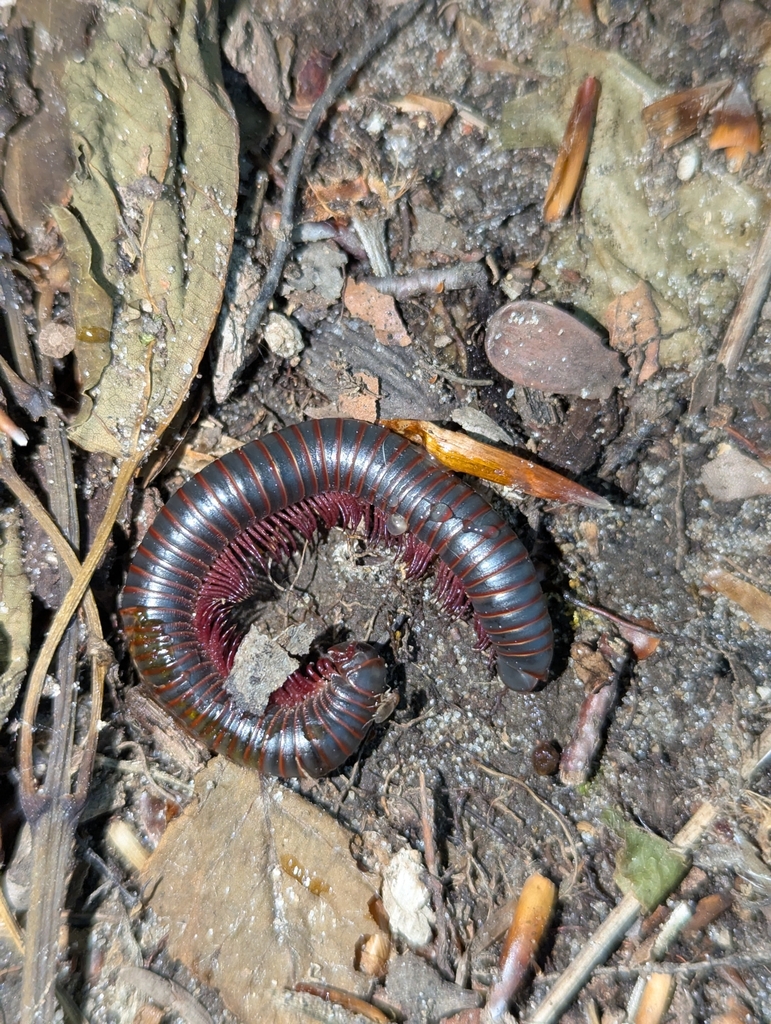
American giant millipede
Narceus americanus

Giant African millipede
Archispirostreptus gigas
≠The key differences
Also a dark, round-backed millipede that coils when disturbed, but much smaller (up to about 10 cm), often with reddish edges to the segments, and native to eastern North America.
⚖︎Side by side
| American giant millipede | Giant African millipede | |
|---|---|---|
| To humans | Irritating secretion | Irritant secretions |
| Size | 5-10 cm (50-100 mm) long | 20-38 cm long (200-380 mm), sometimes reported slightly larger in captivity |
| Colours | Dark brown, Reddish brown, Cream, Black | Dark brown, Black, Reddish brown |
| Family | Spirobolidae | Spirostreptidae |
| Habitat | Moist terrestrial habitats: leaf litter, rotting logs, under stones, compost piles, and garden mulch; also inside basements and crawl spaces when moist | Tropical and subtropical forests, woodlands and savanna margins; ground layer under leaf litter, logs and stones |
| Range | Eastern and central North America, from the northeastern United States through the southeastern states; reports extend into parts of the Midwest and southern Canada | Native to East Africa (including Tanzania, Mozambique and surrounding regions); distributed more widely by the pet trade and accidental transport |
| Active | Mostly nocturnal and active in warm, wet seasons; activity peaks in spring through fall in temperate regions | Mostly nocturnal and crepuscular; active year-round in suitable climates |
| Pest? | No | No |
🔍How to spot an American giant millipede
- Large cylindrical body with many segments, each segment bearing two pairs of legs
- Often 5-10 cm long and coils into a tight spiral when disturbed
- Alternating darker dorsal coloration with lighter margins or subtle banding on segments
- Short bead-like antennae and numerous short legs visible from the sides
🔍How to spot a giant African millipede
- Very large cylindrical body up to about 20-38 cm long with many segments.
- Each body segment bears two pairs of legs, producing a dense, banded-looking underside.
- Glossy dark brown to black or reddish-brown dorsal plates; curls into a tight spiral when disturbed.
- Slower moving than centipedes and lacks the flattened, fast-bodied appearance and visible long legs of centipedes.
?Frequently asked questions
What is the difference between an American giant millipede and a giant African millipede?
Also a dark, round-backed millipede that coils when disturbed, but much smaller (up to about 10 cm), often with reddish edges to the segments, and native to eastern North America.
Is an American giant millipede or a giant African millipede more dangerous?
American giant millipede: Irritating secretion. Giant African millipede: Irritant secretions. Not venomous or aggressive. Not venomous and do not bite as a defense.
Identification from photos is never certain: don't handle insects you can't identify, and get medical advice for bites, stings or allergic reactions.