
Common green lacewing
Chrysoperla carnea · Green lacewings
Delicate green predatory insects whose larvae eat aphids and other soft-bodied pests, widely used in biological control.
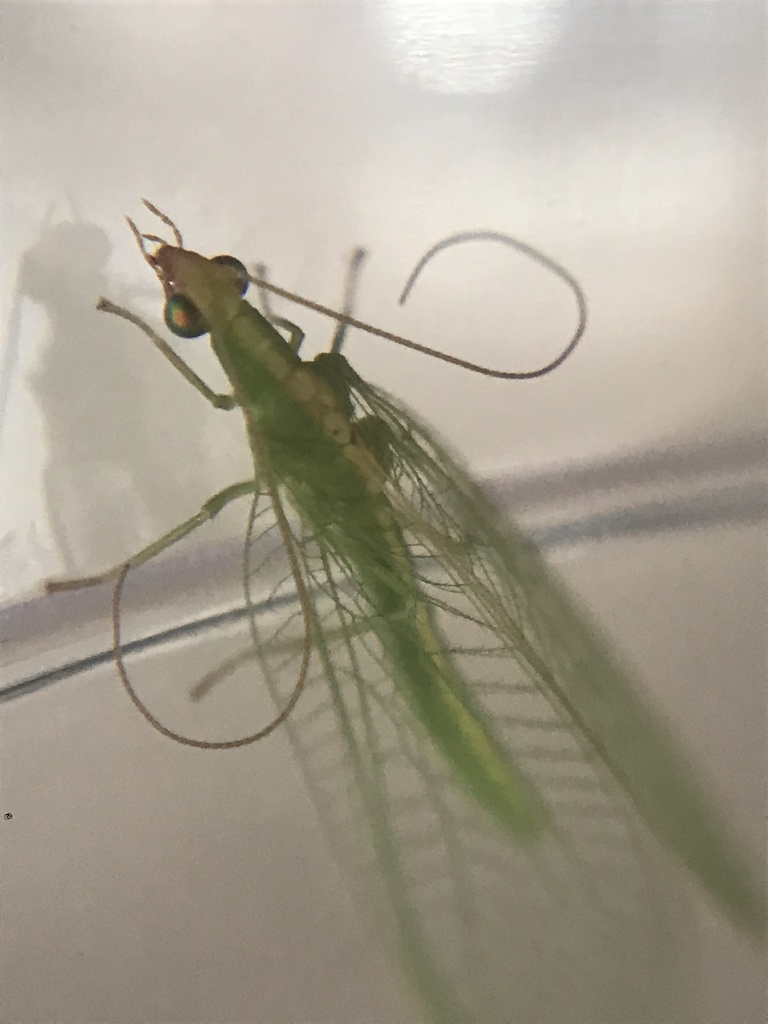
!Is the common green lacewing dangerous?
No. Not dangerous. Adults do not sting or inject venom. Larvae are predatory and can give a minor pinch if handled, but bites are rare and not medically significant. No known disease transmission.
Pets
Harmless to cats and dogs. Larvae may nip if handled but will not harm larger pets.
📖Overview
Chrysoperla carnea is a small, delicate green lacewing found across much of Europe and temperate regions; it belongs to a group of closely related lacewing species often referred to as the C. carnea complex. Adults are fragile, long-winged insects that visit flowers for nectar and pollen and are attracted to lights. The larvae are active predators — called "aphid lions" — that feed on aphids, mites, whiteflies and insect eggs and are valued in gardens and greenhouses for biological pest control. The species is most common in warm months and is not harmful to people or structures.
🔍How to identify a common green lacewing
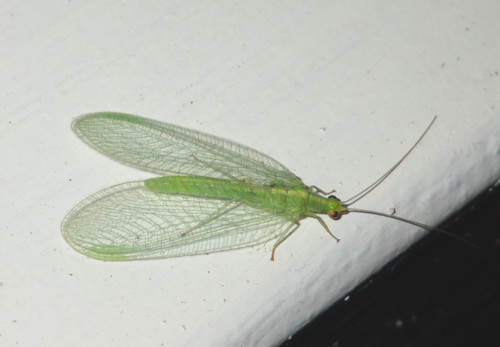
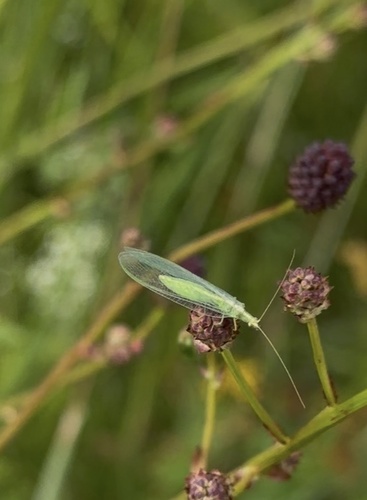
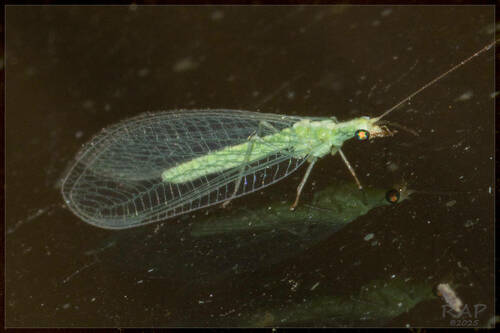
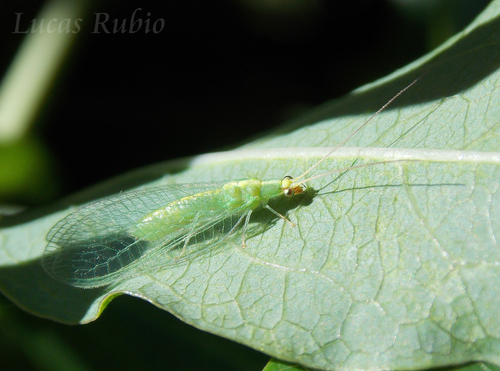
Adults are slender, pale green insects with long, narrow, net-veined (lacy) wings held roof-like over the body. The eyes are often golden or coppery. Body length of adults is small and delicate; wings may extend well beyond the abdomen. Larvae are elongated, slightly flattened, tapered at both ends, and bristly; Chrysoperla larvae do not carry debris, unlike the trash-carrying larvae of some other lacewings; they look like tiny alligators and are active hunters. Eggs are laid singly on long thin stalks to reduce predation.
- Delicate, bright leaf-green body with long, narrow transparent wings showing a net-like venation.
- Golden or coppery eyes are conspicuous in many individuals when viewed close-up.
- Eggs on long slender stalks and 'alligator-like' predatory larvae distinguish their life cycle from many other insects.
- Adults are attracted to lights at night and are fragile; wings held roof-like over the body when resting.
Lookalikes
Other Chrysoperla species (C. lucasina, C. agilis) Chrysoperla lucasina, Chrysoperla agilis
Very similar in appearance as many belong to the C. carnea species group; differences are usually confirmed by song (vibrational signals) or genetic analysis rather than simple visual marks.
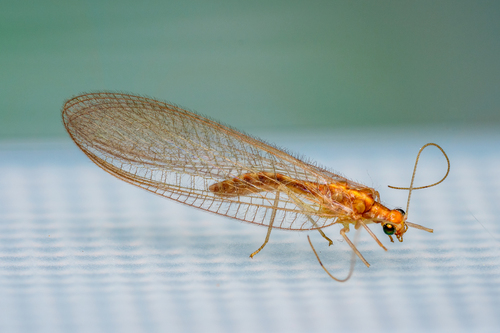
Brown lacewing Hemerobiidae (various species)
Brown lacewings are smaller, brown or tan rather than green, and have different wing venation and habits.
↻Life cycle
Egg
Laid singly at the end of a thin stalk attached to leaves or stems; stalked eggs reduce predation by predators and cannibalism.
Larva (aphid lion)
Active, elongated predatory stage that hunts aphids and other small insects; Chrysoperla larvae are "naked" and do not carry debris on their backs.
Pupa
Pupal stage occurs in a silken cocoon attached to vegetation; metamorphosis into the adult takes place inside the cocoon over several days to weeks.
Adult (lacewing)
Delicate, net-winged adult that feeds on nectar, pollen and honeydew and disperses to find mates and oviposition sites.
🍃Diet and predators
Young eat
Predatory: aphids, thrips, whiteflies, mite eggs, insect eggs and other soft-bodied arthropods.
Adults eat
Nectar, pollen and honeydew; unlike the larvae, Chrysoperla adults are not predators.
Predators of the young
Parasitoid wasps, ants, spiders, predatory beetles and birds may eat larvae.
Predators of adults
Bats, night-flying insectivorous birds, spiders, and predatory insects.
🌱Effect on plants and gardens
Larvae feed on aphids, thrips, whiteflies, small caterpillars and insect eggs, helping reduce pest populations on many garden and crop plants. Adults feed mainly on nectar, pollen and honeydew and do not hunt prey.
📍Where and when to find it
Adults on flowers, leaves and near lights; eggs on underside of leaves on thin stalks; larvae active on infested plants hunting aphids and other pests.
Best time
Spring through early autumn; best observed at dusk and night for adults, and during the day when inspecting plants for larvae among foliage.
Observation tips
Look on flowering plants and undersides of leaves for stalked eggs. To photograph, use a macro lens and a low shutter speed with a gentle flash; approach slowly to avoid startling the fragile adults.
✨Fun facts
- Larvae are nicknamed 'aphid lions' because they are fierce predators of aphids.
- Some Chrysoperla species communicate by substrate-borne vibrations (songs) rather than visual displays.
- They are widely used in biological control: millions of lacewings are mass-reared and released in greenhouses to control pests.
?Frequently asked questions
Are common green lacewings harmful to people?
No. They are harmless to people, do not sting or spread disease. Larvae can nip if handled, but bites are rare and not medically significant.
Do green lacewings bite or sting?
Adults do not bite or sting. Larvae are predatory and can give a minor pinch if grabbed, but they are not dangerous.
Why are lacewings in my house at night?
Adults are attracted to artificial lights at dusk and night and may enter houses through open windows or doors, especially in summer.
How can I get rid of lacewings in my home?
They are beneficial, so gently capture and release them outdoors. To reduce indoor visits, turn off unnecessary lights at night and seal gaps around windows and doors.
Are lacewings good for my garden?
Yes. Larvae feed on common plant pests like aphids and thrips and are valuable for natural pest control in gardens and greenhouses.
📷Photos of the common green lacewing
More other creepy crawlies
This guide was written with AI assistance and fact-checked, last updated 2026-10-09. Identification from photos is never certain: don't handle insects you can't identify, and get medical advice for bites, stings or allergic reactions.