
Velvet mite
Trombidium holosericeum · Velvet mites
A bright red, soft-bodied mite found on soil, leaf litter and flowers in spring; adults are free-living predators, larvae temporarily parasitize insects.
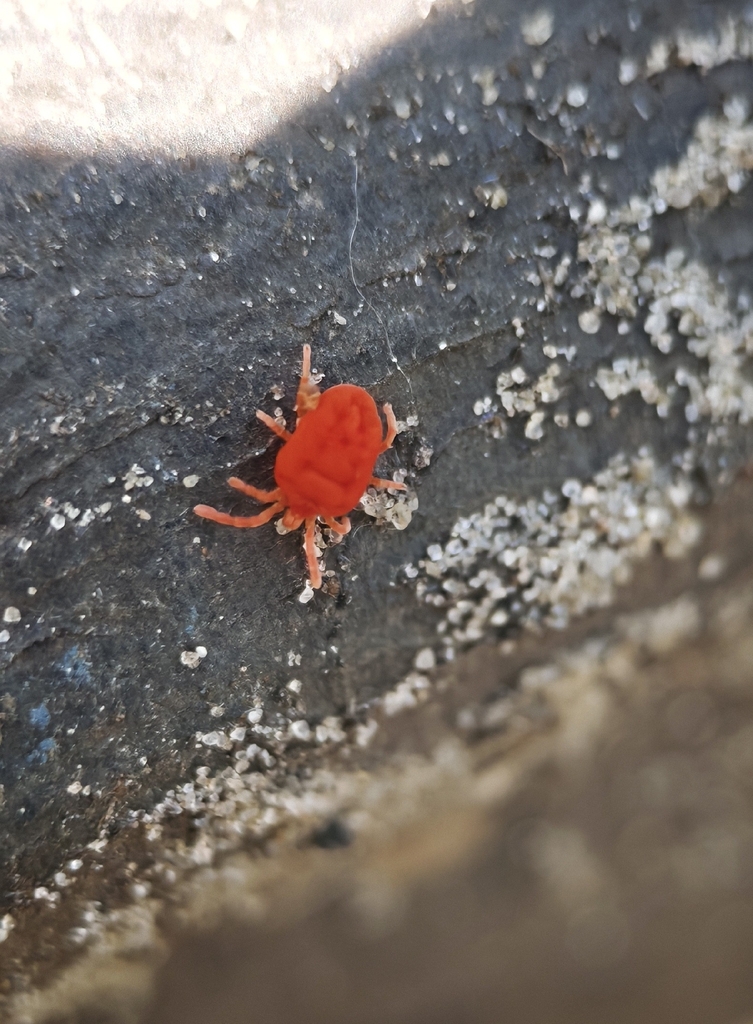
!Is the velvet mite dangerous?
No. Adults do not bite people and are non-venomous. Larvae sometimes attach to insects and very rarely to larger animals; such attachments are temporary and not dangerous. If a larva were to cling to skin it may cause minor irritation but serious reactions are not reported. Clean with soap and water if skin contact occurs.
Pets
Generally harmless. Adults are too small to harm pets. Larval parasitism targets insects and is not a veterinary concern.
📖Overview
Trombidium holosericeum is a conspicuous, bright red mite commonly seen in spring on soil, leaf litter and vegetation. Adults are free-living predators that hunt tiny arthropods and eggs, while the tiny six-legged larvae often attach briefly to insects as temporary parasites. They prefer moist habitats and become active on warm, sunny days after rains.
This species is well known in Europe and parts of Asia. Adults are soft-bodied and covered in fine hairs that give them a velvety appearance and the common name "velvet mite." They are not dangerous to people or pets, and their striking red colour makes them easy to spot during their active season.
🔍How to identify a velvet mite
Adults are round to oval, compact mites with a dense covering of fine setae that produces a velvety texture. The body is a vivid red to orange-red. Legs are relatively short and stout compared with some other mite groups. Larvae are tiny (sub-millimetre), pale to orangish, and have only six legs (typical of parasitic mite larvae), while nymphs show intermediate features and eight legs.
- Bright, velvety red to orange-red body, round to oval and soft-bodied.
- Adults about 2-4 mm long and covered with dense fine hairs giving a plush texture.
- Larvae are tiny (sub-millimetre) and have only six legs; nymphs and adults have eight legs.
- Typically found on soil, leaf litter, low vegetation or flowers in spring after wet weather.
Lookalikes
Clover mite Bryobia praetiosa
Clover mites are much smaller (under 1 mm), reddish-brown, not velvety, and often swarm on sunny walls and windowsills; they feed on plants rather than hunting.
Velvet mite (other Trombidium species) Various Trombidium spp.
Many Trombidium species look similar; precise identification often requires microscopic examination of body setae and genital structures.
Red wall mite Balaustium murorum
Red wall mites are smaller (about 1-2 mm), fast-running and common on walls and paving in spring; they lack the plush, velvety appearance of adult velvet mites.
↻Life cycle
Egg
Laid in batches in soil or litter; eggs develop into larvae in suitable conditions.
Larva (parasitic)
Six-legged larva that seeks out a host (typically insect or other arthropod) and attaches temporarily to feed before dropping off to continue development.
Nymph
Several nymphal stages follow the larval stage; nymphs are eight-legged and progressively resemble adults while becoming free-living predators.
Adult
Eight-legged, bright red, free-living predatory mite that feeds on small arthropods and eggs.
🍃Diet and predators
Young eat
Larvae are temporary ectoparasites of insects and other arthropods.
Adults eat
Predatory on tiny arthropods, insect eggs and small invertebrates; adults do not feed on plants.
Predators of the young
Small predatory insects, other mites and soil predators.
Predators of adults
Birds, ground beetles, spiders and larger predatory arthropods.
🌱Effect on plants and gardens
Adults prey on tiny arthropods and eggs and do not eat plants; they do not damage crops or gardens and may help control small pest insects.
📍Where and when to find it
Look on soil surfaces, leaf litter, low vegetation and flowers after rain; adults are conspicuous on bare soil patches and garden beds. Larvae are tiny and found on or attached to insect hosts.
Best time
Spring and early summer on warm, sunny days after rain; daytime activity is most common.
Observation tips
Use a hand lens or macro lens for photography. Wear gloves when searching in dense litter if you have sensitive skin. Photograph against contrasting backgrounds to show the bright red colour.
✨Fun facts
- The dense fine hairs on their body give them a velvety appearance and the common name "velvet mite."
- Adults are active and easy to spot after spring rains when they emerge on soil and vegetation.
- Larvae can be parasitic on insects but the adult stage is a beneficial predator of small arthropods.
?Frequently asked questions
Are velvet mites dangerous to humans?
No. Adults do not bite or sting people and are non-venomous. Larvae rarely attach to larger animals and are not dangerous.
Do velvet mites bite or sting?
Adults do not bite or sting. Larvae are parasitic on insects and only very rarely attach to mammals; such events are uncommon and usually cause little or no harm.
Why are velvet mites in my garden or house?
They appear in gardens after rains because moist conditions bring out adults searching for prey. They are generally outdoor soil and litter dwellers; finding one indoors usually means it was accidentally brought in on plant material.
How can I get rid of velvet mites?
Control is usually unnecessary because they are harmless and beneficial predators. To reduce numbers, reduce excessive moisture, remove dense leaf litter or move potted plants indoors when wet. Insecticide use is not recommended for routine control.
Where does Trombidium holosericeum live?
In soil, leaf litter, moss, under stones and on low vegetation in moist, disturbed or grassy habitats across parts of Europe and Asia; active mainly in spring.
More mites & chiggers
This guide was written with AI assistance and fact-checked, last updated 2026-10-10. Identification from photos is never certain: don't handle insects you can't identify, and get medical advice for bites, stings or allergic reactions. More about the velvet mite: iNaturalist, Wikipedia.