
Two-striped walkingstick
Anisomorpha buprestoides · Walkingsticks
A stout, flightless stick insect from the southeastern United States that bears bold dark longitudinal stripes and sprays an irritating defensive secretion.
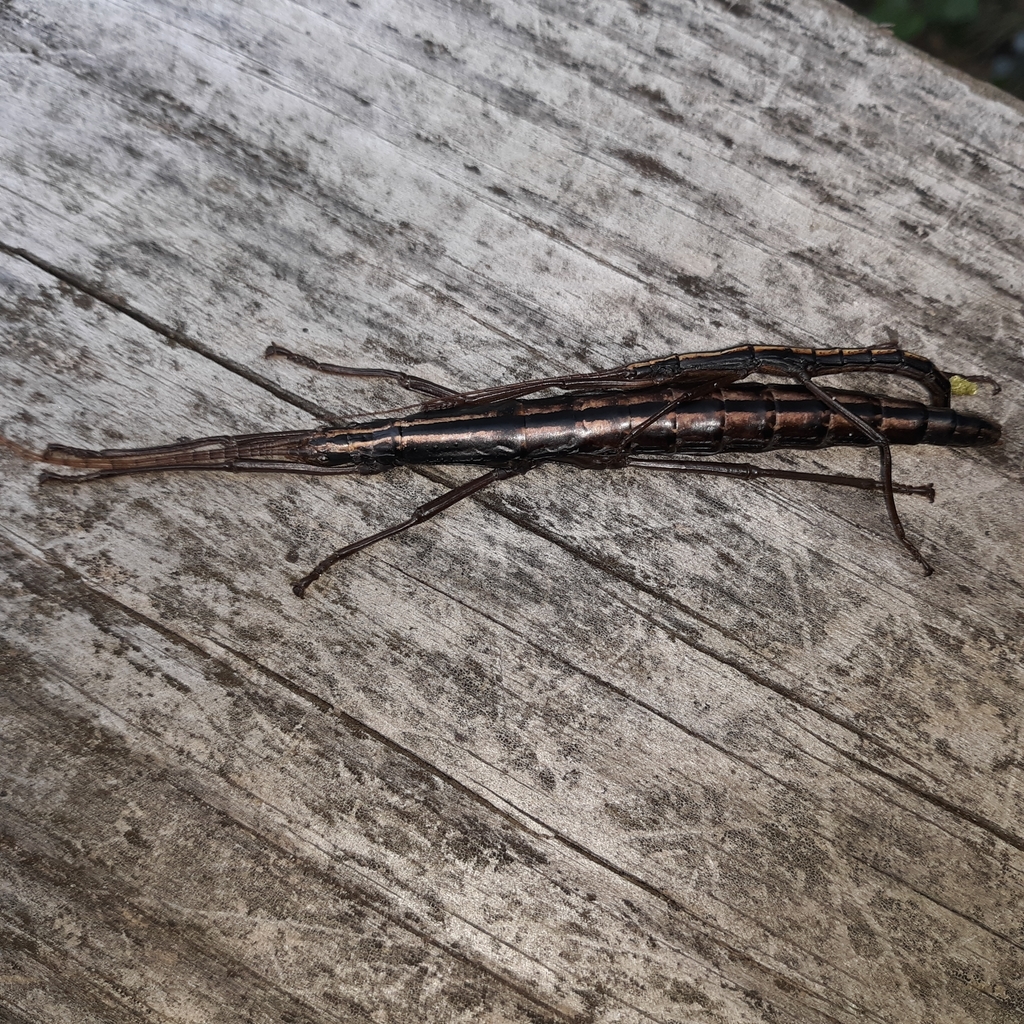
!Is the two-striped walkingstick dangerous?
Only mildly. Not venomous and does not bite or sting. Adults can eject a milky defensive secretion that may cause burning, itching, or intense watering of the eyes and, in some cases, temporary blurred vision. If sprayed in the eyes, rinse immediately with clean water for at least 15 minutes and see a doctor, as the spray can injure the cornea; get prompt care if pain, redness or vision problems continue.
Pets
The spray can irritate pets' eyes and mucous membranes, and dogs that harass these insects have suffered painful eye injuries such as corneal ulcers. Keep pets away from them, rinse an affected eye gently with water, and see a veterinarian if the pet squints, paws at the eye or the eye stays red.
📖Overview
Anisomorpha buprestoides is a medium-sized stick insect native to the southeastern United States and nearby regions. It is relatively robust compared with many long, twig-like phasmids and is best known for the dark longitudinal stripes that run along the body. When threatened it can eject a defensive milky secretion from glands on the thorax that may irritate skin and eyes. Adults are herbivores, active at night, and are most often found on shrubs and small trees.
This species is not aggressive toward people and does not bite or sting, but its chemical defence can cause temporary eye injury and strong irritation if sprayed into the face. It is not a major agricultural pest and usually occurs at low densities in wildland and suburban vegetation.
🔍How to identify a two-striped walkingstick
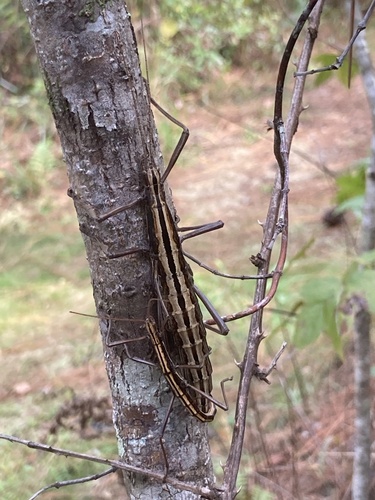
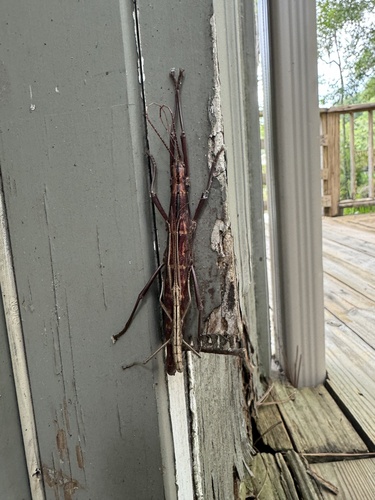
Adults are relatively short and stout for stick insects, with a thick cylindrical body and short legs compared with the very slender stick species. Most adults are tan to brown with bold black longitudinal stripes running along the back from the head to the tip of the abdomen; local color forms with white, orange or pale stripes on a black body also occur. Females are larger and more robust than males. Nymphs resemble small wingless adults and retain the striped pattern in many populations.
- Stout, cylindrical stick insect 40-70 mm long rather than extremely slender
- Bold dark longitudinal stripes along the back (pale-striped color forms occur locally)
- Robust short legs and lack of well-developed wings
- If disturbed, may curve body and spray a milky defensive secretion from thoracic glands
Lookalikes
Common walkingstick Diapheromera femorata
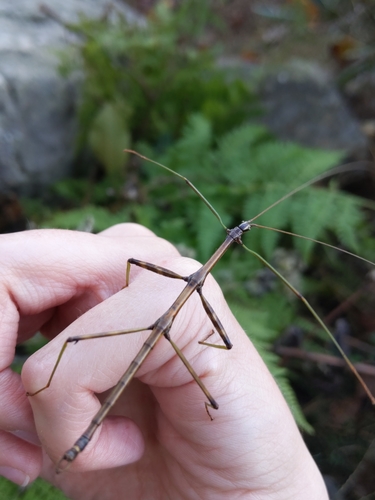
Diapheromera femorata is longer and much more slender with no prominent paired dorsal stripes and lacks the same defensive spray behavior noted for Anisomorpha.
Northern two-striped walkingstick Anisomorpha ferruginea
A close relative from further north and west in the southeastern US with a similar stout, striped body and defensive spray; it is usually browner with less contrasting stripes.
↻Life cycle
Egg
Females drop or deposit hard, seed-like eggs on the ground or low vegetation; eggs may have a hard casing and can overwinter in cooler areas.
Nymph (juvenile)
Nymphs hatch looking like small wingless adults and go through multiple molts, gradually increasing in size and developing adult markings.
Adult
Adults are wingless or nearly wingless and reproduce after the final molt. They use chemical defenses when threatened.
🍃Diet and predators
Young eat
Leaves of the same host shrubs and trees eaten by adults
Adults eat
Folivorous on a range of woody plants and shrubs; specific hosts vary regionally
Predators of the young
Birds, small mammals, spiders and predatory insects
Predators of adults
Birds and small mammals; the chemical spray deters many would-be predators
🌱Effect on plants and gardens
Feeds on the leaves of a variety of woody shrubs and small trees. At natural densities it rarely causes significant damage to gardens or crops.
📍Where and when to find it
Look on the leaves and branches of shrubs and small trees at night; eggs are found on the ground or attached to leaf litter.
Best time
Warm months (spring through early autumn); nocturnal so evenings and night are best for finding active adults.
Observation tips
Search quietly at night with a flashlight held to the side (not shining directly into their eyes). Wear gloves and eye protection when handling and avoid provoking them to prevent being sprayed in the face.
✨Fun facts
- When threatened, it can aim a defensive spray toward the attacker and sometimes toward the face of a human observer.
- Its eggs often resemble seeds and may be scattered on the ground, which helps them avoid detection by predators.
- The spray is a highly effective deterrent against predators such as birds and ants.
?Frequently asked questions
Do two-striped walkingsticks bite?
No. They do not bite or sting. Their main defence is a chemical spray that can irritate skin and eyes.
Is the spray dangerous to humans?
The spray is irritating and can cause painful eye irritation and temporary blurred vision if it gets into the eyes. Rinse thoroughly with water for at least 15 minutes and see a doctor if it gets into the eyes.
Why is this walkingstick in my house or yard?
They live on shrubs and small trees and may be found in yards with suitable host plants. Juveniles or eggs can be moved on plant material or enter buildings accidentally.
How can I remove or get rid of them?
Move them with gloves and eye protection, relocating them away from the house. Reducing dense shrubs and moving preferred host plants away from house foundations makes your yard less attractive. Chemical control is rarely necessary because populations are usually low.
Where does the two-striped walkingstick live?
It is native to the southeastern United States and nearby regions, inhabiting shrubby woodland edges, gardens and understory vegetation.
📷Photos of the two-striped walkingstick
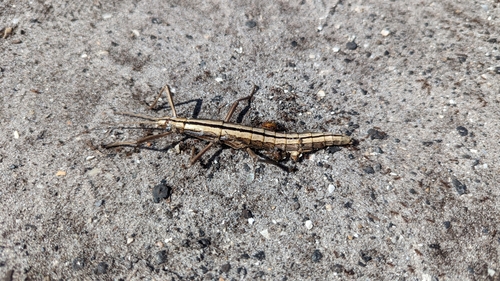
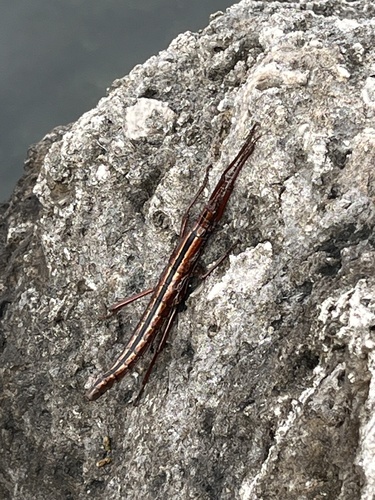
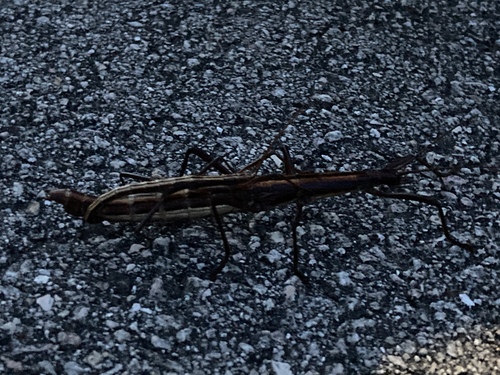
More stick & leaf insects
This guide was written with AI assistance and fact-checked, last updated 2026-10-10. Identification from photos is never certain: don't handle insects you can't identify, and get medical advice for bites, stings or allergic reactions. More about the two-striped walkingstick: iNaturalist, Wikipedia.