
Common shiny woodlouse
Oniscus asellus · Woodlice
A small, smooth, grey-brown terrestrial isopod that lives in damp places and helps break down dead plant material.

!Is the common shiny woodlouse dangerous?
No. Harmless to people. They have no venom and cannot meaningfully bite people. Wash hands after handling to avoid transferring dirt or microbes.
Pets
Not poisonous to pets. Pets may eat woodlice without harm in most cases, although large quantities could cause mild digestive upset. Some amphibians and small reptiles feed on them.
📖Overview
Oniscus asellus is a widespread terrestrial isopod (often called a woodlouse) common in gardens, leaf litter, under logs and inside damp buildings. It is a detritivore that feeds on decaying plant material and fungi and plays a useful role in nutrient recycling. It prefers moist, shaded microhabitats and is most active at night or after rain. Native to Europe, it has been introduced to many other temperate regions worldwide.
🔍How to identify a common shiny woodlouse
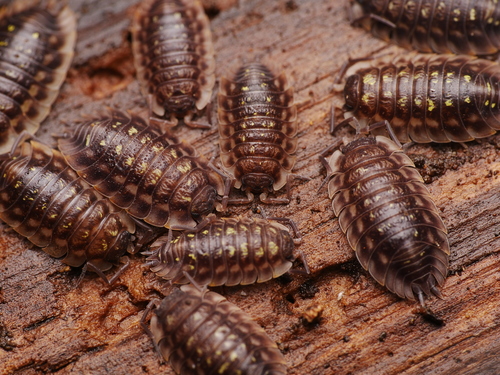
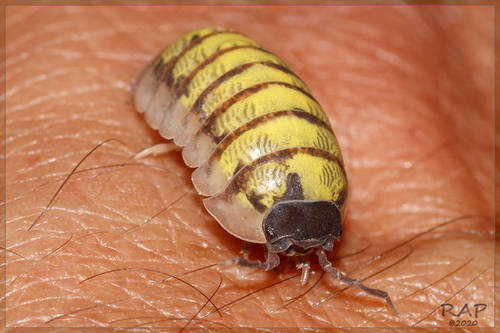
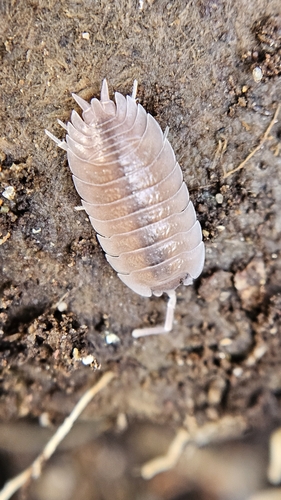
Adults are oval, flattened, and slightly convex, with smooth, shiny dorsal plates (pereonites) and clearly segmented body rings. Color ranges from mid grey to brown with lighter edges on segment sutures; legs and antennae are pale. Unlike roly-poly woodlice (Armadillidium spp.), O. asellus cannot roll into a tight ball. Adults typically show 7 visible pereon segments and a tail-like uropod pair at the rear.
- Smooth, shiny dorsal plates and overall glossy appearance compared with rougher-bodied species
- Size 8-15 mm, flattened oval body with 7 visible segments and rear uropods
- Cannot roll into a tight ball (unlike Armadillidium species)
- Prefers damp shaded places; often found under logs, stones and leaf litter
Lookalikes
Common rough woodlouse Porcellio scaber
Porcellio scaber has a rough, textured dorsal surface and tubercles; O. asellus is smoother and shinier.
Common pillbug (roly-poly) Armadillidium vulgare
A. vulgare rolls into a tight ball when disturbed; O. asellus does not.
Powdery woodlouse Porcellionides pruinosus
P. pruinosus often has a powdery, bluish bloom and is paler; O. asellus appears uniformly grey-brown and glossy.
↻Life cycle
Egg
Females brood eggs in a marsupium (brood pouch) until they hatch. Eggs develop inside the female for several weeks.
Juvenile (manca)
Young emerge as small, translucent mancae that resemble adults but lack the last pair of legs; they moult several times while growing.
Adult
Sexually mature, fully sclerotized individuals with 7 visible body segments; adults reproduce and continue the cycle.
🍃Diet and predators
Young eat
Decaying plant material, fungal matter, similar to adults but may also scavenge smaller particles
Adults eat
Mainly decaying leaves, wood, fungi and other detritus; occasionally living plant tissue if very soft or damaged
Predators of the young
Ground beetles, centipedes, spiders, small mammals and birds
Predators of adults
Birds, amphibians, ground beetles, centipedes, small mammals and predatory insects
🌱Effect on plants and gardens
Feeds on decaying plant matter and fungi; helps break down leaf litter and compost. Rarely damages healthy living plants, though juveniles may nibble soft seedlings in very damp conditions.
📍Where and when to find it
Look under logs, stones, bark, compost heaps, plant pots and in damp basements or cellars. Juveniles are found in similar microhabitats but may cluster in crevices.
Best time
After rain and at night; year-round in mild climates, spring to autumn in cooler areas.
Observation tips
Turn over damp logs and stones slowly and photograph from close range; use a flashlight at night. Place a damp piece of cardboard overnight to attract and concentrate them for observation.
✨Fun facts
- Woodlice are crustaceans closely related to shrimp and crabs, but they live on land.
- Females carry eggs and young in a brood pouch called a marsupium until the young are ready to venture out.
- Oniscus asellus is often found clustering in groups in very damp places, which helps reduce water loss.
?Frequently asked questions
Are common shiny woodlice harmful to people?
No. They are non-venomous and not known to transmit disease to people; handling is safe though you should wash hands afterward.
Do common shiny woodlice bite?
No. Their mouthparts are made for chewing decaying plant matter and are too weak to bite people.
Why do I have woodlice in my house?
They come indoors seeking moist, dark shelter—often during wet weather or if a basement, cellar or ground-floor room is damp.
How can I get rid of woodlice?
Reduce moisture and sealing entry points: improve ventilation, fix leaks, use dehumidifiers, remove leaf litter and store firewood away from foundations. Trapping with rolled-up damp cardboard can collect them for removal.
Will they damage my garden?
Mostly no—they are beneficial detritivores that decompose leaf litter and improve soil. Only occasionally do they nibble very soft seedlings in extremely damp conditions.
📷Photos of the common shiny woodlouse




More woodlice & pill bugs
This guide was written with AI assistance and fact-checked, last updated 2026-10-10. Identification from photos is never certain: don't handle insects you can't identify, and get medical advice for bites, stings or allergic reactions. More about the common shiny woodlouse: iNaturalist, Wikipedia.