
Fourteen-spotted ladybird vs Twenty-two-spot ladybird
These two are easy to mix up. Here's how to tell a fourteen-spotted ladybird from a twenty-two-spot ladybird, and whether either one bites or stings.
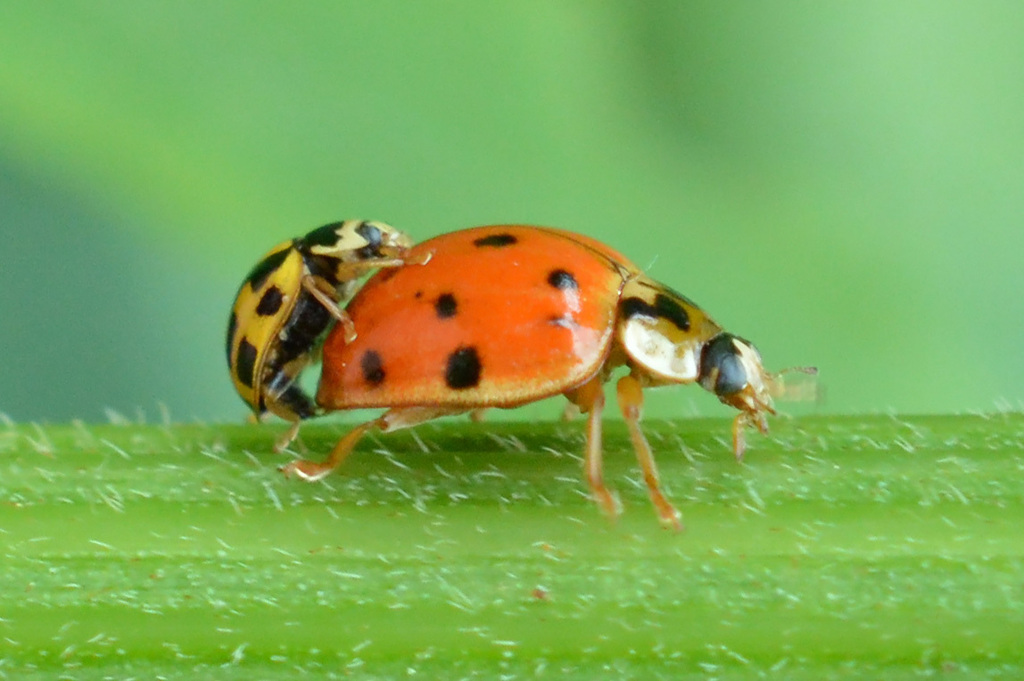
Fourteen-spotted ladybird
Propylea quatuordecimpunctata

Twenty-two-spot ladybird
Psyllobora vigintiduopunctata
≠The key differences
The fourteen-spot is larger (3.5-4.5 mm) with squarish black marks that often merge into an anchor or chequer pattern; the twenty-two-spot is brighter lemon yellow with small, separate round spots.
⚖︎Side by side
| Fourteen-spotted ladybird | Twenty-two-spot ladybird | |
|---|---|---|
| To humans | Non-toxic | Non-toxic |
| Size | 3.5-5 mm long | 3.0-4.5 mm long |
| Colours | Yellow, Black, Orange | Yellow, Black, Brown (underside/legs) |
| Family | Coccinellidae | Coccinellidae |
| Habitat | Gardens, meadows, hedgerows, agricultural fields, shrubs and other vegetation where aphids are present; also shelters for overwintering in leaf litter and buildings. | Meadows, hedgerows, gardens, damp grassland and wherever powdery mildew occurs on low vegetation |
| Range | Native across much of Europe and parts of western Asia; introduced and established in parts of North America. | Widespread across Europe and parts of the Palearctic region |
| Active | Active mainly spring through autumn; diurnal (daytime) hunters; adults often most visible in warm sunny weather. | Mainly spring to autumn (April-September); active during daylight |
| Pest? | No | No |
🔍How to spot a fourteen-spotted ladybird
- Small size (about 3.5-5 mm) and rounded, domed beetle shape
- Yellow to cream elytra marked with squarish black spots, often counted as fourteen and frequently merged
- Pronotum pale with a dark central marking; body outline and spot pattern differ from larger ladybirds
- Be aware of dark (melanic) variants; check size and habitat if spot pattern is unclear
🔍How to spot a twenty-two-spot ladybird
- Small size: 3.0-4.5 mm (much smaller than some common ladybirds)
- Bright yellow elytra with about 20-22 black round spots; spots may fuse or vary in number
- Favors low vegetation and is often found on plants with powdery mildew rather than on aphid colonies
- Pronotum yellow with five small black spots (not fully black)
?Frequently asked questions
What is the difference between a fourteen-spotted ladybird and a twenty-two-spot ladybird?
The fourteen-spot is larger (3.5-4.5 mm) with squarish black marks that often merge into an anchor or chequer pattern; the twenty-two-spot is brighter lemon yellow with small, separate round spots.
Is a fourteen-spotted ladybird or a twenty-two-spot ladybird more dangerous?
Fourteen-spotted ladybird: Non-toxic. Twenty-two-spot ladybird: Non-toxic. This species does not pose a health risk. Not venomous and does not pose a medical risk.
Identification from photos is never certain: don't handle insects you can't identify, and get medical advice for bites, stings or allergic reactions.