
Green drake mayfly
Ephemera danica · Mayflies
A common European freshwater mayfly: green-bodied adults with upright clear wings, aquatic nymphs that live in river and stream sediments and adults that live for only a day or two.
!Is the green drake mayfly dangerous?
No. Adults do not bite or sting and are harmless to people. They have non-functional mouthparts and do not feed. Large emergences can be a nuisance when adults accumulate on surfaces, but there is no medical risk.
Pets
Harmless to pets; pets may eat adults without ill effect, though many birds and fish feed on them.
📖Overview
Ephemera danica is a widespread mayfly found across much of Europe and parts of western Asia. The aquatic nymphs live buried in soft sediment in rivers, streams and some lakes where they filter and gather fine detritus and algae. Adults emerge in conspicuous swarms in spring and early summer; they have a very short life as winged insects (often only a few hours to a couple of days), during which they mate and females lay eggs on the water surface.
This species is well known to anglers because its emergences can trigger intensive feeding by trout and other freshwater fish. Ephemera danica is not harmful to people: adults do not bite or sting and have vestigial mouthparts, so they do not feed as adults.
🔍How to identify a green drake mayfly
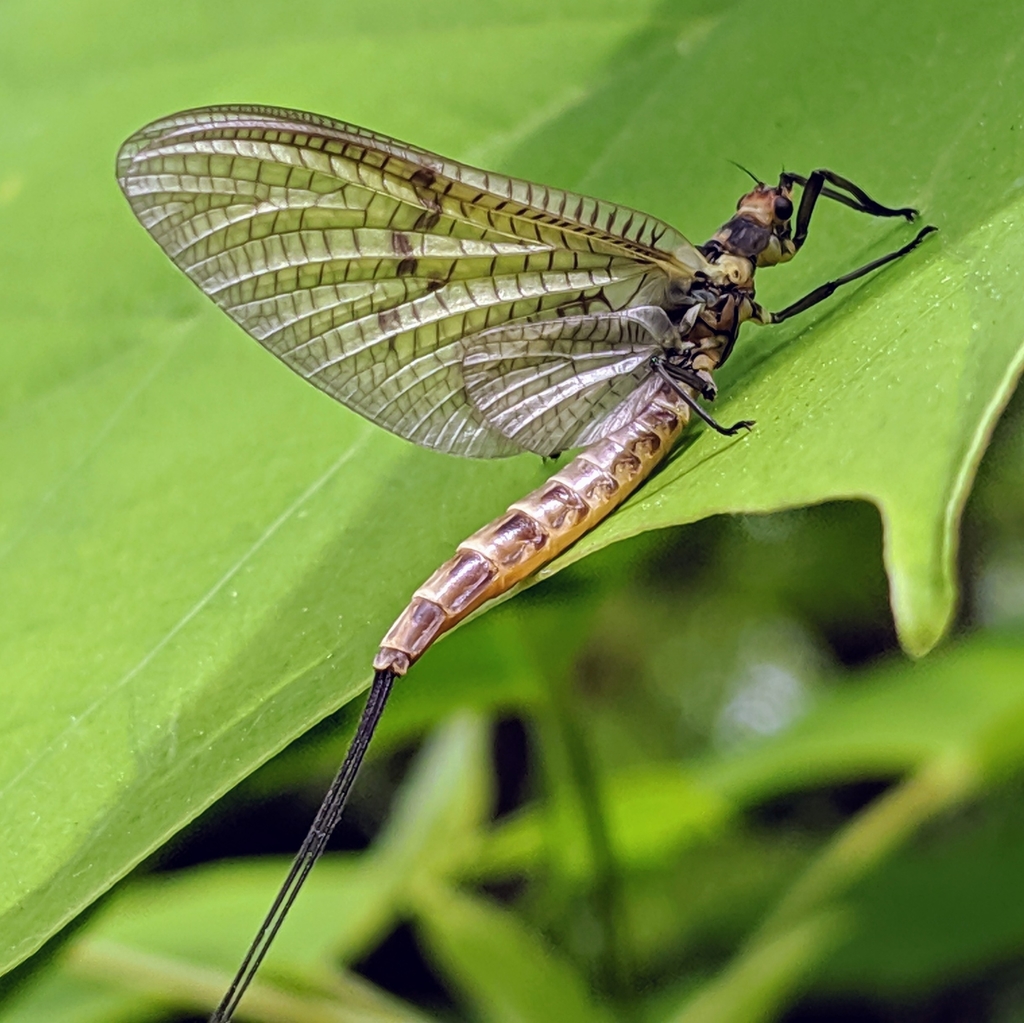
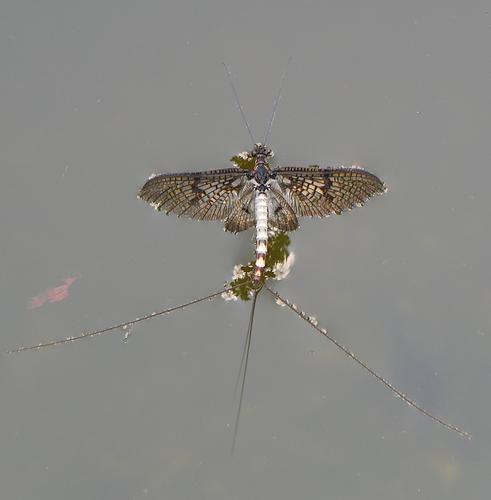
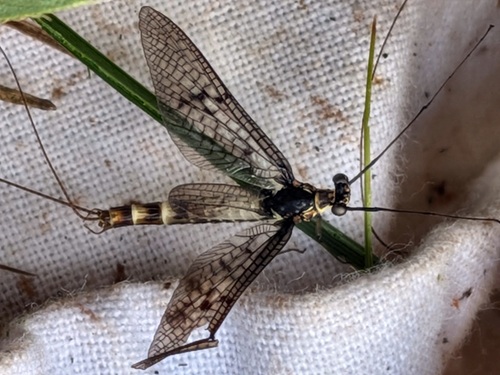
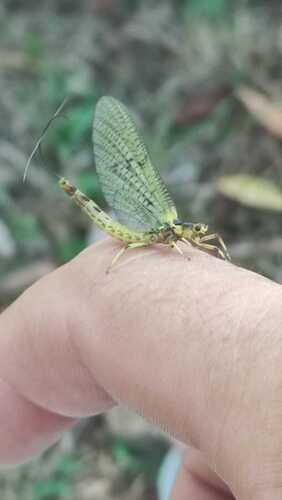
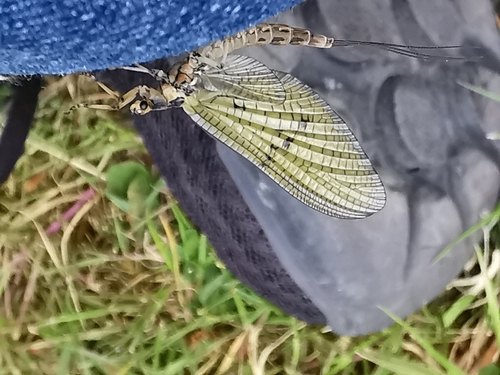
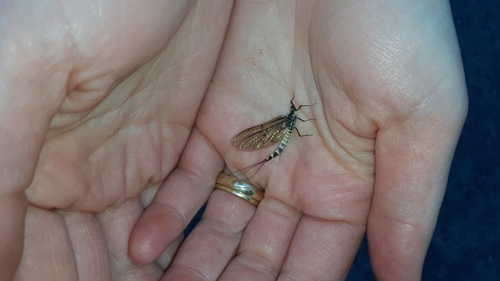
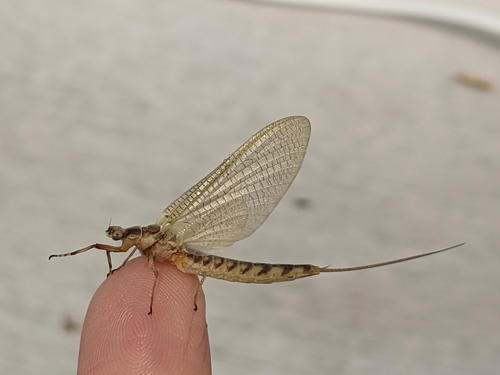
Adults are large for mayflies, with a slender, elongated body and three long slender tails. Freshly emerged subimagos (anglers' 'green drakes' or duns) have dull greenish-yellow wings; the final adults (imagos or 'spinners') have clear, glossy wings with dark spots and a creamy-white abdomen with dark markings, including paired dark streaks on the rear segments. Forewings are triangular and held upright at rest; hindwings are much smaller. Males have larger eyes and longer front legs and tails. Nymphs are pale, elongate burrowers with tusk-like mandibles, three fringed tails and feathery gills along the abdomen.
- Large mayfly with three long tails, triangular forewings held upright at rest and much smaller hindwings; duns have greenish-yellow wings, spinners clear wings with dark spots.
- Look for three long terminal tails (cerci) on both nymphs and adults.
- Nymphs are pale with tusk-like mandibles and feathery gills and live in U-shaped burrows in sandy or silty sediment.
Lookalikes
Ephemera vulgata Ephemera vulgata
Very similar; E. vulgata has dark triangular markings on the upper side of most abdominal segments, whereas E. danica has paired dark streaks mainly on the rear segments. E. vulgata favours slower, muddier lowland waters.
Ephemera lineata Ephemera lineata
A rarer relative of larger rivers; it has dark lines running along the abdomen rather than the streak pattern of E. danica.
↻Life cycle
Egg
Females lay eggs on the water surface; eggs sink and stick into sediment where they develop over weeks to months before hatching.
Nymph (aquatic)
The nymph stage lives in sediment for 1-3 years, feeding on detritus and algae and growing through multiple molts.
Subimago then imago (winged adult)
Mayflies emerge as a winged subimago (a unique mayfly stage) then molt again to a final adult (imago); adults are short-lived and focused on mating and egg-laying.
🍃Diet and predators
Young eat
Detritus, decomposing organic matter and algae in sediment
Adults eat
Adults do not feed; mouthparts are non-functional
Predators of the young
Fish, aquatic insects, amphibians and benthic predators
Predators of adults
Fish (feeding on adults at the water surface), swifts, swallows, bats and other aerial insectivores
🌱Effect on plants and gardens
Nymphs feed on detritus and algae and do not damage living aquatic plants; the species is not a crop or garden pest.
📍Where and when to find it
Nymphs: buried in soft sediment of streams, rivers and lake margins. Adults: flying above or resting near the water surface and nearby vegetation during emergence swarms.
Best time
Best observed during spring and early summer emergences; adults are most noticeable during daylight and dusk when swarms form.
Observation tips
Photograph adults from the side to show upright forewings and tails; for nymphs, look for burrowed tubes in soft sediment or use a kick-sample net in shallow water (with appropriate permits/local guidelines).
✨Fun facts
- Mayflies like Ephemera danica have a unique subimago stage: a winged but sexually immature form that molts once more into the final adult.
- Anglers call the newly emerged subimago a 'green drake' or dun, and the spent females falling to the water after egg-laying 'spent gnats'.
- Although winged adults live only hours to a couple of days, the nymph stage usually lasts one to two years underwater.
?Frequently asked questions
Do green drake mayflies bite?
No. Adults do not bite; they have vestigial mouthparts and do not feed.
Are green drake mayflies dangerous to humans?
No. They are harmless. Large swarms can be a nuisance when adults land on cars or buildings, but they pose no health risk.
Why are there so many mayflies on my riverbank in spring?
Mass emergences occur when nymphs synchronise maturation and hatch as winged adults to mate and lay eggs; environmental cues like water temperature and day length trigger this.
How can I stop mayflies from swarming around my lights?
Mayflies are attracted to light; reduce outdoor lighting at night near water, use downward-facing fixtures, or move lights farther from entrances to reduce attraction.
How do I get rid of mayfly nymphs in my pond?
They are a natural part of freshwater ecosystems and generally beneficial as fish food. Large nuisance populations indicate habitat conditions; improving water flow or habitat complexity can reduce dense burrowing populations. Chemical control is not recommended.
Where do the green drake nymphs live?
Nymphs live buried in soft mud or silty sediment on the bottoms of rivers, streams and some lakes, often in areas with moderate flow.
📷Photos of the green drake mayfly
More mayflies, stoneflies & caddisflies
This guide was written with AI assistance and fact-checked, last updated 2026-10-10. Identification from photos is never certain: don't handle insects you can't identify, and get medical advice for bites, stings or allergic reactions. More about the green drake mayfly: iNaturalist, Wikipedia.